Zero-Click Search: How to Win Brand Visibility Without Getting the Click
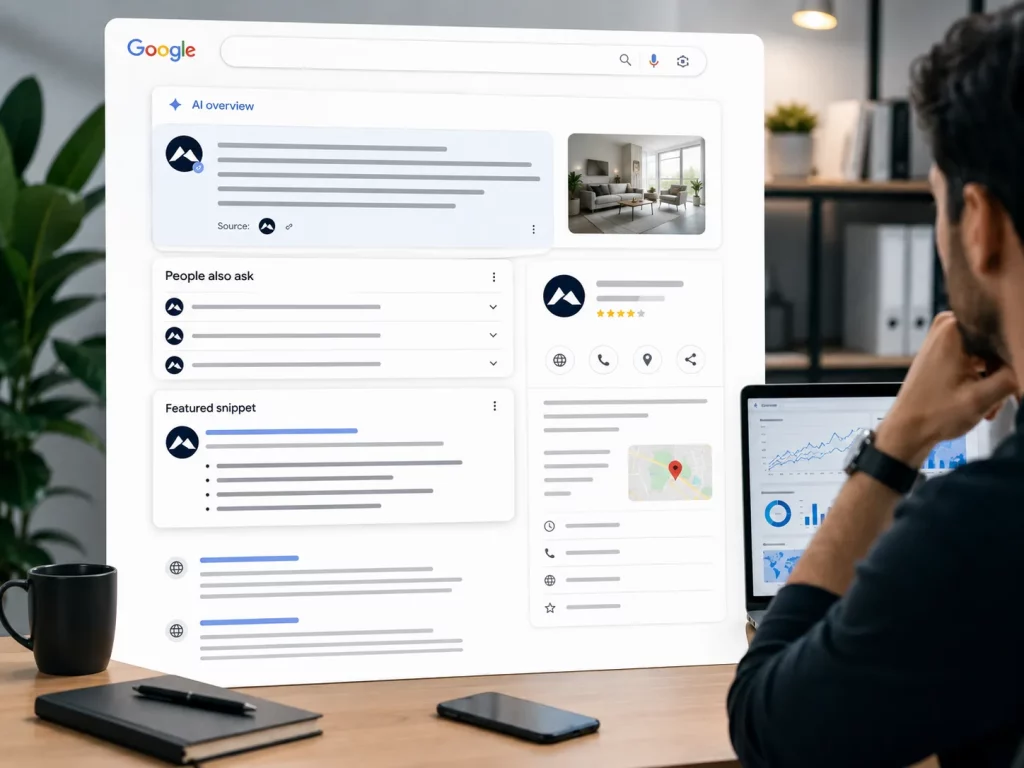
Zero-click search optimization means structuring your content so it shows up directly on Google’s results page, so your brand gets seen even when someone never visits your website.
This is not a niche SEO tactic anymore. It’s becoming the default reality of search. According to data from SparkToro and Datos, over 58% of Google searches in the US now end without a single click to any website. In Europe, that number crosses 60%. And with Google’s AI Overviews now appearing above organic results for millions of queries, that share is only going up.
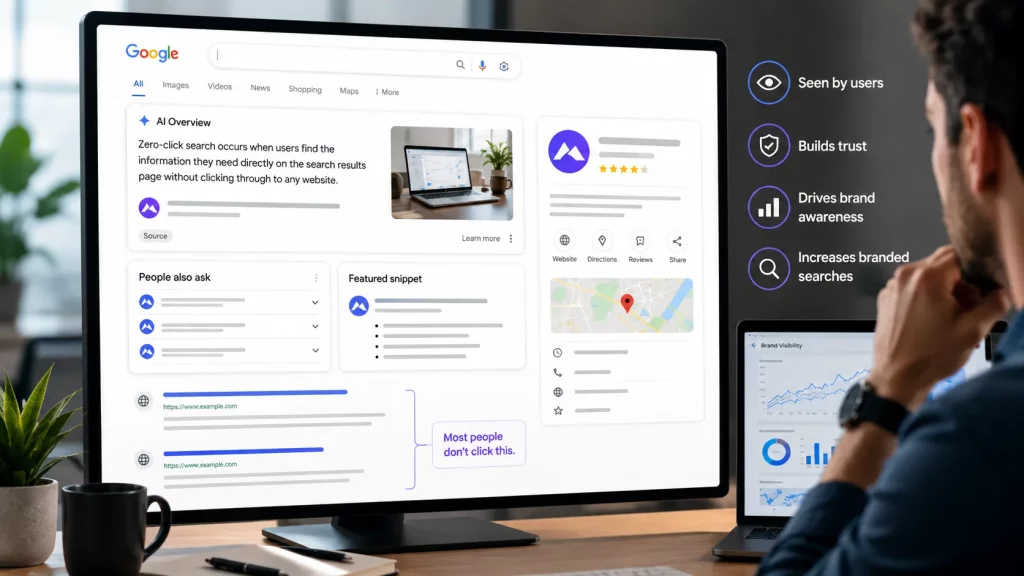
For brands, this creates an uncomfortable question: if your content ranks well but users never click through, are you invisible or are you actually winning?
The answer depends entirely on whether you’ve built a zero-click search strategy or not.
TL;DR
- Over 58% of Google searches end without a click. That number is growing as AI Overviews expand.
- Zero-click search optimization is about winning brand visibility in AI search results, featured snippets, PAA boxes, and knowledge panels, not just ranking for clicks.
- SERP features without clicks still build brand recall, influence purchase decisions, and grow branded search volume over time.
- The five SERP features worth optimizing for: Featured Snippets, Google AI Overviews, People Also Ask boxes, Knowledge Panels, and Local Packs.
- A zero-click search strategy in 2026 measures success through SERP feature ownership, share of voice, branded search trends, and impressions, not just sessions.
- Brands that ignore this shift are handing their competitors the most visible real estate on Google.
Why Are So Many Searches Ending Without a Click?
Google is answering questions itself, right on the search page, before users ever reach an organic result.
Search for a symptom, and you get a medical summary. Ask for a recipe and see the ingredients listed immediately. Type a brand name and find their hours, reviews, and address without opening a single website. This is how Google works now, and it’s not going back.
The shift accelerated with the rollout of AI Overviews, Google’s AI-generated answer summaries that pull from multiple sources and appear above all organic results. Google’s direction is clear: keep users on the SERP longer by giving them what they need right there.
Your content might be ranking well, answering the right questions, doing everything it’s supposed to do, and Google is using it to respond to queries without sending you the traffic.
That’s the reality of zero-click search in 2026. The brands adjusting their strategy to this are building visibility and trust at scale. The ones still optimizing only for clicks are watching their share of SERP voice shrink quarter by quarter.
What SERP Features Create Zero-Click Searches, and Which Ones Actually Matter?
Not all SERP features without clicks are equal. Some build real brand visibility. Others are dead ends. Knowing the difference shapes your entire zero-click search strategy.
Featured Snippets appear at the very top of search results, above all organic listings. Google pulls a paragraph, numbered list, or table directly from a webpage and shows it prominently with your brand name and URL right next to it. For brand visibility in AI search results, this is one of the highest-value placements on the entire SERP.
Google AI Overviews are generated summaries that appear for complex or multi-part queries. Google pulls from several sources, builds a combined answer, and lists the cited sources below. Getting your brand cited here is becoming one of the most important signals of authority in search, and it’s only going to matter more as AI Overviews expand to more query types.
People Also Ask (PAA) boxes show up mid-SERP as expandable question clusters. Each answer is pulled from a webpage, and each expansion generates more related questions, keeping users on Google’s page rather than yours. Winning PAA placements keeps your brand name in front of users even as they browse without clicking.
Knowledge Panels appear for branded searches. These are the right side on SERP and show your company name, description, social links, founding information, and more. This is what a user sees when they search your brand name directly. It’s your first impression, and it’s driven by structured data and third-party signals, not your website design.
Local Packs show a map with three local business listings for location-based searches. On mobile, this placement dominates the entire screen above the fold. For any brand with physical locations, appearing here matters more than most organic rankings.
Focus your zero-click search optimization efforts on the first five. Those are the ones that build brand visibility in AI search results and influence how users perceive your brand before they ever land on your site.
Does Zero-Click Search Optimization Actually Help Your Brand?
Yes, but only if you stop measuring it the wrong way.
The old model of SEO was straightforward: rank higher, get more clicks, get more conversions.
Zero-click search breaks that second step. So if your entire revenue depends on website traffic, display ads, lead forms, and direct e-commerce, then growing zero-click visibility without growing traffic is a real problem worth taking seriously.
But that model misses something important: people make decisions about brands before they click anything. How?
When someone searches “best CRM for small business,” and your brand shows up in the AI Overview answering that question, they’ve just encountered you in a high-trust context. Google essentially vouched for you as a relevant answer.
Even if they don’t click, that association sticks. They’re more likely to search your brand name later, more likely to recognize you in a paid ad, more likely to trust your site when they do eventually land there.
Brand recall research consistently shows that repeated exposure in relevant moments, even without direct interaction, influences purchase behavior. It grows branded search volume, increases direct traffic, and shortens sales cycles because users arrive already familiar with who you are.
How this plays out by brand type:
- B2B brands: Showing up in AI Overviews for industry questions builds thought leadership before a buyer ever reaches a sales page. By the time they’re evaluating vendors, your name already feels familiar.
- E-commerce brands: Featured snippets on product comparison and buying guide queries put you in front of high-intent shoppers at exactly the right moment.
- SaaS companies: PAA boxes on problem-based queries (“how do I automate invoicing”) are top-of-funnel touchpoints that create awareness before the user even knows they’re in buying mode.
- Local businesses: A Local Pack appearance on mobile is often the only result a user sees before making a call or getting directions.
The risk isn’t optimizing for zero-click. The risk is doing it while still reporting only on clicks and sessions. That makes real progress invisible to your stakeholders.
How to Optimize for Zero-Click Searches: What Actually Works
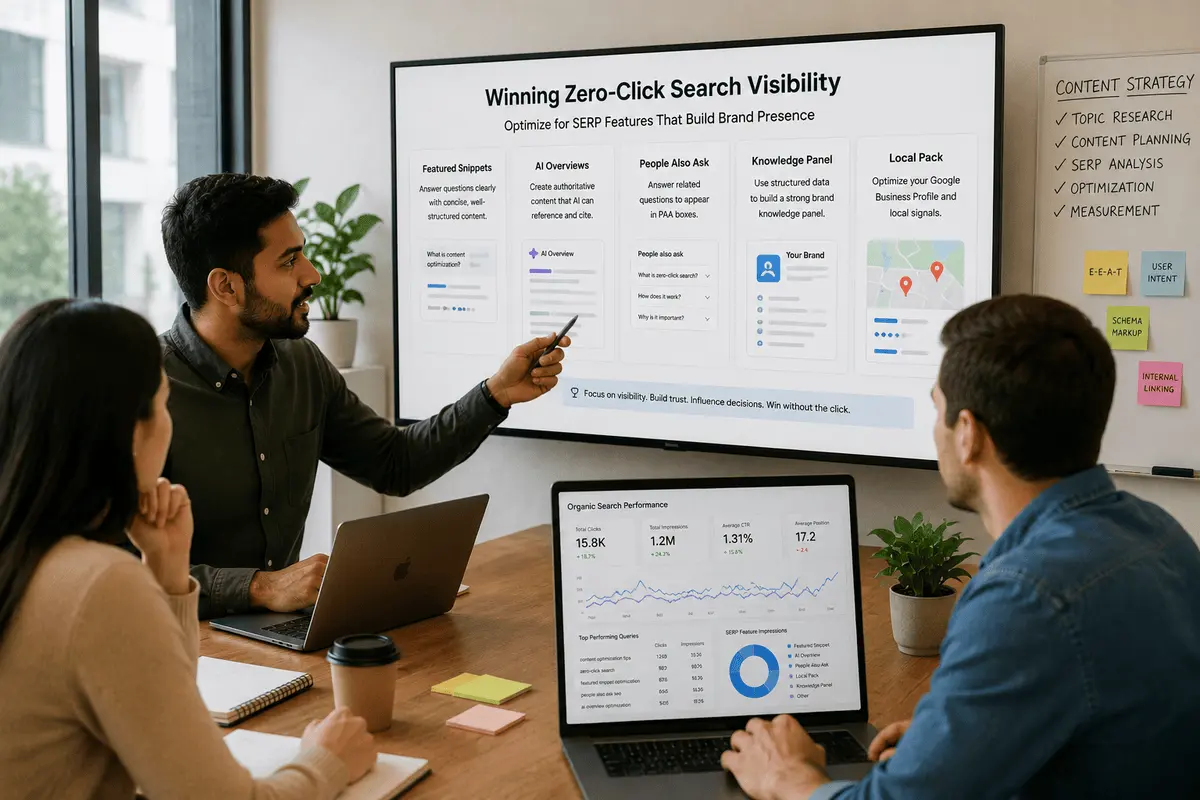
To optimize for zero-click searches, you have to optimize for all five SERP features mentioned earlier in this post. Each one works differently, so the approach for each is different. Here’s how to tackle them one by one.
Tips to Optimize Featured Snippets
Google only pulls featured snippets from pages already ranking in the top 10 for a query, so ranking is the prerequisite. But pages sitting at positions 2 through 5 regularly take snippets away from the #1 result when their content is better structured.
- Go after question-based queries first. Queries starting with “how,” “what,” “why,” and “which” trigger featured snippets far more often than broad keyword searches. Use Ahrefs or SEMrush to find queries in your space that already show a featured snippet. Those are your fastest opportunities because the format is proven, and the only question is who gets it.
- Put the answer immediately below the heading. Write a clean, direct answer in 40–60 words right under the H2 that matches the question. Don’t build up to it. Don’t give context first. Answer, then explain.
- Match the format Google is already using for that query. If the current snippet is a numbered list, write a numbered list. If it’s a table, build a table. If it’s a short paragraph, write a tight paragraph. Google gravitates toward the format that already works for a query. Your job is to do that format better than whoever currently holds the snippet.
- Mirror the question in your heading. If users are asking “how to optimize for zero click searches,” your H2 should be that question or very close to it. This is how Google connects a query to a piece of content as a snippet candidate.
- Add FAQ schema markup. This structured data tells Google explicitly that your page contains question-and-answer content. It doesn’t guarantee a snippet, but it makes your content significantly easier for Google to read, extract from, and surface in multiple SERP features at once.
How to Optimize for Google AI Overviews Brand Visibility
AI Overviews pull from sources that demonstrate E-E-A-T — Experience, Expertise, Authoritativeness, and Trustworthiness. The pattern is becoming clear even as Google continues refining how it selects sources.
- Write content that takes a clear position and backs it up. Google’s AI doesn’t pull from content that hedges everything or says “it depends” without explaining why. Specific, factual, well-supported answers get cited. Content that covers all angles without committing to any of them doesn’t.
- Build topical authority through content clusters. One blog post on a topic makes you a source. Fifteen interlinked posts covering a subject from every angle make you an authority. AI Overviews consistently favor sites with deep, structured coverage of a topic, not one-off pieces.
- Get your brand mentioned in credible third-party content. Industry publications, analyst reports, and well-regarded news outlets. When these sources reference your brand in relevant contexts, those mentions send authority signals that influence Google AI Overviews brand visibility. This is why digital PR has become a direct SEO input in 2026, not just a separate channel.
- Keep your facts consistent and current. Google’s AI doesn’t cite sources that conflict with other authoritative sources on the same topic. If your content contradicts itself across pages or contradicts well-established facts elsewhere, it gets passed over. Accuracy across your entire content library matters.
Also Read: Best GEO Tools for AI Visibility Tracking in 2026
How to Win People Also Ask Boxes
PAA boxes appear for almost every informational query. They’re easier to win than featured snippets, and they show up throughout the SERP, not just at the top. For brand visibility in AI search results, they’re a consistent, underused opportunity.
- Map every PAA question for your target keywords. Search each of your primary keywords and write down every question that surfaces in the PAA box. These are the questions your audience is actively asking that Google has already validated as relevant. That’s a valuable signal.
- Build dedicated content around each question cluster. A sentence buried in a blog post won’t win a PAA placement. You need a proper FAQ section, a standalone post, or a dedicated section that answers the question directly and completely, with the short answer first, then the details.
- Format answers to match how PAA boxes display content. The collapsed PAA view shows 2–3 sentences. Write your answer to work at that length first, then expand below it. Google pulls the short version for the box and gives users the option to click through for more.
How to Optimize Your Knowledge Panel
Your Knowledge Panel is what users see when they search your brand name directly. It’s your most visible brand asset in search, and most brands pay almost no attention to it.
- Fill out your Google Business Profile. Every field: category, description, hours, services, photos, products. Completeness directly affects what Google surfaces and how confidently it shows a Knowledge Panel for your brand.
- Add the Organization schema to your homepage. This structured data tells Google your official name, logo, foundation date, social profiles, and contact information in a format it can read without guessing. Without it, Google pieces together your brand information from whatever it finds, which is often inconsistent.
- Make your Name, Address, and Phone number identical everywhere. Google, Yelp, LinkedIn, industry directories, every listing. When your NAP data conflicts across sources, Google’s confidence in your brand entity drops, and your Knowledge Panel either shows incomplete information or doesn’t show at all.
- Build a Wikidata entry if you’re a mid-to-large brand. Wikipedia and Wikidata are among Google’s most trusted sources for Knowledge Panel data. A well-maintained Wikidata entry with accurate, sourced information directly strengthens what appears in your panel.
How to Show Up in the Local Pack
For brands with physical locations or service areas, Local Pack rankings are often more valuable than organic rankings, particularly on mobile, where the map takes up most of the screen above the fold.
- Keep your Google Business Profile active, not just complete. Regular posts, updated hours, new photos, responses to reviews. Google treats active profiles as more relevant. A profile that hasn’t been touched in six months looks abandoned compared to one updated weekly.
- Focus on review velocity, not just review count. Five new reviews this month carry more weight than 200 reviews accumulated over three years. Build a simple review request process into your post-purchase or post-service touchpoints and make it consistent.
- Write local landing pages with actual local content. Not the same template with the city name swapped in. But with real content such as local team information, area-specific services, and local references. Google can tell the difference between landing pages that are genuine and ones that are not, and so can users.
- Audit your citations and clean up inconsistencies. Tools like BrightLocal or Whitespark will surface every place your business is listed and flag anywhere your NAP data conflicts. Fix those inconsistencies, and your Local Pack rankings will improve without any other changes.
Zero-Click Search Strategy 2026: What’s Shifting Right Now
The direction is clear. Google is expanding AI Overviews into more query types every month, and the share of searches that end without a click is growing as a result.
A few things worth paying attention to as you build your zero-click strategy:
- Conversational queries are becoming the norm. People are increasingly searching in full sentences and questions, partly because of voice search, partly because AI chatbot habits are changing how people interact with search. Content that answers questions directly and clearly outperforms content that’s been structured around keywords alone.
- Being cited in AI Overviews is a brand signal, not just a traffic source. In B2B, especially, buyers are using AI tools to research solutions before they ever contact a vendor. Showing up as a cited source in those answers positions your brand at the very beginning of the buying process before your competitors even enter the picture.
- Informational queries are increasingly Google’s territory. “What is X?” “How does X work?” “What’s the difference between X and Y?” Google answers these directly now. Brands that keep chasing clicks from purely informational content are going to be disappointed. The smarter move is to use informational content to build topical authority and brand visibility in AI search results, then convert that authority into traffic on commercial and transactional queries where users still want to explore options before deciding.
How Do You Measure Zero-Click Search Optimization if Clicks Aren’t the Point?
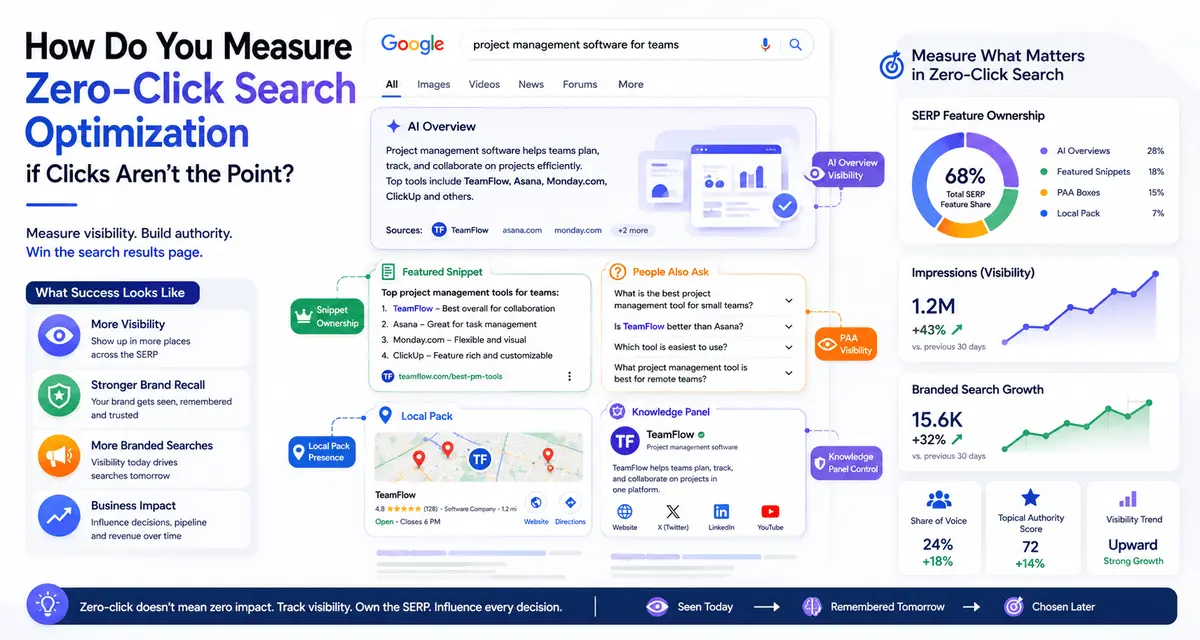
Most brand dashboards are built around sessions and conversions. Zero-click success doesn’t show up there, which is why so many brands either ignore it or think it isn’t working.
Track these instead:
- SERP feature ownership rate. How often does your brand appear in featured snippets, PAA boxes, or AI Overviews for your target keywords? Run this weekly. SEMrush’s Position Tracking and Ahrefs’ SERP features filter both to track this at scale.
- Share of voice. What percentage of total SERP impressions in your category does your brand capture? This tells you whether you’re gaining or losing ground relative to competitors, regardless of how many clicks you’re getting.
- Branded search volume. Track month-over-month changes in direct searches for your brand name. When zero-click visibility is working, branded search grows because users who see your brand answering their questions start searching for you directly.
- Direct traffic trends. People typing your URL directly or using a saved bookmark is a strong signal of brand recall. If your SERP visibility is growing and direct traffic is growing alongside it, those two things are connected.
- Google Search Console impressions. GSC separates impressions from clicks. Growing impressions with flat clicks isn’t a sign that something’s broken. It’s zero-click visibility doing exactly what it’s supposed to do.
FAQs
Does zero-click search mean SEO is no longer worth investing in?
No. SEO still drives real traffic and real revenue, but the scope of what you’re optimizing for has expanded. Clicks and conversions still matter. But brand visibility in SERP features without clicks now matters alongside them. Brands that only optimize for clicks are leaving a significant amount of search real estate to their competitors.
Which types of brands are most affected by zero-click search?
Media and publishing brands feel it most — clicks are their revenue model. E-commerce brands are more protected because product and purchase queries still drive clicks. B2B and SaaS brands sit in the middle: informational queries get answered by Google, but commercial and comparison queries still generate meaningful traffic.
How long does it take to start winning featured snippets?
Pages already ranking in the top 10 that apply proper formatting changes can see snippet wins within a few weeks. Building the kind of topical authority needed for consistent Google AI Overviews brand visibility takes longer, typically three to six months of focused content development and digital PR.
What’s the difference between a featured snippet and an AI Overview?
A featured snippet pulls from one page and displays it directly- your content, your URL, shown verbatim. An AI Overview pulls from multiple sources and builds a new combined answer, with citations listed below. One well-optimized page can win a featured snippet. Getting cited in AI Overviews requires broader authority signals across your site and across the web.
Is schema markup worth adding even if results aren’t immediate?
Yes. Schema markup is foundational. It helps Google read and understand your content more reliably, which influences featured snippets, Knowledge Panels, rich results, and how Google’s AI models interpret your brand. The impact isn’t always immediate, but it builds over time and creates no downside.
How do I check if my brand is being cited in AI Overviews?
Search your target queries in an incognito window and look for AI Overview boxes. For tracking at scale, SEMrush and Ahrefs both have AI Overview visibility features in development. Google Search Console doesn’t currently separate AI Overview impressions from other impressions, but that capability is expected to expand.