
How to Do Topical Keyword Research: Step-by-Step Process and Free Tools


Topical keyword research is the practice of mapping out an entire subject ecosystem, identifying every main theme, subtopic, and long-tail query your audience searches for, so you can build domain-wide expertise rather than trying to rank isolated pages for single keywords.
Here is a practical guide on how to do topical keyword research.
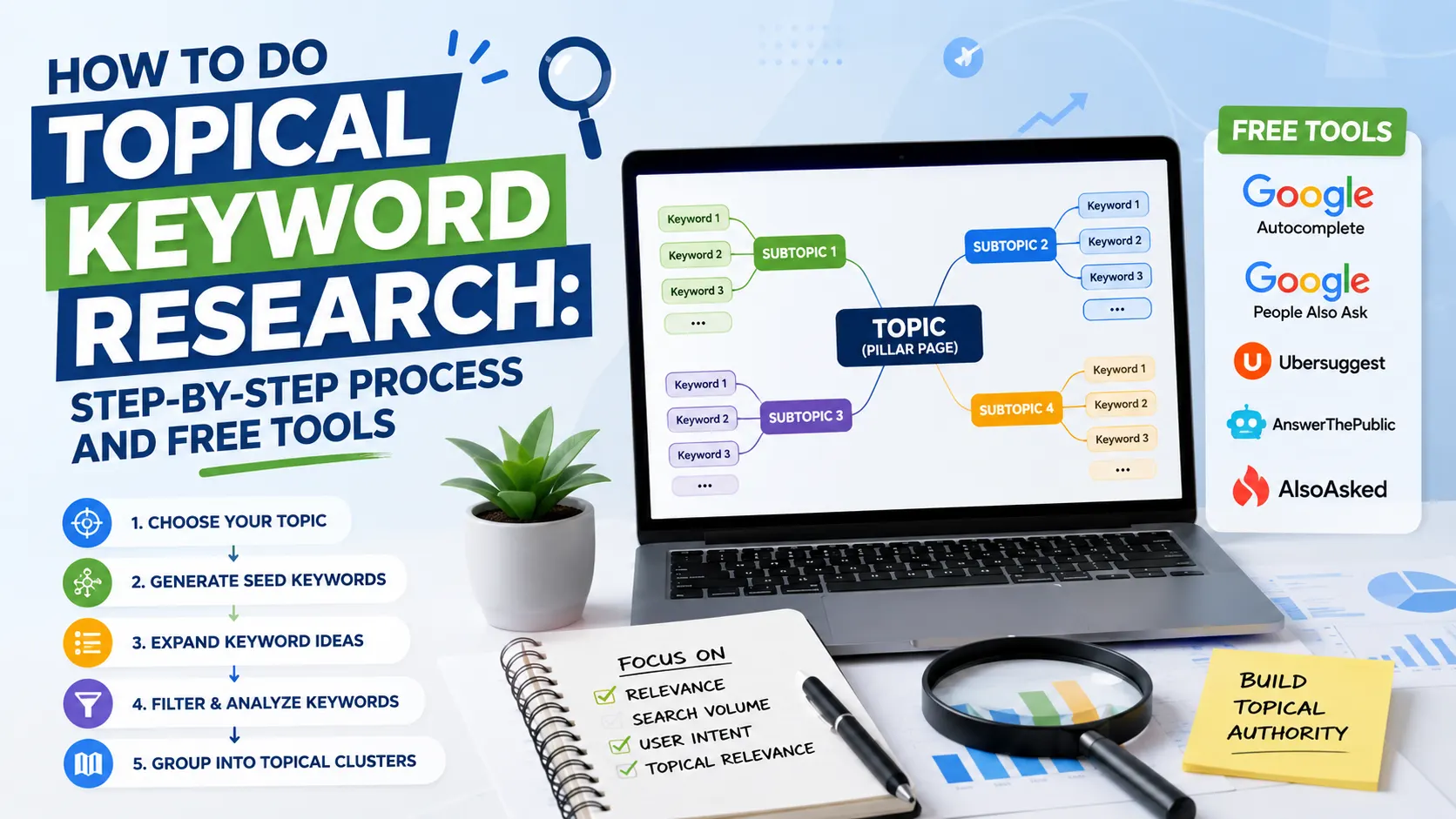
Key Takeaways
- Build topical authority, not just keyword rankings. Cover a topic comprehensively to improve your website’s long-term visibility in search.
- Group related keywords into content clusters. This helps avoid keyword cannibalization and ensures each page serves a clear search intent.
- Use semantic keywords naturally. Include related terms, concepts, and industry language to give search engines better context about your content.
- Match content to search intent. Create content for informational, commercial, and transactional queries to guide users through every stage of their journey.
- Identify content gaps regularly. Compare your website with competitors and analyze search performance to uncover topics and keywords you’re missing.
- Strengthen your internal linking strategy. Connect related informational and commercial pages to improve topical authority and help users navigate your content.
How Is Topical Keyword Research Different From Traditional Keyword Research?
Traditional keyword research focuses on finding individual search terms that have high monthly search volume and low competition. You pick a single term, write an article, and hope it ranks.
Topical keyword research, on the other hand, focuses on mapping out an entire subject ecosystem. Instead of hunting for standalone terms, you identify every major subtopic, secondary question, and nuance your audience cares about when exploring a topic.
Traditional vs. Topical Keyword Research
| Feature | Traditional Keyword Research | Topical Keyword Research |
| Core Goal | Rank individual pages for specific terms. | Build domain-wide authority on a topic. |
| Strategy | Target isolated, high-volume keywords. | Create connected clusters around core themes. |
| Content Structure | Standalone articles with minimal connection. | “Hub-and-Spoke” model linked together logically. |
| User Experience | Answers one isolated query. | Guides the user through their entire learning journey. |
When you cover a topic comprehensively, search engines recognize your site as an authoritative hub. Ranking one page becomes significantly easier because all your related pages pass context and authority to each other.
How to Conduct Topical Keyword Research: A Step-by-Step Practical Process
To make this practical, let’s pretend you run a blog or website dedicated to “Home Espresso & Coffee Brewing.” Your goal is to build total topical authority around this niche so that whenever someone searches for anything related to home espresso, search engines recommend your site.
Step 1: Define Your Core Root Topics (The Hubs)
Estimated Time: 15–30 Mins.
Start by listing 3 to 5 broad umbrella topics that define your core focus. These are your “Pillar Topics” or “Hub Keywords.” They represent broad concepts rather than specific blog posts.
For the Home Espresso website, core pillars might be:
- Pillar 1: Espresso Machines & Equipment
- Pillar 2: Coffee Beans & Grinding Techniques
- Pillar 3: Espresso Extraction & Brewing Science
- Pillar 4: Milk Texturing & Latte Art
Rule of Thumb: A pillar topic should be broad enough to cover at least 10–20 subtopics. If a topic is too narrow (e.g., “how to clean a portafilter”), it’s a subtopic, not a pillar.
Step 2: Brainstorm Subtopics & Category Branches
Estimated Time: 45 Mins.
Take one core pillar at a time and break it down into primary categories. Think like a beginner taking a course on the topic: What are the essential building blocks they must understand?
Let’s break down Pillar 3: Espresso Extraction & Brewing Science:
- Branch A: Dialing in espresso (grind size, dose, yield)
- Branch B: Extraction issues (channeling, sour espresso, bitter espresso)
- Branch C: Water chemistry & temperature
- Branch D: Pressure profiling and pre-infusion
Notice how each branch represents a distinct sub-theme under the main pillar.
Step 3: Discover Real Search Queries Using Semantic Keywords
Estimated Time: 1–2 Hours.
Now that you have your branches, it is time to find the exact phrasing real people use when searching online. To build depth, you need to target semantic keywords naturally related to your core topic (e.g., particle size, channeling, extraction time, flow rate).
Step 3:What are semantic keywords, and why are they important?
Semantic keywords are words, phrases, and related concepts that provide context for your content to search engines. They aren’t just synonyms. They include associated terms, entities, industry jargon, and commonly discussed subtopics.
For example, if your pillar topic is “Espresso Machines & Equipment,” relevant semantic keywords could include:
- commercial espresso machines
- home espresso machines
- espresso grinders
- coffee tampers
- milk frothers
- portafilters
- espresso accessories
- coffee brewing equipment
- barista tools
- espresso machine maintenance
Using these naturally throughout your content signals to search engines that you’ve covered the topic comprehensively. It also improves the relevance of your content for a wider range of related searches, making it easier to rank for multiple queries instead of a single keyword.
Here are three practical, accessible methods to find semantic keywords:
- Google Autocomplete & ‘People Also Ask’ (PAA): Type your branch into Google (e.g., “sour espresso”). Look at suggested completions and expand PAA drop-down boxes to reveal related semantic terms.
- Question-Based Research Tools: Use free tools like AnswerThePublic or KeywordTool.io. Paste “espresso extraction” in the search bar to find what questions users might have; focus on why, how, what is questions.
- Community Mining (Reddit & Quora): Visit subreddits like r/espresso or r/Coffee. Note down recurring troubleshooting questions real users post every week.
Step 4: Group Raw Data Using Keyword Clustering
Estimated Time: 1 Hour.
Organize individual search phrases into logical content units; this is called keyword clustering.
If two search queries share the same goal and need the exact same answer, combine them into one article. If a query requires a different step-by-step guide or deeper explanation, give it its own dedicated page.
Example of Keyword Clustering Grouping:
- Pillar Hub: The Ultimate Guide to Espresso Extraction & Troubleshooting
- Supporting Page 1: How to Fix Sour Espresso: Causes & Grind Adjustments
- Supporting Page 2: Understanding Espresso Channeling (And How to Prevent It)
- Supporting Page 3: Espresso Shot Timing: How Long Should a Shot Take?
Step 5: Apply Search Intent Mapping to Plan Content Priority:
Estimated Time: 45 Mins.
Not every keyword in your cluster should be written immediately. Map your keywords with the search intent.
How do you map keywords to search intent?
Instead of grouping keywords by volume alone, organize them by what the searcher wants to achieve.
- Informational: Seeking knowledge (e.g., “What is espresso channeling?”)
Best format: How-to guides, tutorials, and educational articles. - Commercial: Comparing products before buying (e.g., “Best dual boiler espresso machines under $1000”)
Best format: Buying guides, comparison pages, and reviews. - Transactional: Ready to make a purchase (e.g., “Buy 58mm precision filter basket”)
Best format: Product pages, category pages, and collection pages. - Navigational: Looking for a specific brand, product, or website (e.g., “Breville espresso machines official website” or “La Marzocco Linea Mini”)
Best format: Brand pages, product pages, support pages, or the homepage.
Once you’ve identified the intent, create content for each intent.
Estimated Time: 1 Hour.
Step 6: Perform Content Gap Analysis to Find Hidden Opportunities:
Before writing, conduct a content gap analysis against competitors and your existing site to find missing angles.
- Competitor Audit: Look at the top 3 ranking sites for your topic. What specific subtopics or troubleshooting questions are they missing?
- Google Search Console Audit: Check your GSC report for queries in positions 8–20. These represent terms search engines already associate with your site that need dedicated content.
Estimated Time: Ongoing.
Topical authority is communicated to search engines through clear internal linking. Follow this simple structure for internal linking:
Step 7: Connect Your Pages with Internal Link Architecture:
- Every supporting subtopic page links up to its main Pillar Page.
- The main Pillar Page links out to every supporting subtopic page in the cluster.
- Related subtopic pages link laterally to one another where helpful (e.g., the Sour Espresso article links to the Grind Size Adjustments article).
Free Tools for Topical Keyword Research

You do not need an expensive software subscription to perform high-quality topical research. Here is a breakdown of free tools for topical keyword research and how to use them:
1. Google Search Console (GSC)
If you have an active website, GSC is your best source for content audit. Go to Performance > Search Results, filter by high impression queries ranking on page 2 or 3, and build dedicated supporting articles to capture those terms.
2. Competitor Site Navigation Analysis
Examine top competitors in your niche. Look at their navigation menu and blog category tags. Where are they missing answers? Uncovering these missing subtopics gives you an instant advantage in topical coverage.
What to Avoid When Building Topical Maps
When executing topical keyword research, avoid these three common mistakes:
Creating Overlapping Content (Keyword Cannibalization):
- The Mistake: Writing one post for “How to fix sour espresso” and a separate post for “Why does my espresso taste sour?”
- The Fix: Use keyword clustering to combine queries with identical intent into one definitive guide.
Ignoring Search Intent Mapping:
- The Mistake: Writing a 3,000-word educational guide for a search term where users just want a product list or buy button.
- The Fix: Always search your target term on Google first to see what content format is currently ranking.
Publishing Orphaned Pages:
- The Mistake: Publishing subtopic pages without linking back to the central pillar page or sister articles.
- The Fix: Add internal links immediately whenever a new supporting article goes live.
Conclusion
Topical keyword research changes your AI SEO strategy from targeting isolated keywords to owning entire subjects. By applying keyword clustering, capturing semantic keywords, using search intent mapping, and filling missing opportunities with content gap analysis, you build a topical authority that satisfies both the search intent of human readers and search algorithms.
Frequently Asked Questions
How many subtopics do I need to cover a topic completely?
It depends on the breadth of the subject. A narrow topic may only require 5 to 8 supporting articles linked to a central page, while a broad niche may need dozens of articles spread across multiple sub-clusters.
How does content gap analysis improve topical authority?
Content gap analysis helps you identify unanswered user questions or subtopics that competitors missed. Filling these gaps ensures your content hub is the most comprehensive resource available on the search engine results page.
How do you identify topic clusters?
Group keywords that share the same search intent or answer the same user need. Each cluster should represent one page or content asset.
How many keywords should a topic cluster include?
There’s no fixed number. A cluster should include all closely related keywords that can be answered comprehensively on a single page without creating duplicate content.
What tools are best for topical keyword research?
Popular tools include Ahrefs, Semrush, Google Search Console, Google Keyword Planner, Keyword Insights, AlsoAsked, AnswerThePublic, and Google’s People Also Ask results.
How do you find content gaps in your topical coverage?
Compare your content with competitors, analyze Google Search Console queries, and identify related questions or subtopics your website doesn’t currently address.
Does topical keyword research improve topical authority?
Yes. Covering a topic comprehensively with well-structured, interconnected content shows the search engines you’re a credible authority source on that topic.
How often should you update your topical keyword research?
Review it every few months or whenever search trends, customer needs, or your products and services change to keep your content strategy relevant.
Can AI tools help with topical keyword research?
Yes. AI tools can speed up topic discovery, keyword clustering, and content ideation, but you should still validate search demand, intent, and competitive opportunities using SEO tools and SERP analysis.