Social Proof Marketing: Boost Ads with Reviews & UGC

Consumers rarely make buying decisions based on what a brand says alone. They look for proof that other people have tried the product, trusted the company, and achieved positive results. That’s why ads featuring authentic customer experiences often outperform those built only around promotional messaging.

The challenge isn’t collecting social proof. Most businesses already have them. The real challenge is knowing how to use each type of social proof strategically to increase clicks, build credibility, and convert more prospects into customers…
This guide explains how to create a social proof marketing strategy that strengthens your advertising campaigns. You’ll learn when to use customer reviews, testimonials, and UGC, where they have the greatest impact across different ad formats, and the best practices to turn customer experiences into measurable improvements in ad performance..
Key Takeaways
- Social proof works because people trust peer experience over brand claims.
- UGC-based ads get roughly 4x higher click-through rates than traditional ads and drive over 10x higher conversions than non-UGC posts.
- Displaying five or more reviews can lift conversion rates by around 270%.
- Different types of proof work at different funnel stages. If you use the wrong type at the wrong stage, you waste the proof and the ad spend behind it.
- Fake-looking, outdated, or overly polished social proof damages trust faster than having none at all.
Why Social Proof Affects Ad Performance
People do not trust ads. They trust other people. And social proof closes the trust gap between a stranger seeing your ad and that stranger believing you. That gap is where most ad budgets quietly leak.
-
It Builds Trust Faster Than Your Copy Can
A new visitor doesn’t know you. A review or testimonial gives them a reason to believe your brand in the three seconds they spend looking at your ad, instead of the ten minutes they’d spend researching you elsewhere.
-
It Reduces the Hesitation That Kills Conversions
Hesitation is the silent reason your CTR looks fine, but your conversion rate doesn’t. When someone sees proof that people like them had a good outcome, that “what if this doesn’t work for me” thought gets quieter.
-
It Increases CTR and Conversions With Numbers Behind It
UGC-based ads get roughly 4x higher click-through rates compared to traditional ads. Emplifi’s Q3 2025 Social Media Benchmarks Report found that posts featuring UGC drove over 10x higher conversion rates than non-UGC posts, plus more site visits and higher average order value.
-
It Improves ROAS Because It Lowers Your Cost Per Result
When an ad converts better, you’re paying less to get each customer out of the same budget. Social proof creative also tends to feel native to the feed instead of like an interruption, which often brings cost-per-click down too.
Different Types of Social Proof
Not all social proof looks the same, and not all of it works in every format. Here is the breakdown.
- Reviews: Short, independent customer feedback left on a platform like Google, Amazon, or Trustpilot. You don’t control the wording.
- Testimonials: Longer, curated statements you select and feature, usually with the customer’s permission. You have some control over which ones go live.
- UGC: Content customers create on their own, like an unboxing clip or a casual photo. No script, no brand direction.
Each one answers a different question your buyer is silently asking, which is why mixing them up in your strategy costs you conversions.
How to Decide Which Social Proof Type is Best for Your Ad Campaign?
Match your proof type to your campaign goal and funnel stage.
| Your campaign goal | Funnel stage | Use this first | Skip this for now |
| Cold prospecting, new audience | Top of funnel | UGC (unscripted video, casual photos) | Polished testimonials read like ads to strangers |
| Retargeting people who viewed but didn’t buy | Middle of funnel | Testimonials addressing a specific objection (price, fit, results) | Generic star ratings alone, they already know you exist |
| Closing warm leads who are comparing options | Bottom of funnel | Reviews with volume and a high average rating | Influencer content, it doesn’t answer “does this work” at this stage |
| Re-engaging past customers or abandoned carts | Retention/recovery | A review or testimonial that mirrors their original hesitation | Brand-new UGC, they don’t need to be introduced to you again |
| Building category trust for a complex or high-cost purchase | Any stage, high-consideration | Expert endorsements or detailed case studies | Short-form UGC can’t carry the weight of a big decision |
-
Customer Reviews: Use These for Fast, Broad Trust
Customer feedback improves ad performance because it’s short and numerous. Customers don’t need to read one to get the point. They see “4.8 stars, 2,400 reviews” and their brain registers it instantly.
Where to put them: Top of landing pages, product pages, and retargeting ads aimed at people who already looked at your offer once.
What format actually works: A star rating with the review count visible, plus one short pulled quote near your CTA.
Example: An ecommerce ad showing “4.8 stars from 2,400 reviews” directly above the buy button outperforms the same ad with no rating shown, because the rating answers “is this legit” before the visitor has to ask it.
-
Customer Testimonials: Use These to Handle Specific Objections
If a review answers “is this legit,” a testimonial answers “will this work for someone like me.” That’s a deeper question, and it needs a deeper answer.
Video versus written: Video testimonials build more trust because the viewer sees a real face and hears a real tone. Written testimonials are faster to produce and easier to test across multiple ad variations, so use written when you need volume and video when you need depth.
What makes a testimonial actually work: A real name, a specific result, and language that sounds like the customer actually said it. The moment a testimonial sounds rewritten by a copywriter, it stops doing its job.
Also Read: How to Use Testimonials to Generate Leads
-
UGC: Use This to Win Attention From People Who Don’t Know You Yet
UGC is the least polished format and often the most effective one in paid social, specifically because it doesn’t look like an ad.
What actually counts as UGC: Unboxing videos, casual product photos, social posts a customer made without being asked, and short clips of someone using the product in a normal setting.
Why it outperforms polished creative for cold traffic: A cold audience hasn’t decided to trust you yet. Polished, branded content reads as a sales pitch and gets skipped. UGC reads as a friend’s post and gets watched.
Formats worth testing first: Short vertical video for Reels and TikTok, before-and-after clips, and casual photo carousels for Meta feed placements.
Also Read: Winning Strategies for UGC Ads on Instagram
How to Build a Social Proof Marketing Strategy?
A real strategy needs a process, not a folder of quotes you paste into ads when you remember to.
Step 1: Figure out what objection you’re actually solving.
Price doubts need value-driven reviews. Trust doubts need testimonials with a specific, named outcome.
Step 2: Set up a system to collect social proof.
A simple post-purchase email with a one-click review link gets far more responses than waiting for organic feedback.
For collecting customer reviews:
- Send a request by email or SMS within a few days of delivery, while the experience is fresh
- Offer a small incentive to customers for asking for a review with their real photo
- Make the review form short. Long forms kill completion rates
For collecting UGC:
- Ask happy customers directly if you can use their photo or video in ads
- Run a branded hashtag campaign so customers tag you organically
- Get explicit usage rights in writing before any content goes into a paid ad. A verbal yes is not consent; you can defend later
The first five reviews matter the most. Conversion rates increase 270% when a retailer displays five or more product reviews, and the lift is even bigger for higher-priced items. After that, returns start to flatten.
Step 3: Ask customers directly for UGC.
A small incentive like a discount code, a branded hashtag, or simply a direct request to repost content they already shared works better than a generic “tag us” line in your bio.
Step 4: Match the proof to the buyer’s decision journey.
Cold audiences need UGC that earns attention. Warm audiences need testimonials that answer their specific hesitation. Retargeting audiences need a review that confirms the decision they’re already leaning toward.
Step 5: Refresh your proof.
Old testimonials and outdated reviews lose their pull fast. Rotate creative every few weeks so the same proof doesn’t wear out your audience.
How Do You Measure Whether Your Social Proof Marketing Strategy Is Actually Working?
Adding a testimonial to an ad isn’t the finish line. You need to know if it’s actually doing anything, and that means watching the right metrics.
-
CTR (Click-Through Rate): Tells You If the Proof Earned Attention
If CTR goes up after you add social proof, the proof is doing its first job, getting someone to stop and click. If CTR stays flat, the proof isn’t standing out in the format you used. Try a different placement or a more specific quote to improve the CTR.
-
Conversion Rate: Tells You If the Proof Closed the Gap
CTR can go up while the conversion rate stays the same, and that’s a real signal. It usually means the proof grabbed attention but didn’t address the actual hesitation that stops someone from buying. Swap a UGC clip for a testimonial that names a specific result and retest.
-
CPA (Cost Per Acquisition): Tells You If the Win Is Actually Worth It
A higher CTR and conversion rate mean nothing if your CPA goes up too. Social proof should lower your CPA over time because you’re converting more of the same traffic instead of needing more traffic to get the same conversions.
-
ROAS (Return on Ad Spend): Tells You the Real Bottom Line
ROAS pulls CTR, conversion rate, and CPA together into one number that actually matters to whoever approves your budget. If you can only track one metric closely, track this one, but don’t stop watching the others, since ROAS alone won’t tell you why a campaign is underperforming.
Also Read: How EvenDigit Tripled a Client’s ROAS
A Quick Reference for What Each Metric Is Telling You
| Metric | What it measures | What a problem here usually means |
| CTR | Whether the ad earns a click | The proof isn’t grabbing attention. Try a different format or placement |
| Conversion rate | Whether the click turns into action | The proof isn’t answering the real hesitation; try a more specific testimonial |
| CPA | What you’re paying per result | Even a strong CTR can hide an expensive funnel; check where the drop-off happens |
| ROAS | Whether the spend is worth it overall | The campaign math doesn’t work yet, pull back and retest one variable at a time |
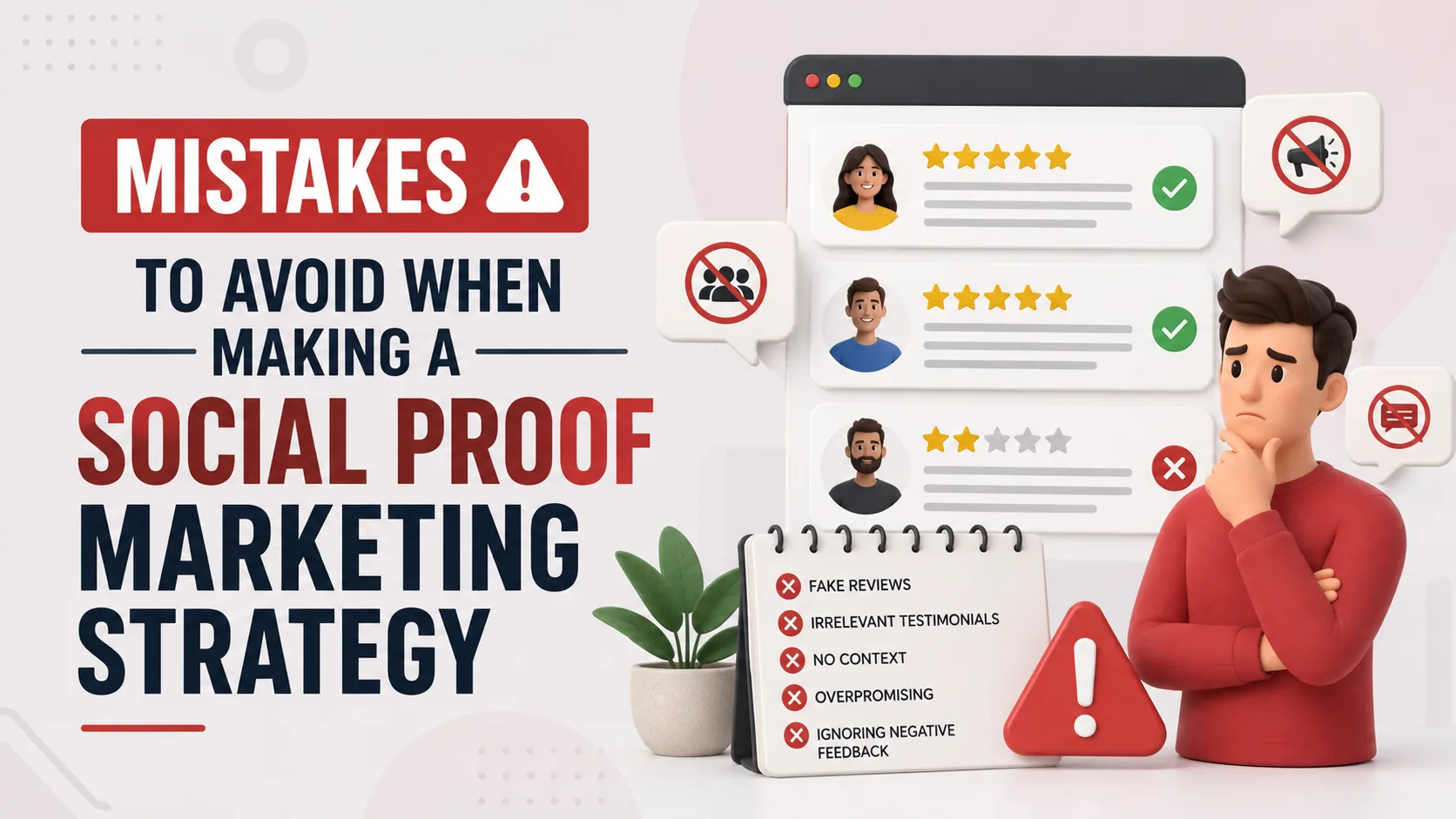
Mistakes To Avoid When Making a Social Proof Marketing Strategy
Mistakes To Avoid When Making a Social Proof Marketing Strategy
Bad social proof can hurt performance more than running no social proof at all.
- Generic testimonials. “Great product, highly recommend” tells the viewer nothing and gets ignored.
- Fake or overly polished reviews. People notice when something sounds scripted, and it damages trust in everything else on the page too.
- Outdated feedback. A testimonial from three years ago suggests you haven’t kept customers happy recently.
- No visual proof. Text-only claims convert worse than the same claim paired with a photo or short video.
- Mismatched proof for the audience. Showing a beginner’s testimonial to an expert audience, or vice versa, falls flat because it doesn’t reflect their situation.
- Hiding negative reviews entirely. A spotless 5-star record looks suspicious to anyone who’s bought online before. A mix of mostly positive with a few honest critiques actually reads as more credible.
Best Practices for Winning Social Proof Marketing Strategy
- Feature a specific outcome instead of a vague compliment.
- Include a real name, photo, or video whenever you have the customer’s permission to use it.
- Use recent experiences instead of leaning on proof from years back.
- Test reviews against testimonials against UGC directly, since the best format depends on your specific audience, not a universal rule.
- Pair social proof with a clear, direct CTA so the trust you’ve built actually converts into action.
- Keep collecting fresh proof on an ongoing basis instead of treating it as a one-time setup task.
How EvenDigit Helps
Social proof marketing strategy is the part of the campaign strategy we spend the most time on with clients, because it’s usually the fastest lever to pull when an account has decent traffic but weak conversion rates.
In practice, that means auditing what proof a client already has sitting unused in their reviews and customer messages, setting up a simple system to collect more of it, and testing which format (review, testimonial, or UGC) actually works for that specific audience before scaling the ad spend behind it.
If your ads are getting clicks but not conversions, the missing piece is often trust, not targeting. That’s usually the first thing we provide in our free audit report.
The Bottom Line
Your buyer is silently asking one question before they click your CTA: did this work for someone like me? Reviews, testimonials, and UGC each answer that question in a different way, and the ad accounts seeing the strongest performance right now are the ones matching the right kind of proof to the right audience at the right moment, not the ones with the most proof.
Questions You’re Probably Asking
How do you use UGC in ads?
Source it through direct customer requests, a branded hashtag, or a small incentive, then run it against cold audiences first, since unscripted content earns attention before a polished pitch would.
How do customer reviews improve digital marketing performance?
They build trust fast for new visitors and lower hesitation at the exact moments people decide, which shows up as better conversion rates on landing pages, product pages, and retargeting ads.
What is the best user-generated content marketing strategy?
One that makes participation easy, offers a real reason for customers to bother, and routes the content to the right funnel stage instead of dumping it into every ad at once.
How do testimonials improve ad performance?
They handle a specific doubt with detail a star rating can’t provide, which is exactly what a mid-funnel audience still weighing the decision needs to see.
Which social proof converts the most?
It depends entirely on the funnel stage you’re targeting. UGC tends to win cold traffic attention. Testimonials and reviews tend to win warmer audiences closer to deciding.
Can small businesses actually benefit from this, or is it just for big brands?
Small businesses often benefit more, since a handful of strong, specific reviews can build credibility that a large ad budget alone can’t buy.
How much social proof is too much in a single ad?
One strong piece, placed right next to your CTA, usually beats stacking three testimonials into one ad. Too much proof crowds out the actual offer you’re asking them to act on.