The 10 Best Ecommerce Marketing Automation Software in 2026 (And Which One Is Right for You)
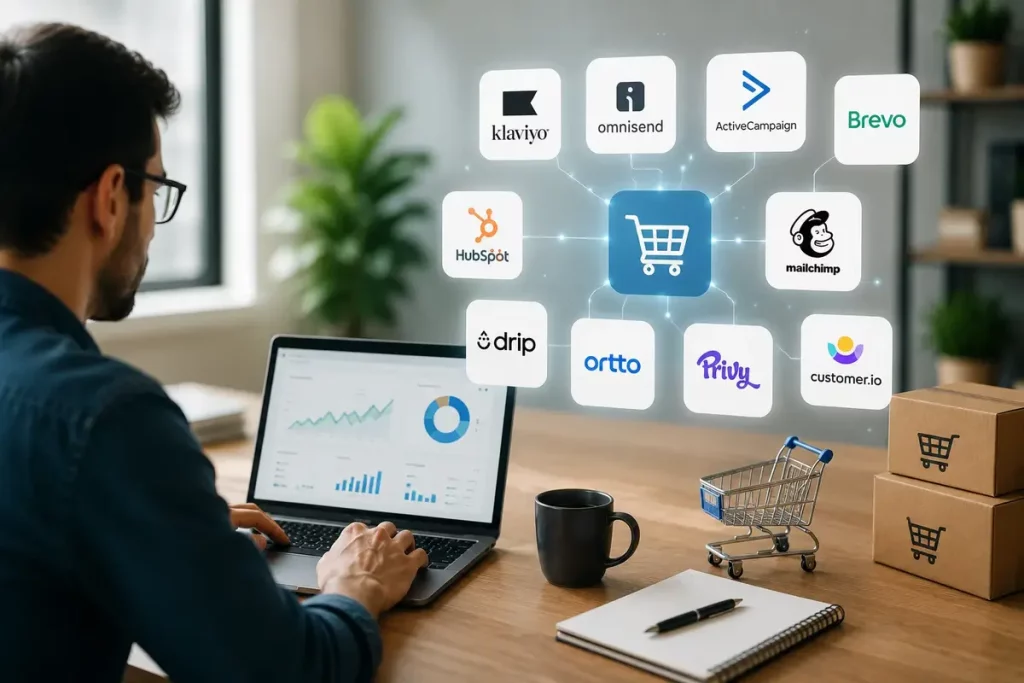
Ecommerce marketing automation software watches what your customers do, what they buy, what they browse, how long since they’ve been back, and sends the right message without you lifting a finger.
A first-time buyer gets a welcome sequence. Someone who hasn’t ordered in 90 days gets a win-back offer. A shopper who viewed a product three times gets a nudge.
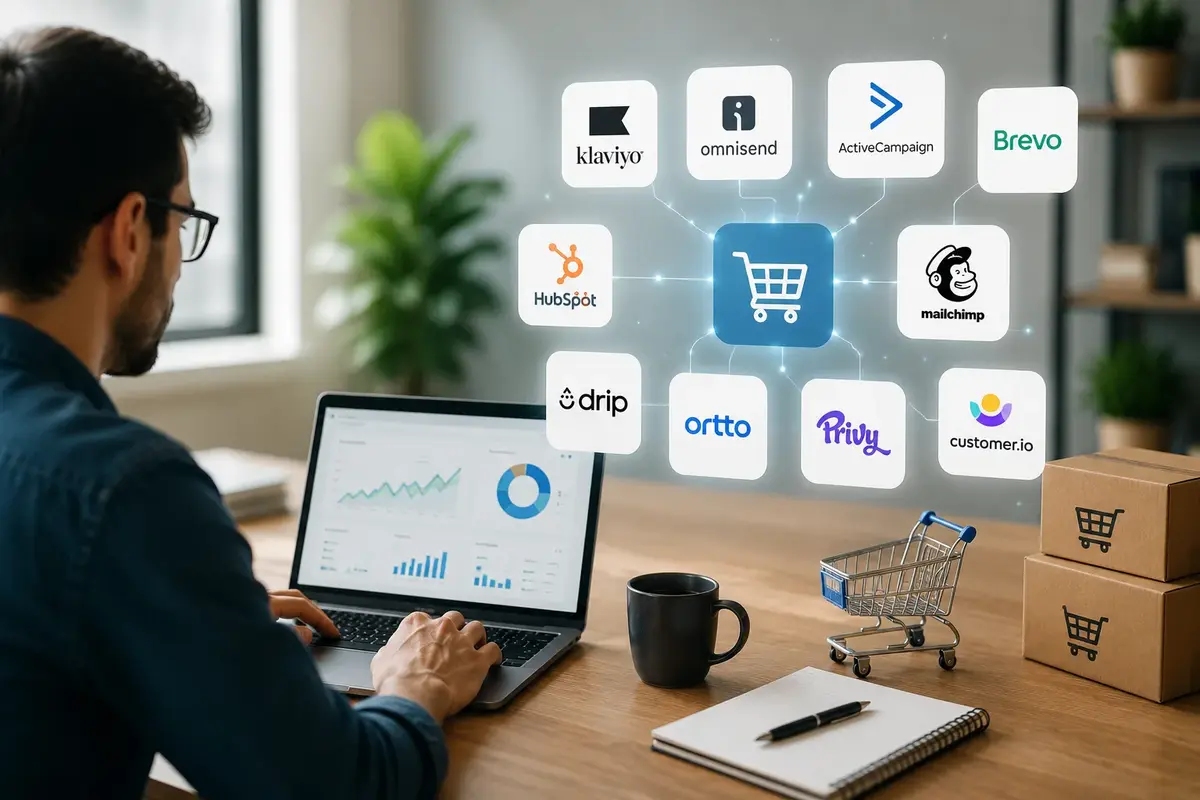
Done well, this can drive 30 to 40 percent of your total email revenue. Done poorly, it just annoys people.
The top 10 ecommerce marketing automation tools below handle it all. But they are not built for the same store, team, or budget.
How Many Types of Ecommerce Marketing Automation Software Are There
Depending on how they handle data and interact with your shoppers, ecommerce marketing automation software falls into 5 main types.
1. Pure-Play Ecommerce Multi-Channel Suites (B2C Focus)
These platforms are purpose-built strictly for online retail. They feature deep, native integrations with platforms like Shopify, WooCommerce, and BigCommerce. They automatically pull in real-time store data (like SKU inventory, live cart actions, and customer lifetime value) to trigger multi-channel flows.
- Channels Automated: Email, SMS, Web Push Notifications, WhatsApp.
- Core Workflows: Abandoned cart recovery, browse abandonment, post-purchase review requests, and replenishment reminders.
- Popular Examples: Klaviyo, Omnisend, Drip.
2. Enterprise Customer Data & Experience Platforms (CDPs / CXPs)
Built for high-volume, enterprise-level retail brands, these platforms go beyond simple email loops. They function as massive data hubs, unifying offline store data (POS systems), app downloads, customer service logs, and website behavior into a single “360-degree” customer profile to orchestrate complex consumer journeys.
- Channels Automated: Web, Mobile App (In-app messaging/Push), SMS, Email, Paid Ad Retargeting, WhatsApp.
- Core Workflows: Predictive AI-driven product recommendations, dynamic cross-channel journey building, and hyper-personalized website layouts.
- Popular Examples: Insider One, Salesforce Marketing Cloud, Adobe Marketo Engage, Braze.
3. All-in-One CRM + Marketing Automation Platforms (Inbound & B2B)
These platforms treat ecommerce shoppers like traditional sales leads. They bridge the gap between marketing messages and human sales pipelines. While they handle ecommerce automation well, their true strength is lead scoring, assigning point values to users based on how heavily they interact with your site before or after a purchase.
- Channels Automated: Email, On-site Live Chat, Social Media Scheduling, Sales Pipeline tasks.
- Core Workflows: Long-term lead nurturing, automated sales task creation, and pipeline tracking for high-ticket or custom wholesale ecommerce.
- Popular Examples: HubSpot Marketing Hub, ActiveCampaign, Keap.
4. General Email-First Automation Tools
These platforms started out as basic email newsletter services but added automation over time. They are highly user-friendly and incredibly budget-friendly for small businesses, but they often lack the deep, granular data-tracking required for complex, hyper-personalized behavioral targeting across multiple apps.
- Channels Automated: Primarily Email, with basic SMS additions.
- Core Workflows: Standard welcome series, generic drip campaigns, and basic automated newsletters.
- Popular Examples: Mailchimp, Brevo (formerly Sendinblue), GetResponse.
5. Backend Workflow Orchestrators (No-Code Integration Tools)
Unlike the ecommerce automation tools above, these do not actually send the emails or SMS messages themselves. Instead, they act as the “glue” or the nervous system connecting your ecommerce platform to other software in your tech stack. They use logic-based rules (If This, Then That) to automate operational and backend marketing tasks.
- Channels Automated: Inter-app data transfers, team communication alerts, inventory-triggered actions.
- Core Workflows: “If a VIP customer spends over $500, tag them in the CRM, notify the team via Slack, and auto-generate a loyalty reward coupon.”
- Popular Examples: Shopify Flow, Zapier, Activepieces, AutomateWoo.
What Are The Best Tools for Ecommerce Automation

HubSpot is the best CRM for ecommerce automation. But there are many more in the category, depending upon what you want to automate, the type of ecommerce platform you use, and the price you can pay.
| Tool | Focus Area | Best For | Standout Strength | Starting Price |
| Klaviyo | Advanced Data Tracking | Scaling Shopify Stores | Deep audience segmentation | Free / $20/mo |
| Omnisend | Multi-channel Retail | Budget-Conscious SMBs | Easy email and text workflows | Free / $16/mo |
| ActiveCampaign | CRM & Automation | Brands with Sales Pipelines | Powerful journey builder | $15/mo |
| Brevo | Volume Sending | Large Lists / Low Budgets | Fixed cost per email send | Free / $9/mo |
| HubSpot | Corporate All-in-One | Mid-Market & Enterprises | Complete unified company data | $20 to $800/mo |
| Mailchimp | General Marketing | Absolute Beginners | Simple user friendly templates | Free / $13/mo |
| Drip | Behavioral Flows | Independent DTC Brands | Flexible tracking and tags | $39/mo |
| Ortto | Business Analytics | Data-Driven Teams | Combines tracking with metrics | $199/mo |
| Privy | Audience Conversion | Fast List Building | Excellent on-site popups | Free / $30/mo |
| Customer.io | Event Messaging | Mobile & Subscription Apps | Tech-forward custom logic | $100/mo |
1. Klaviyo
Klaviyo is a widely used data platform in the direct-to-consumer space. It built its reputation on a tight, native integration with Shopify, though it connects with other major storefronts as well. It reads every single action a visitor takes on your site and uses that data to trigger incredibly precise messages.
- Key Features: One-click integration with major store platforms; advanced predictive analytics that calculate customer lifetime value; highly visual customer journey builder; built-in forms and SMS management.
- Pros: Outstanding data synchronization that updates customer behaviors in real time; top-tier segmentation options; massive library of pre-built store templates.
- Cons: The pricing scales up aggressively as your contact list grows, making it an expensive choice for high-volume, low-margin brands.
- Pricing: Free for up to 250 profiles. Paid plans start at $20/month for email or $35/month for email and SMS. For 10,000 profiles, you will spend roughly $150/month.
2. Omnisend
If Klaviyo feels a bit too complex or expensive, Omnisend is usually the alternative store owners turn to. It is built strictly for retail brands and focuses heavily on multi-channel messaging. You can easily drag email, SMS, and web browser notifications into a single automated workflow without jumping between different menus.
- Key Features: Unified multi-channel automation builder; automated product recommendations based on past purchases; pre-built workflows for cart recovery, welcome series, and order confirmation.
- Pros: Highly competitive pricing structure; very generous free plan; award-winning 24/7 support that is available even to non-paying users.
- Cons: Its audience segmentation options, while good, lack the absolute technical depth that enterprise-grade data tools offer.
- Pricing: Free plan handles up to 500 contacts and 1,000 emails per month. Paid tiers start at $16/month and scale based on contact size. For 10,000 contacts, it costs around $102/month.
3. ActiveCampaign
ActiveCampaign positions itself as a powerful engine for customer experience. It is not just an email tool; it includes a fully functional customer relationship management system. This makes it an ideal fit for brands that need to manage wholesale accounts, run complex business-to-business pipelines alongside their store, or track direct sales teams.
- Key Features: Advanced marketing automation logic with over 900 pre-made workflow templates; built-in sales CRM with lead scoring and pipeline tracking; predictive sending times driven by user engagement habits.
- Pros: Unmatched visual workflow capabilities; excellent ability to bridge the gap between automated marketing and direct sales pipelines.
- Cons: The platform has a noticeable learning curve. The interface can feel cluttered and overwhelming if you only want to send basic sequences.
- Pricing: Starts at $15/month for basic setups. For full access to ecommerce features and CRM pipelines, you will look at their Plus or Pro plans, which run around $49 to $79/month for small lists and scale upward.
4. Brevo
Formerly known as Sendinblue, Brevo has grown from a transactional email service into an affordable, all-in-one hub. It is highly valued by businesses with large contact lists because it does not charge you based on how many subscribers you have. Instead, you pay strictly for the total number of emails you send out each month.
- Key Features: Shared inbox for customer support; transactional email and text messaging; built-in WhatsApp marketing; simple pipeline management tool.
- Pros: Incredibly predictable pricing model; excellent email delivery rates; allows you to store unlimited contacts without paying extra penalties.
- Cons: The automation builder is relatively simple and lacks the deep behavioral logic triggers found in retail-first platforms.
- Pricing: The free plan allows 300 emails per day to unlimited contacts. Paid plans start at $9/month for basic sending and run around $39 to $66/month for mid-range volume needs.
5. HubSpot Marketing Hub
HubSpot is a premium, all-in-one solution designed for mid-market and enterprise operations. It connects your marketing automation, website content management, sales pipelines, and customer service desks into a singular ecosystem. It is a capable platform if you want your entire company to operate out of one system.
- Key Features: Multi-channel journey orchestration; deep contact attribution reporting; integrated ad tracking and management; enterprise-level custom behavioral events.
- Pros: A complete database that eliminates data silos between marketing, sales, and support; highly customizable user permissions and tracking.
- Cons: Extremely expensive. It requires an annual contract for higher tiers and often includes mandatory upfront onboarding fees that run into thousands of dollars.
- Pricing: Starter plans open at $20/month with limited features. Professional plans, where true automation and store workflows unlock, start at $800/month for 2,000 contacts, plus onboarding fees.
6. Mailchimp
Mailchimp is one of the most recognizable names in email marketing automation. While it started as a tool for simple newsletters, it has evolved into an all-in-one marketing platform. It offers a solid mix of entry-level store automations, social media scheduling tools, and content generation assistance.
- Key Features: Visual customer journey builder; dynamic content blocks that change based on who is reading; basic purchase behavior segmentation; built-in generative text suggestions.
- Pros: Very familiar user interface that is easy for absolute beginners to navigate; massive selection of pre-made design templates.
- Cons: Advanced multi-step journeys are locked behind higher payment tiers, and pricing climbs rapidly as your database expands.
- Pricing: Free tier supports up to 500 contacts and 1,000 monthly sends. Paid plans start at $13/month (Essentials) and move to $20/month (Standard) for proper automated journeys. 10,000 contacts will cost well over $100/month.
7. Drip
Drip is a behavioral marketing platform designed specifically for independent store brands. It acts as an accessible CRM for ecommerce that focuses entirely on point-and-click workflow customization. It treats every subscriber as a unique individual with an attached timeline of events, rather than just a name on a list.
- Key Features: Highly flexible tagging and custom field systems; visual workflow split-testing; real-time revenue attribution dashboards that show exactly which emails made money.
- Pros: Exceptional ability to build hyper-customized, branching customer tracks; works very smoothly with WooCommerce and BigCommerce.
- Cons: It lacks native SMS features in many regions, meaning you often have to connect external services to run true multi-channel campaigns.
- Pricing: No free plan, though they offer a trial. Pricing starts at $39/month for up to 2,500 contacts and scales directly with your list size.
8. Ortto
Ortto brings together customer data, marketing automation, and business analytics into a single interface. It is built for data-focused brands that want to see how marketing campaigns impact broader business metrics, like recurring revenue or profit margins.
- Key Features: Integrated customer data platform; visual tracking widgets; built-in artificial intelligence that helps predict conversion behavior; cross-system data unification.
- Pros: Beautiful, modern interface; incredible reporting tools that pull data from your storefront, payment systems, and ad platforms simultaneously.
- Cons: Starting prices are high, making it difficult for bootstrapped start-ups or very small operations to justify the cost.
- Pricing: Plans start at $199/month for their entry-level package, which covers basic contact and data processing limits.
9. Privy
Privy takes a different approach by focusing heavily on the very front end of the sales funnel: list growth and conversion. While it handles basic email sequences, its primary strength lies in its on-site pop-ups, spin-to-win wheels, and cart-saving banners that stop users from leaving your site.
- Key Features: High-converting exit-intent forms; integrated coupon code generation; basic three-step cart abandonment email flows; cross-sell displays.
- Pros: Incredible tool for rapidly growing an audience list; very simple to launch without needing code or design skills.
- Cons: It does not have the deep post-purchase or behavioral sequence logic that platforms like Klaviyo or ActiveCampaign provide.
- Pricing: Free plan for up to 100 contacts. Paid growth plans start at $30/month for email features and move to $45/month if you want to include SMS capabilities.
10. Customer.io
Customer.io is an advanced behavioral messaging platform built for tech-savvy teams, subscription-box stores, and mobile commerce brands. Instead of relying on standard list uploads, it runs on real-time event data sent via code or system connections, allowing you to build highly personalized communication paths.
- Key Features: Event-driven message triggering; complex multi-product split-testing; direct access to raw data pipelines; support for in-app messaging, push alerts, SMS, and email.
- Pros: Incredible structural control over technical sequences; perfect for intricate subscription or custom retail business models.
- Cons: Requires technical knowledge or development support to set up correctly; completely unsuited for standard non-technical store operators.
- Pricing: Built for mid-market budgets, starting at $100/month for their Essentials tier, which covers up to 5,000 profiles.
Choosing an Automation Tool Based on Your Ecommerce Platform
Your marketing automation tool should integrate with the platform your store is built on.
Shopify Klaviyo, Omnisend, and Postscript all have deep native Shopify integrations with real-time data sync. Customer events, order data, and product catalog information flow in automatically. Most tools on this list support Shopify at some level, but these three treat it as their primary platform.
WooCommerce Klaviyo and Drip both have strong WooCommerce integrations. Klaviyo requires a plugin, but syncs well once set up. Drip was built with WooCommerce users heavily in mind and tends to be a smoother experience for stores on that platform.
BigCommerce, Klaviyo, and Yotpo both support BigCommerce natively. Omnisend also integrates well. The ecosystem is smaller than Shopify, so you’ll find fewer plug-and-play options, but the major tools cover it.
Magento / Adobe Commerce, HubSpot, and Klaviyo both integrate with Magento, though setup is more technical. Brevo also supports it. If you’re on Magento, you’re likely at a scale where technical setup isn’t the main obstacle, but it’s worth confirming integration depth before committing.
Headless or custom builds. If your store runs on a custom stack, you’ll need a tool with a strong API and solid developer documentation. Klaviyo and ActiveCampaign are the most flexible here. Expect more setup time regardless of which tool you choose.
Choose Automation Software Based on Your Specific Goal

- Want to recover more abandoned carts?
Klaviyo and Omnisend are both strong here. Omnisend is faster to set up out of the box. Klaviyo gives you more control over timing, branching logic, and segment conditions if you want to get precise.
- Increasing the repeat purchase rate is your goal
Drip and Klaviyo both do this well through post-purchase flows and predictive replenishment triggers. Yotpo adds a loyalty layer on top if points and rewards are part of your retention strategy.
- Need to build and scale an SMS list
Attentive has the best list growth tools on the market. Postscript is the better choice if you’re on Shopify and want something more hands-on at a smaller scale.
- Automate the full customer lifecycle without a big team
Omnisend is the right automation tool for customer lifecycle automation. It has pre-built workflows, meaning you’re not starting from scratch, and the channel coverage (email, SMS, push) is broad enough to handle most of what a small team needs.
- Understand which campaigns are actually making money
Choose Klaviyo. Revenue attribution per flow, per campaign, and per segment is more detailed than other top platforms for ecommerce marketing automation on this list.
- Manage customer relationships alongside marketing
Undoubtedly, HubSpot. If you need a pipeline, deal tracking, and a sales team working alongside your marketing automation, nothing else here comes close on the CRM side.
- Consolidate reviews, loyalty, and retention into fewer tools
Yotpo. The trade-off is that each module costs extra, so run the numbers to see what you’re currently paying before assuming it saves money.
- Reach customers across email, SMS, and WhatsApp
Brevo is the only tool on this list that covers WhatsApp as a channel alongside email and SMS. Useful for brands selling in markets where WhatsApp is a primary communication channel.
The Final Verdict: Which Marketing Automation Software is Best for Your Ecommerce Store
| If you are… | Start here |
| Just launching, tight budget | Mailchimp (free) or Brevo (send-based pricing) |
| Growing store, want email + SMS without complexity | Omnisend |
| The WooCommerce brand that wants Klaviyo’s power at a lower cost | Drip |
| Need complex automation logic and a built-in CRM | ActiveCampaign |
| Shopify brand scaling past $1M | Klaviyo |
| High-ticket, longer sales cycle, or any B2B element | HubSpot |
| SMS-first brand on Shopify | Postscript |
| Enterprise brand scaling SMS | Attentive |
| Want reviews, loyalty, and SMS in one bill | Yotpo |
Final Words
In 2026, the top ecommerce platforms for marketing automation are not the ones in demand, but are those right for your store. Picking the most powerful option when you’re not ready to use it just means paying more for features you’ll ignore. Start with what fits your size and goals, and upgrade when you’ve outgrown it.
Frequently Asked Questions
What is ecommerce marketing automation software, exactly?
It’s software that sends messages to customers automatically, based on what they do (or don’t do) in your store. Is someone buying for the first time? They get a welcome email. Someone abandons a cart? They get a reminder. Hasn’t someone bought in three months? They get a win-back offer. You set up the rules once, and the software handles the sending. Most brands that do this well see 20 to 40 percent of their email revenue coming from these automated flows.
How is marketing software different from a regular email marketing tool?
A regular email tool sends a campaign to your whole list. Marketing automation software watches individual customer behavior and sends relevant messages based on what each person does. The difference in revenue between the two is significant.
Do I need a CRM for ecommerce?
Most pure DTC brands don’t. Your store and email platform together hold enough customer history. But if you have a sales team, sell high-ticket items, or have repeat B2B buyers, a dedicated CRM for ecommerce like HubSpot gives you more control.
Which is the best automation tool for Shopify?
Klaviyo, Omnisend, and Postscript all have strong native Shopify integrations with real-time data sync. For WooCommerce, Klaviyo, and Drip are all solid.
Can I use more than one tool?
Yes. Plenty of brands run Klaviyo for email and Postscript for SMS. Just make sure both tools pull from the same customer data so your segments and suppression lists stay consistent.