Google AI Mode vs AI Overviews: How Each Affects Website Traffic

AI Overviews add an AI-generated summary to the regular search results page, while AI Mode offers a separate conversational search experience. Both can surface website links, but they use different approaches and may cite different sources.
For website owners, the key question is not just which feature generates more visibility. It is how each affects organic clicks, brand exposure, and the way potential customers discover your content.
Key takeaways
- AI Overviews appear within traditional Google Search results, while AI Mode provides a separate conversational experience.
- Google says the two features may use different models and techniques, resulting in different answers and source links.
- Ahrefs found only 13.7% citation overlap between AI Overviews and AI Mode in its analysis of 730,000 response pairs.
- Ahrefs’ February 2026 study found that AI Overviews correlated with a 58% lower average CTR for the top-ranking page.
- Google Search Console reports AI-feature impressions but does not separately report AI-specific clicks or distinguish AI Mode from AI Overviews in its Generative AI performance report.
- Both features require the same foundational SEO practices. Google does not require special AI markup or additional technical optimization.
What is Google AI Mode, and how is it different from AI Overviews?
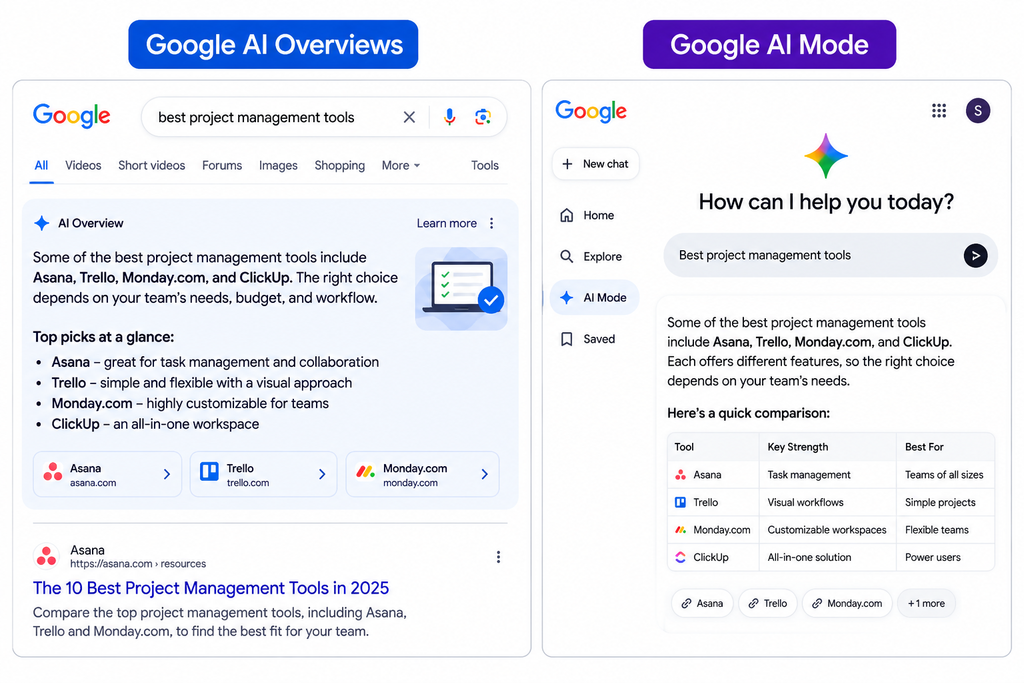
Google AI Mode is a conversational search experience where users can ask complex questions, explore topics, and ask follow-up questions. AI Overviews are AI-generated summaries that appear within traditional Google Search results.
Both features provide links to supporting websites, but they serve different search experiences.
| Comparison | AI Overviews | AI Mode |
| Where it appears | Within traditional Google Search results | Separate conversational search experience |
| Main purpose | Summarise information and help users explore a topic | Support deeper research, comparisons and follow-up questions |
| User interaction | Reads the summary and can visit supporting links | Asks follow-up questions to refine the search |
| Search experience | AI summary alongside traditional results | AI-generated responses in a conversational interface |
| Source selection | Can surface supporting links from relevant websites | Can retrieve and cite sources across related searches |
How do AI Mode and AI Overviews generate answers?
Both AI Overviews and AI Mode can use query fan-out to explore different aspects of a user’s question.
Query fan-out breaks an initial search into multiple related sub-queries. Google can use these searches to retrieve information from different sources and build a more comprehensive response.
For example, someone searching for “best CRM for a small business” may need information about pricing, integrations, ease of use, and available features.
Rather than relying only on the original search, AI-powered Search can explore these related aspects to build its response.
Google confirms that AI Overviews and AI Mode may use different models and techniques. Their responses and supporting links can therefore vary.
How do AI Mode and AI Overviews choose sources?
AI Mode and AI Overviews do not necessarily cite the same websites, even when answering similar questions.
Ahrefs analyzed 730,000 AI Overview and AI Mode response pairs and found that only 13.7% of their cited URLs overlapped. The two features reached similar conclusions in many cases but frequently used different sources to support their answers.
This has an important implication for SEO: “Appearing in an AI Overview does not guarantee that your website will appear in AI Mode.”
Your content needs to be relevant to the different aspects of a topic, not just one search query.
How do brand and link visibility differ?
AI Overviews and AI Mode provide different opportunities for website and brand visibility.
AI Overviews can introduce a website to users directly within traditional search results. AI Mode provides a longer conversational experience where users can explore additional questions and compare information from multiple sources.
Ahrefs found that AI Mode responses were approximately four times longer than AI Overview responses on average. Its analysis also found that AI Mode included 2.5 times more people and brand entities.
This suggests that AI Mode can provide more opportunities for brands to be mentioned within longer answers. However, brand mentions and website citations are different visibility signals, and neither guarantees a website visit.
How does the search journey differ?
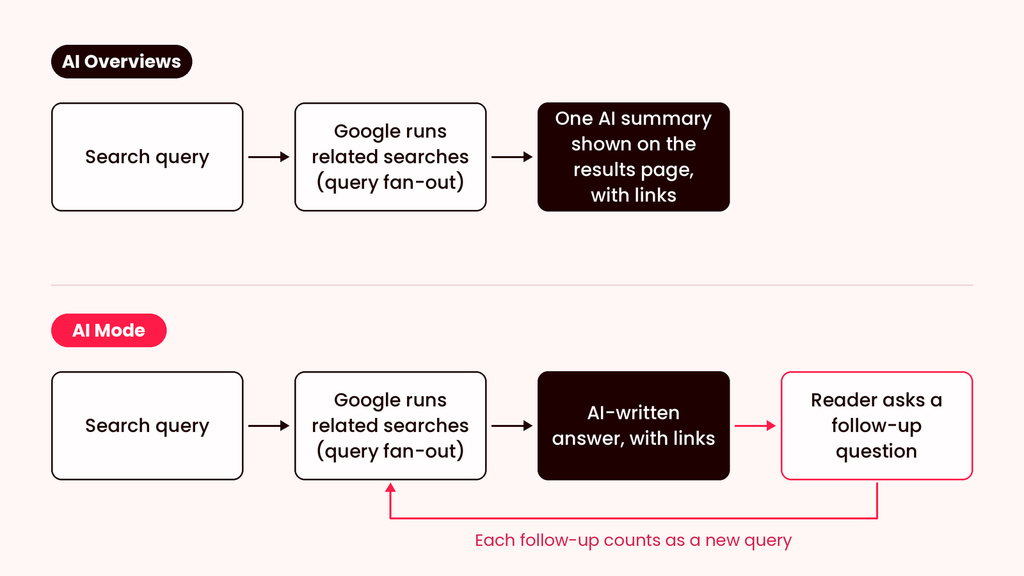
With AI Overviews, users receive an AI-generated summary alongside traditional search results. They can use the summary to understand a topic quickly or visit a supporting website for more information.
AI Mode supports a longer research process. Users can ask follow-up questions, compare options, and explore additional details without returning to the traditional results page for every question.
For businesses, this creates two visibility opportunities:
- AI Overviews: Get your website included as a supporting source when users search for relevant information.
- AI Mode: Make your brand and content relevant to the different questions users explore during a research session.
How do AI Overviews affect website traffic?
AI Overviews can affect organic traffic by providing answers directly in Google search results, meaning fewer users may click through to individual websites.
However, being cited in an AI Overview can help a brand reach potential customers, build awareness, and attract visitors seeking more in-depth information. The actual impact varies by search query and how much additional information users need.
A February 2026 analysis by Ahrefs found that searches featuring an AI Overview were associated with a 58% lower average CTR for the top-ranking page.
The study analyzed 300,000 keywords, comparing informational searches with and without AI Overviews. It used Google Search Console data to examine changes in desktop CTR between December 2023 and December 2025.
The finding is significant, but it needs context. It is an analysis of CTR patterns, not a controlled experiment proving that AI Overviews alone caused every lost click.
What does this mean for website owners?
A strong organic ranking may no longer translate into the same number of website visits when an AI Overview appears for a search.
Start by identifying the pages most exposed to this change:
- Find informational keywords that trigger AI Overviews.
- Identify the pages ranking for those keywords.
- Compare their organic clicks and impressions over consistent reporting periods.
- Look for pages where impressions remain stable, but clicks decline.
- Review whether the AI Overview already answers the main question covered by your page.
Prioritize pages where users need additional information, expert guidance, product details, or a comparison before making a decision.
How does AI Mode affect website traffic?
AI Mode changes the search experience by allowing users to explore a topic through follow-up questions and longer AI-generated responses.
Unlike AI Overviews, which appear within traditional search results, AI Mode keeps users within a conversational search environment as they refine their questions.
Ahrefs’ research shows that AI Mode and AI Overviews frequently cite different websites. Its analysis found just 13.7% overlap between their cited URLs.
However, this research measures citation differences, not website traffic losses. It does not establish how many clicks AI Mode removes from websites.
Semrush’s traffic analysis provides additional context about AI-driven referrals. Its study of more than 50,000 websites across 17 industries found that AI referral traffic grew by 66% in 2025 but still accounted for less than 0.15% of total website visits.
The study also reported rapid growth in Google AI Mode referrals. However, those visits represented only around 0.01% of total website traffic in the analyzed period.
These findings suggest that AI-driven referrals are growing, but traditional organic search remains a much larger traffic source.
How should you measure AI Mode visibility?
Measure AI Mode visibility through a combination of AI citations, referral traffic, branded search activity, and conversions. No single metric captures the full impact because a brand can appear in an AI-generated answer without sending a visitor to its website.
Track these AI visibility metrics together:
- AI citations and brand mentions: How often AI search platforms cite your website or mention your brand in relevant responses.
- AI referral sessions: Visits from platforms such as ChatGPT, Perplexity, and Gemini, tracked in GA4.
- Branded search performance: Changes in branded organic impressions and clicks in Google Search Console.
- Organic landing-page performance: Traffic and conversions on pages that target important informational and commercial queries.
- Query-level visibility: Changes in your presence for priority queries across AI search platforms.
Keep AI visibility and website traffic separate when reporting results. An increase in AI mentions or impressions does not necessarily translate into more clicks, sessions, or conversions.
AI Overviews Vs AI Mode: Which one costs your website more traffic?
There is not enough comparable evidence from the approved sources to conclude that AI Mode consistently reduces website traffic more than AI Overviews.
The two features have different search experiences, source-selection patterns, and reporting limitations.
Ahrefs’ research demonstrates that they frequently cite different websites. Its separate CTR study documents the relationship between AI Overviews and lower organic click-through rates.
Semrush’s traffic analysis also shows that AI referral traffic is growing, although it remains a small share of total website visits.
The impact on your website will depend on:
- How frequently your target keywords trigger AI Overviews.
- How often your audience uses AI Mode.
- Whether your pages appear as supporting sources.
- Whether your content answers questions that users need to explore further.
- How much of your organic traffic comes from informational versus commercial searches.
Rather than assuming one feature is more damaging, measure their visibility and your website’s traffic trends separately wherever the available data allows.
Is being cited in AI answers worth it if users don’t click?
Yes. An AI citation can introduce your brand to someone researching a product, service, or business, even when that person does not immediately visit your website.
EvenDigit helped Microlit, a laboratory equipment brand, get 498 pages cited by AI platforms in a single month through comprehensive product guides, question-based content, and entity listings.
Microlit also earned 97 brand mentions in AI answers, with confirmed wins on ChatGPT, Gemini, and AI Overviews.
We can help your brand earn the same AI visibility through our dedicated GEO services.
How do you track AI Mode and AI Overviews in Search Console?
Google Search Console provides two relevant reporting options to track results from both AI Mode and AI Overviews. The standard Performance report includes clicks and impressions from AI features within the Web search type. A separate Generative AI performance report provides dedicated visibility data for generative AI features.
Google announced the Generative AI performance reports on June 3, 2026, and completed their global rollout on August 31, 2026.
What are the Search Console reporting limitations?
The Generative AI performance report has several important limitations:
- It reports impressions but does not provide AI Mode click-through rate.
- It combines AI Overviews and AI Mode rather than separating their performance.
- It does not provide the individual search queries responsible for AI impressions.
- AI-feature clicks remain included in the overall Web search Performance report.
Google’s reporting documentation also explains how AI-feature impressions and clicks are counted.
Search Engine Journal has highlighted these reporting gaps, particularly the difficulty of connecting AI impressions with actual website visits.
How should you optimize for AI Overviews and AI Mode?
Google recommends using the same foundational SEO practices for optimizing for AI Overviews and AI Mode as for traditional Search.
There are no additional technical requirements or special AI markup needed to get cited in AI Mode or AI Overviews.
Instead, focus on making your content accessible, useful, and relevant to the questions your audience searches for.
Here are six practical areas to address:
- Make important pages accessible to Google: Allow Googlebot to crawl your pages and check for indexing problems.
- Improve internal linking: Connect related pages so Google can discover important content and understand how topics relate.
- Create useful and original content: Include extractable answers, original data, expert opinions, and sub-queries to cover the topic in depth.
- Cover related questions: Address the subtopics and follow-up questions users may explore around your main subject.
- Maintain accurate structured data: Ensure schema markup matches the visible content on your pages. Keep relevant Merchant Center and Business Profile information updated.
- Monitor search visibility: Use Search Console to review indexing, organic performance, and AI-feature impressions.
What technical requirements does Google list?
Google’s technical requirements for AI Overviews and AI Mode are the same as those for regular Google Search. For a page to be eligible as a supporting link, it must:
- Be indexed by Google.
- Be eligible to appear in Search with a snippet.
- Meet Google’s Search technical requirements and policies.
Google does not require special schema markup, AI-specific text files, or additional technical optimization for these features.
Plan for both and measure your visibility
AI Overviews and AI Mode offer different visibility opportunities, so their effect on website traffic is best measured separately. Strong SEO foundations, useful coverage of customer questions, and regular tracking of AI visibility alongside organic traffic and conversions help your website stay discoverable across both.
EvenDigit is offering a free AI visibility audit to help businesses understand their presence across AI search experiences, identify content opportunities, and build strategies to improve discoverability across traditional and AI-powered search.
FAQs
What is a zero-click search?
A zero-click search is a search in which a user does not click through to an external website. The user may find enough information directly on the search results page or continue exploring within an AI-powered search experience.
How can you limit what Google shows from your pages in AI features?
Google provides controls such as no-snippet, data-nosnippet, max-snippet, and no-index for managing how content appears in Search. It also provides a Search generative AI control in Search Console to manage site inclusion in AI Overviews and AI Mode. Google-Extended is a separate control for certain other Google AI systems; it does not control inclusion in AI Overviews or AI Mode.
Does a top Google ranking guarantee a citation in AI Overviews or AI Mode?
No. A high organic ranking does not guarantee a citation. Google may use different models, techniques, and related searches to select supporting sources. Your page must also meet Google’s indexing and snippet eligibility requirements.