
How to Measure AI Visibility: 6 Metrics That Actually Matter

AI visibility measures how often, where, and how prominently your brand appears when people ask AI tools like ChatGPT, Gemini, or Google AI Overviews relevant questions. Traditional search visibility is about rankings and clicks. AI visibility is about whether your brand shows up inside the answer itself.
To measure AI visibility properly, you need six metrics: AI Share of Voice, Prompt Coverage, Citation Rate, Brand Mentions in LLMs, AI Overview Presence, and ChatGPT Referral Traffic. Together, they show how often your brand appears, how you stack up against competitors, whether your content gets cited, and whether any of it drives visitors to your website.
Quick Summary (TL;DR)
- No single tool measures all six AI visibility metrics yet. Combine manual prompt testing with your existing analytics setup.
- AI can mention your brand without citing it. These are different things, and mixing them up gives you a false picture of your visibility.
- Rising visibility doesn’t automatically mean rising traffic. Track them separately.
- Start with a spreadsheet and a prompt list before investing in a dedicated AI visibility tracking tool.
What Counts as AI Visibility, and How Is It Different From Ranking Well?
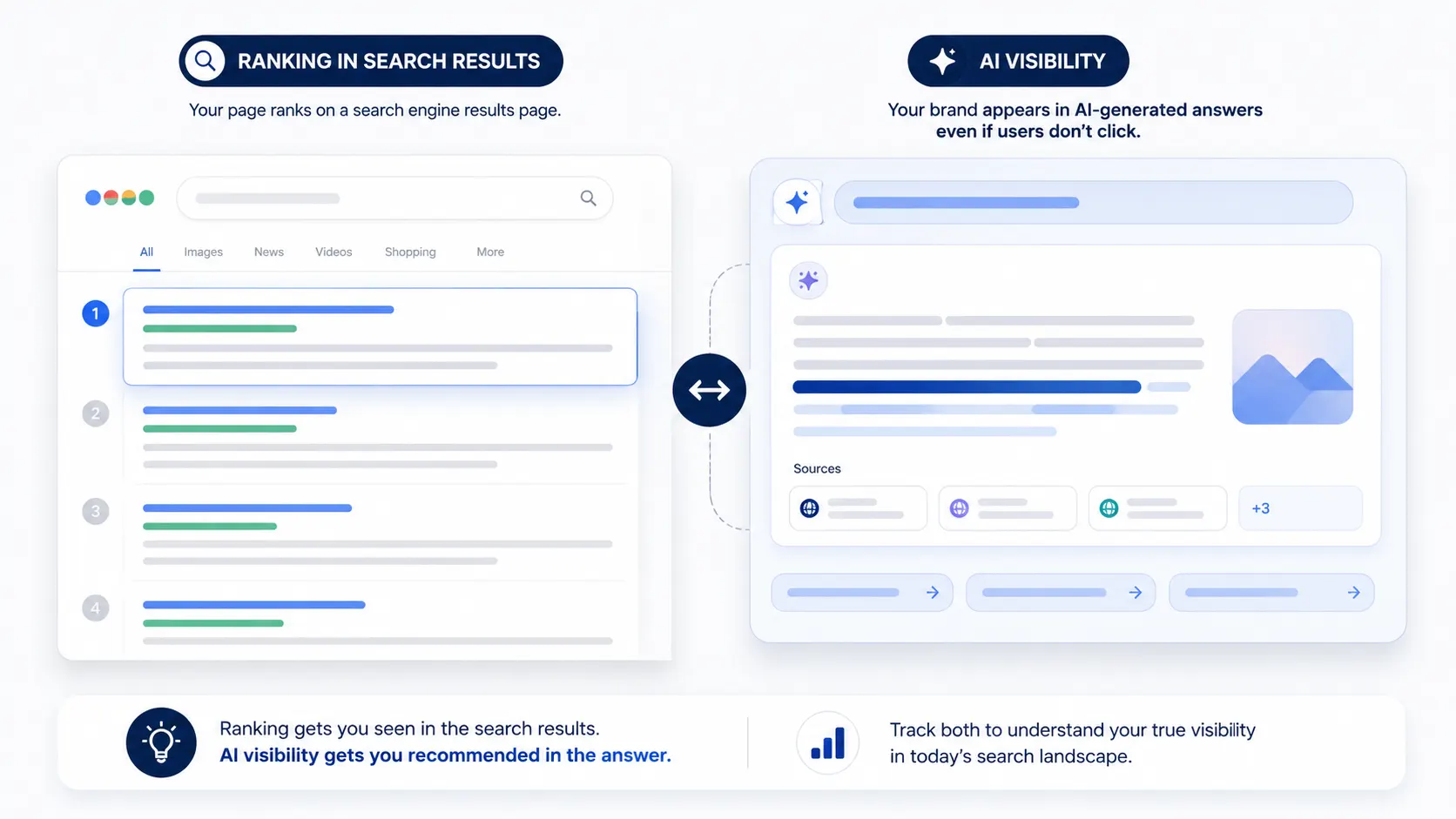
Ranking well means your page sits near the top of search results. AI visibility means your brand is mentioned or linked in an AI-generated answer, even if the user never clicks anything.
Mention vs. Citation: The Distinction That Matters Most
- A mention is when an AI names your brand without linking to your website.
- A citation is when an AI links to a specific page on your website as a source.
AI tools mention brands far more often than they link to them. If you only track citations, you’ll miss cases where your brand is being recommended by name — and for high-intent queries, the recommendation is often worth more than the link.
One caveat applies to every metric below, so here it is once: AI answers vary by prompt wording, model, location, and timing. Lock your prompt set, platforms, and method, and only compare like with like month over month.
The 6 AI Visibility Metrics at a Glance
| Metric | What it tells you | Primary use |
|---|---|---|
| AI Share of Voice | Your visibility vs. competitors | Competitive analysis |
| Prompt Coverage | How broad your visibility is | Finding content gaps |
| Citation Rate | How often your content gets referenced | Content authority |
| Brand Mentions in LLMs | How often and how you’re described | Brand presence tracking |
| AI Overview Presence | Visibility in Google’s AI summaries | Search visibility |
| ChatGPT Referral Traffic | Actual traffic from ChatGPT | Business impact |
1. AI Share of Voice
AI Share of Voice measures how often your brand appears in relevant AI answers compared with your competitors for the same questions.
How to Calculate AI Share of Voice
- Build a list of prompts your customers might ask about your product or services.
- Run them through the AI platforms your audience uses and record every brand that appears in each response.
- Divide your brand’s mentions by the total mentions of your brand plus tracked competitors, then multiply by 100.
Run 100 prompts, appear in 35 while Competitor A appears in 45 and Competitor B in 20, and your AI Share of Voice is 35%.
What the Number Actually Tells You
The absolute number matters less than the gap it exposes. You may be appearing in AI answers while a competitor appears more often for the same questions. Tracking this monthly shows exactly which topics competitors are winning — and those topics become your content roadmap.
2. Prompt Coverage
Prompt Coverage measures how often your brand appears across the relevant questions your audience asks AI tools. Where Share of Voice measures competitive position, Prompt Coverage measures breadth.
Prompt Coverage Formula
Prompts where your brand appears ÷ Total relevant prompts tested × 100
Test 100 relevant prompts, appear in 65, and your prompt coverage is 65%.
Building a Prompt Set That Works
The quality of your prompt set matters more than its size. Include a mix of informational, commercial, comparison, recommendation, problem-solving, and brand-specific questions — and weight the set toward high-intent prompts. Coverage on “best [category] for [use case]” is worth more than coverage on generic definitions.
Read a low coverage rate as a content gap map: every relevant prompt where your brand doesn’t appear is a topic where AI models have no reason to know you exist.
3. Citation Rate in AI Search
Citation Rate measures how often AI responses link to your website as a source.
Citation Rate Formula
Responses citing your content ÷ Total relevant prompts tested × 100
Note the denominator: use total prompts tested, not “responses where your brand appears.” Counting only responses that already mention you inflates the rate and makes it impossible to compare cleanly against Prompt Coverage.
Test 100 relevant prompts, get cited in 28 responses, and your citation rate is 28%.
What to Track Beyond the Percentage
Track which pages get cited, which formats get cited (comparison tables, original data, and step-by-step guides earn citations more reliably than opinion pieces), and how often competitors are cited for the same prompts.
A brand can be mentioned without being cited. That usually means the AI knows your brand but is sourcing its answer from third-party reviews, directories, or publications — a signal to audit what those third-party sources say about you, not just your own site.
4. Brand Mentions in LLMs
Brand mentions measure how often, and in what context, an AI model names your brand. The raw count alone tells you almost nothing.
“We got mentioned 500 times” sounds impressive, but it doesn’t tell you whether those mentions were positive, buried at the bottom of the response, or attached to the wrong product. A more useful statement: “We appeared in 52% of high-intent category prompts and were actively recommended in 31% of them.”
Four Things to Record for Every Mention
When tracking brand mentions across AI search engines, record:
- Where your brand appears in the response — first recommendation or footnote
- Whether it’s recommended or simply named
- Whether the information is accurate, since models can surface outdated pricing or discontinued services
- How often competitors appear in the same responses
Accuracy checks matter more than most teams expect. An AI confidently quoting your 2023 pricing to a 2026 prospect is a visibility problem that more visibility won’t fix.
5. AI Overview Presence
AI Overview Presence measures how often your brand or website appears in Google’s AI-generated summaries for your target queries.
What to Record for Each Target Query
- Whether the query triggers an AI Overview at all
- Whether your brand appears in it
- Which competitors appear
Track 500 queries, find 300 trigger an AI Overview, appear in 72, and your AI Overview presence is 24% of Overview-triggering queries.
How to Track AI Overviews at Scale
Manually checking hundreds of queries doesn’t scale, so use rank-tracking tools that flag AI Overview appearances as a SERP feature. Most major SEO platforms now report which of your tracked keywords trigger an Overview and whether you’re included. Keep manual spot-checks for your highest-value queries, since Overviews vary by location and device.
Your organic ranking does not guarantee AI Overview inclusion. Google states that AI Overviews draw on its core ranking systems but may surface a broader range of supporting sources than the top blue links. Treat this as a separate battle from rankings, not a byproduct of them.
6. ChatGPT Referral Traffic
ChatGPT referral traffic measures how many people actually reached your website from ChatGPT — the only metric on this list tied directly to business impact.
How to Find ChatGPT Traffic in GA4
ChatGPT appends utm_source=chatgpt.com to outbound links, so this traffic surfaces in GA4 without any setup on your end:
- Go to Reports → Acquisition → Traffic acquisition
- Change the primary dimension to Session source/medium
- Search for
chatgpt.com— it typically appears aschatgpt.com / referral
For a cleaner ongoing view, build an exploration filtered to session source containing chatgpt, with landing page, engaged sessions, and key events as metrics. Do the same for perplexity.ai, gemini.google.com, and copilot.microsoft.com while you’re at it — one segment covers all AI referrers.
What to Track and What It Means
Track sessions, engaged sessions, landing pages, leads or key events, and revenue. If 500 ChatGPT sessions produce 40 conversions, that’s an 8% conversion rate. AI referral traffic often converts above site average because the visitor arrives pre-qualified by the answer they already read — but verify that against your own data rather than assuming it.
The caveat: this metric understates your AI visibility. Your brand can appear constantly in AI answers and generate little traffic, because users often get what they need without clicking. Use referral traffic to measure business impact, not as a proxy for overall visibility.
Which AI Visibility Metrics Should You Prioritize?
Roughly in order of effort-to-insight: Prompt Coverage and AI Share of Voice first (cheap, directional), Citation Rate and Brand Mentions second (diagnostic), AI Overview Presence and ChatGPT Referral Traffic third (tool-dependent, business-facing).
Metrics to Treat With Suspicion
- Total AI mentions without context or intent segmentation
- Raw citation counts without relevance checks
- “Number of prompts tested” as a vanity figure
- One-time AI visibility scores from tools that don’t disclose their methodology
- ChatGPT traffic reported without conversion data
How to Measure AI Visibility From Zero: Setup Steps
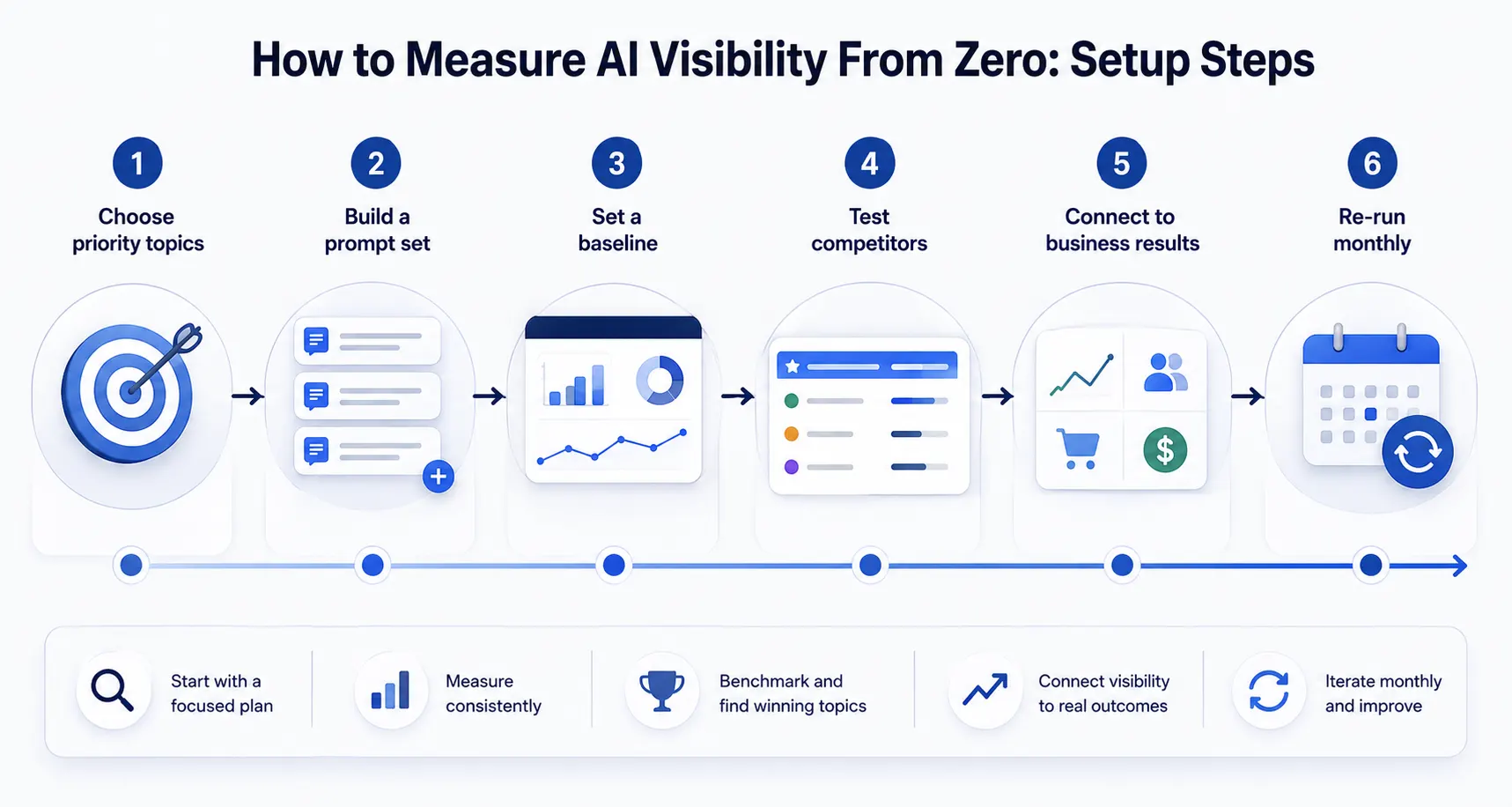
- Choose priority topics. Main products or services, the problems customers search for, and the comparisons they make against competitors.
- Build your prompt set. Mix informational, commercial, comparison, recommendation, and brand-specific prompts. A focused set of 50–100 beats a sprawling set of 1,000.
- Set your baseline. Run the prompts across the platforms your audience uses. Record starting numbers for all six AI visibility metrics in a shared sheet.
- Run the same prompts for competitors. Visibility only means something relative to the alternatives your buyers see.
- Connect to business results. Compare visibility changes against traffic, leads, and conversions. Look for correlation; don’t assume causation.
- Re-run monthly with the same method. Note major model or search-experience updates that could explain sudden shifts.
Conclusion
Once you can measure AI visibility consistently, the job becomes interpretation: where your brand appears, which questions you’re missing, where competitors are winning, and whether your content earns citations. Connect those findings to traffic, leads, and revenue wherever you can.
Start small, keep the method consistent, and let the gaps you find set your content priorities. AI search is changing fast enough that your measurement approach deserves a quarterly review — not just your numbers.
FAQs
Why is my brand mentioned by an LLM but not cited?
The model knows your brand from reviews, directories, or other sources, but it’s using those third-party pages — not yours — to support its answer. A citation specifically means the response links to your page as a source.
Why does my AI Share of Voice fluctuate between prompts or platforms?
Different prompts produce different answers, each platform works differently, and location and timing affect results. The only way to spot real change is identical prompts, platforms, and method each cycle.
Can high AI visibility lead to low referral traffic?
Yes. If the AI answer gives users everything they need, there’s no reason to click. That’s exactly why visibility and referral traffic are measured as separate AI visibility metrics.
Why does my competitor appear in AI Overviews when I rank higher organically?
AI Overviews can pull from a wider set of sources than the top organic results. Ranking position influences but doesn’t determine inclusion — track Overview presence separately.
How many prompts should I track to measure AI visibility reliably?
There’s no fixed number. Enough to cover your main topics and the ways your audience actually phrases questions — a focused, high-intent set beats thousands of loosely related prompts.
What if an AI model describes my brand inaccurately?
Check whether the error repeats across models and responses. If it does, the model is likely learning from outdated third-party sources. Update your own pages and the authoritative external listings the models draw from — directories, review sites, and major reference sources.