How to Optimize for Google AI Mode and AI Overviews: Do’s and Don’ts According to Google
Quick Answer
To appear in Google AI Mode and AI Overviews, your pages must be crawlable, indexed, and eligible to show a snippet in standard Google Search. There is no separate AI index. Beyond that, domain authority and brand traffic are some of the most important AI Mode ranking factors.
Key Takeaways
- There is no separate AI index. Google AI Mode pulls from the same index as standard Search.
- Your site must be opted into AI features in Search Console to be eligible at all.
- Domain traffic is the #1 citation factor, 3x more impactful than content quality (SE Ranking, 2026).
- Google defines commodity content as anything a generative AI could produce; that type of content will not be cited.
- Google Business Profile and Merchant Center feeds are named separately in Google’s guide as AI visibility inputs.
What Is Google AI Mode and How Does It Work?
Google AI Mode is a separate search tab powered by Gemini. When you type a query, it does not run one search. It breaks your query into several parallel sub-queries, fetches results for each, and combines everything into a single answer with clickable source links.
Google calls this query fan-out. A search for ‘how to fix a lawn full of weeds’ fans out into sub-queries like ‘best herbicides for lawns,’ ‘how to remove weeds without chemicals,’ and ‘how to prevent weeds from coming back.’ Each sub-query retrieves separate pages, and the AI stitches the answers together.
The mechanism behind this is retrieval-augmented generation (RAG). Google retrieves pages from its existing Search index and uses those pages as the source material for the AI answer. There is no separate AI database. This is why standard SEO is still the foundation. If your page is not indexed by Google, it cannot appear in AI Mode.
Is AI Mode the same as AI Overview?
No. AI Overviews appear inside the standard results page for one query. AI Mode is a separate tab that supports multi-turn follow-up questions.
What Are the Key AI Mode Ranking Factors and How They Help?
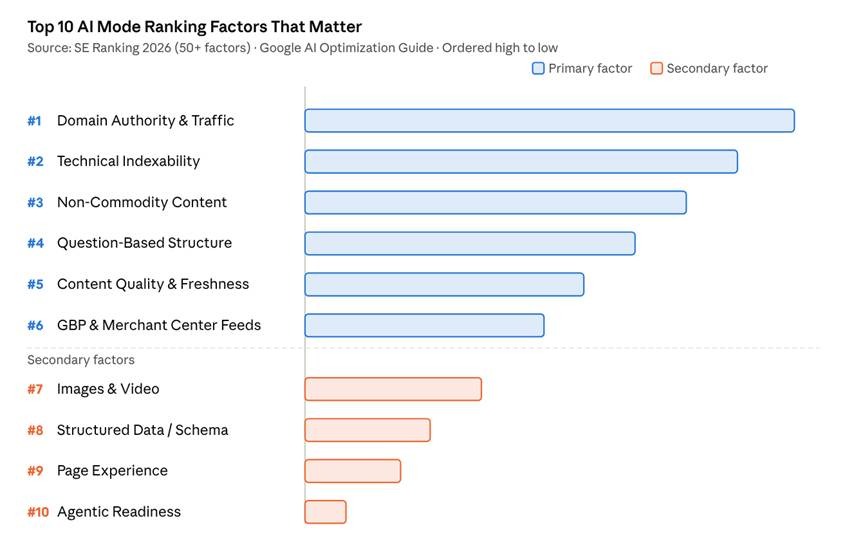
There are many AI Mode ranking factors that impact your visibility, but technical foundation, domain authority, non-commodity content, content structure, GBP, and content freshness are most important.
How Technical SEO Improves AI Mode Visibility
Your website must be crawlable, indexed, and eligible to show a snippet in Google Search before it can appear in any AI feature. Google’s AI optimization guide says pages must meet Search technical requirements and be eligible for snippets. AI features use the same crawling and indexing infrastructure as standard Search.
Your site must be opted into AI features inside Search Console. Without this toggle active, your pages cannot appear in AI Mode regardless of content quality.
Does Domain Authority Help in AI Visibility?
DA plays a role, but it’s hard to say that a high-DA website always gets cited in AI. Two different studies said contradictory things about the relationship between DA and AI visibility.
According to SE Ranking, a website with high domain authority (over 24K) and a stronger backlink profile is cited more in AI search results.
In a separate analysis of 20.5 million AI citations from Wellow, an AI visibility platform, more than 75% of cited sources in AI were fresh websites with a DA score less than 50.
What to conclude from this: domain authority only builds entry and trust in AI search, not the single biggest AI mode ranking factor. Instead, page-level authority matters more than DA score. It tells AI your page has a relevant answer to users’ specific query, which can earn a citation or brand mention.
How to improve page-level authority
Identify three to five queries where your store has the most genuine expertise and existing organic traction. Build non-commodity content in those areas first. Track organic ranking changes in Search Console as a leading indicator of AI citation potential.
What is Non-Commodity Content and How Does it Help
Non-commodity content is a first-hand experience, original data, or expert perspective that cannot be replicated, whereas commodity content is the common knowledge that anyone can produce.
According to Google’s generative AI optimization guide: “A first-hand review provides a unique perspective based on personal experience, whereas a summary of existing content simply restates information already available elsewhere. Don’t just recycle what others on the internet have already said, or could easily be produced by a generative AI model.“
For an ecommerce store, a product page that lists specs is commodity. The same page that explains why you chose that material after testing three alternatives, what customers get wrong about sizing, or what makes your product different from the category standard is non-commodity. AI systems have a reason to cite the second version. They have no reason to cite the first.
EvenDigit built non-commodity content for a laboratory equipment brand, getting their 498 pages cited by AI platforms in a month. We also drove 97 brand mentions across ChatGPT, Gemini, and Google AI Overviews.
What is the Ideal Content Structure to Show Up in AI Mode
SE Ranking’s research identifies question-styled headings as a direct AI Mode citation signal. Organize content under headings that mirror how people actually ask questions to help AI systems map your content to the sub-queries generated during query fan-out.
Google’s generative AI optimization guide also recommends organizing content with clear headings and structure.
What to do:
Look at your top 10 pages and check whether your H2S are labels (‘Product Features,’ ‘Our Process’) or questions (‘What makes this different from X?’, ‘How do I choose the right size?’). Renaming labels to questions your buyers actually ask is a zero-cost change with a direct citation impact.
We recommend making a strong AI content strategy rather than focusing only on structuring content to show up in Google AI mode.
EvenDigit used this approach for Language Academy, a PTE and NAATI coaching provider in Australia, alongside location-based AEO pages and schema markup. Their AI-cited pages grew 61% in four months with 148 brand mentions across AI platforms. ChatGPT now recommends them for ‘top PTE study websites.’
These results come from understanding what your buyers or customers are asking AI. It builds the foundation for Google AI mode SEO. If you are not sure where to start, we recommend our first-look audit to understand your AI visibility.
Should I Optimize GBP and Merchant Center Feeds for AI Mode
Yes. For ecommerce stores, your Google Shopping feed is a direct line into AI Mode product queries. AI Mode pulls pricing, availability, and product data from Merchant Center. A feed with stale prices or out-of-stock items gets passed over. Make sure your feed is active, accurate, and updated regularly.
For local businesses, your GBP name, address, categories, service areas, Q&A, and photos all feed AI local answers. Research from Whitespark’s 2026 study of 540 local queries found AI Overviews appearing in 68% of local business queries. The businesses that appear most often in those answers are the same ones sitting in the top three local pack positions.
What to do: Audit your GBP for completeness. Check every service listed, service areas named, Q&A populated, and photos recent. For ecommerce, run your Merchant Center feed through the Diagnostics tab and fix any disapproved or limited products.
Is Content Structure the Most Important Factor in Google AI Mode SEO?
Yes, content structure is one factor for showing up in AI mode as per Google’s own guide on optimizing for generative AI features, but it is not the only one.
It recommends organizing content in a clear structure with paragraphs and headings that help readers and AI navigate the content easily. However, simply organizing content does not improve AI visibility. It must clearly answer the query and have freshness signals.
Why content quality and freshness matter:
The AI retrieves passages from early in the page first. Research on AI citation patterns finds that a large share of citations come from the first 30% of a page’s text. Answers buried lower rarely get extracted, even when the page ranks well organically.
Freshness matters for a different reason: stale content gets displaced. If your category page still references outdated product lines or old statistics, newer pages that address the same query more accurately will get cited in your place.
Google’s 2026 core updates also applied the Helpful Content system as a domain-level signal. Thin or auto-generated pages do not just hurt those pages individually. They pull down your whole site’s quality score, reducing AI citation frequency across your best content too.
How to improve it:
- Open every key page with the direct answer; do not build to it.
- Keep paragraphs to two or three sentences; short, self-contained paragraphs are easier for AI to extract as standalone passages.
- Write plainly; a clear 12-word sentence is more likely to be cited than the same idea written as a 45-word compound sentence.
- Update top category and product pages quarterly with fresh statistics, fix outdated claims, and add FAQs based on what customers are actually asking now.
- Audit thin or auto-generated pages on your catalog and consolidate them; they reduce AI citation frequency across your entire site.
What Else Matters to Optimize Your Website for AI Mode
These four factors do not decide whether you appear in AI Mode, but they affect how often and how prominently you appear in AI Mode and AI Overview.
- Images and video: Google’s guide states AI features can surface images and video beyond standard web links. Add relevant images and video to product pages and blog posts, with descriptive alt text and correct schema. This gives your site an additional citation surface beyond text links.
- Structured data: Schema is not required for AI features, and Google’s guide says so directly. However, Product, FAQPage, and Article schema still earn rich results in standard Search and support Merchant Center eligibility. Maintain what you have. Do not treat schema as an AI strategy.
- Page experience: Fast load times, mobile-friendly rendering, and clear separation of your main content from navigation elements all affect crawl quality, which feeds AI retrieval quality. Run PageSpeed Insights on your three most important pages and fix Core Web Vitals issues first.
- Agentic readiness: Google mentions browser agents that navigate websites to complete tasks on behalf of users. This is early-stage and optional today. Semantic HTML and accessibility best practices help, but there is no immediate action needed for most stores.
What Does Not Help in Google AI Mode Optimization
Creating llms.txt files for Google AI mode is absolutely one of those things you must avoid. Google Search does not use them. The official guide states they will “neither harm nor help your site’s visibility or rankings in Google Search.” You can maintain one for other platforms that do use it, but it has no effect on AI Mode.
What else you should avoid as per Google’s generative AI optimization guide:
- Do not break your content into small chunks for AI. There is no requirement to do this. Google’s systems can understand multiple topics on a single page and will surface the relevant passage. Write for your human reader, not for an AI parser.
- Do not rewrite content specifically for AI phrasing. AI Mode understands synonyms and general intent. You do not need to capture every long-tail keyword variation or worry that your phrasing does not match how someone might search. Write clearly and directly.
- Do not buy or solicit inauthentic brand mentions. Google’s guide states that spam detection systems actively block manufactured mentions. Inauthentic signals do not improve AI citation rates — they risk flagging your domain.
- Do not over-invest in structured data as an AI strategy. Structured data is not required for AI features, and there is no special AI-specific schema. Keep existing schema in place for rich results in standard Search, but do not treat it as the lever for AI Mode visibility.
How to Optimize for Google AI Mode? A Final Checklist
Whether you are optimizing for Google AI mode or AI overviews, these AI mode ranking factors are the starting point.
1. Fix your technical foundation first
- Check that key pages are crawlable, indexed, and snippet-eligible in Google Search.
- Go to Search Console > Settings > Search Appearance > AI features and confirm the opt-in is active.
- Verify JavaScript rendering in Search Console’s URL Inspection tool (critical for Shopify and WooCommerce themes).
- Run PageSpeed Insights on your homepage, top category page, and top product page and fix Core Web Vitals issues.
- Consolidate or remove thin and auto-generated pages as they lower your domain’s quality signal for AI features across the whole site.
2. Build organic authority on a narrow topic first
- Identify three to five queries where your store has genuine expertise and existing traction.
- Build non-commodity content in those areas before trying to compete broadly.
- Track organic ranking changes in Search Console as a leading indicator. AI citations follow organic performance.
3. Write content AI systems can extract
- Put the direct answer in the first paragraph of every key page.
- Rewrite H2 and H3 headings as the questions your buyers actually ask, not label-style headings.
- Keep paragraphs to two or three sentences. Short, self-contained passages are easier for AI to extract and cite.
- Include first-hand experience, original data, or expert perspective that a generative AI could not produce itself.
4. Update your Google Business Profile and product feeds
- Complete every GBP field, services, service areas, Q&A, and recent photos.
- Keep your Google Shopping feed updated with current prices and availability; disapproved or stale products get skipped.
- For local businesses, list every service area by name. AI Mode uses this when answering location-specific queries.
5. Keep content fresh on a schedule
- Review and update your top category pages, collection pages, and buying guides quarterly.
- Refresh statistics, fix outdated product claims, and add new FAQs based on current customer questions.
How to Track Your AI Mode Visibility
Tracking AI Mode visibility requires three separate layers. Each answers a different question.
Method 1: Track Through Google Search Console
This is the only tool with direct access to Google’s AI citation data. Go to Search Console > Search results > filter by Search type: AI. The Generative AI performance report shows impressions and clicks your pages receive from AI Mode and AI Overviews.
What to monitor: Which pages receive AI impressions. Pages with deep organic impressions but zero AI impressions. These are citation gaps. Changes in AI impression volume after content updates, which shows whether your changes worked.
Method 2: Check Google Analytics 4
GA4 tracks sessions arriving from third-party AI platforms (ChatGPT, Perplexity, Gemini, Copilot) when a user clicks through to your site. Create a custom channel group with a regex matching chatgpt.com, perplexity.ai, gemini.google.com, and copilot.microsoft.com. Build an Exploration report by landing page to see which content earns third-party AI clicks.
What to monitor: Volume and trend of AI referral sessions. Which landing pages receive AI referral traffic. Conversion rate of AI referral sessions versus organic — AI-referred visitors typically show higher intent.
Method 3: Use Third-Party AI Visibility Tools
AI visibility tracking tools track where and how often your site appears inside AI-generated answers. Unlike Google Search Console, which only covers Google’s own AI features, third-party tools monitor your citations across ChatGPT, Perplexity, Gemini, and Claude.
They show you which queries your brand appears in, which competitors are being cited on queries where you are not, and whether changes you make to content or structure are improving your AI citation share over time. Use them alongside Search Console, not instead of it.
| Tool | What it measures | Best used for |
| SE Ranking AI Results Tracker | Monitors which AI Overviews mention your site by keyword | Tracking keyword-level AI Overview citations |
| SEMrush AI Toolkit | AI Overview presence filter in Position Tracking | Finding gaps between your ranked keywords and AI-cited pages |
| Ahrefs SERP Features filter | Shows which queries trigger AI Overviews and which pages are cited | Competitive citation gap analysis |
| Otterly.ai | Brand mentions inside ChatGPT, Gemini, Perplexity, and Claude | Third-party AI platform citation monitoring |
| Profound | AI citation share-of-voice across multiple engines | Competitive AI visibility benchmarking |
Why Brands Choose EvenDigit to Rank in Google AI Mode
Brands confidently choose EvenDigit for GEO services built on 15 years of foundation in traditional SEO. Every tactic we use traces back to Google’s or OpenAI’s own published documentation, not industry speculation. We back every claim with raw screenshots, not proprietary dashboards.
They trust us for the deep knowledge and understanding of the AI landscape and search engines like ChatGPT and Gemini that our expert team possesses. Our team always keeps up with the fast-moving pace of AI to ensure your brand always appears where your customers are. As a result, we brought over 100 brand mentions for our clients in a few months.
We also work with agencies to help their clients dominate AI search spaces through our white-label service where everything is delivered under your brand with a full NDA.
Frequently Asked Questions
Do I need GEO services if my SEO is already strong?
You need both, but in order. SEO gets your pages indexed and eligible for AI features. GEO handles content restructuring, so AI engines can extract clear passages, improving freshness signals, optimizing your product feeds or Google Business Profile, and tracking where you actually appear in AI-generated answers.
EvenDigit offers both GEO and traditional SEO to increase your brand visibility in AI while fixing your traditional SEO to create a solid foundation for the AI future ahead.
Does schema markup help with Google AI Mode?
Not directly. Google’s guide is explicit: schema is not required for AI features, and no special AI schema exists. It still earns rich results in standard Search and supports Merchant Center eligibility. Maintain what you have, but do not treat it as your primary AI visibility lever.
How long does it take to appear in AI Mode results?
There is no published timeline. Pages already ranking organically for relevant queries have the best chance and can see AI citations follow within weeks of technical and content fixes. For stores still building authority, the timeline tracks organic growth months, not days.