
What Is Query Fan-Out and How to Write Content for It

Query fan-out is how Google’s AI search breaks a single search into several related queries, runs them in parallel, and combines the results into one answer. Pages that rank for these related queries have a better chance of appearing in AI Overviews. However, covering every sub-query on a single page won’t improve visibility. The better approach is to write focused sections that answer each relevant question directly.
Key highlights
- Google confirms that AI Overviews and AI Mode may use query fan-out, but doesn’t disclose how many sub-queries they generate.
- Pages ranking for both the main query and at least one fan-out query were 161% more likely to appear in AI Overview citations.
- ChatGPT cited pages covering 26-50% of sub-queries at a rate of 38.2%, compared with 34.0% for pages covering all of them.
- Only about 27% of fan-out queries repeat across multiple runs. This makes topic clusters more useful than creating one page for every query.
What Is Query Fan-Out in SEO?
Query fan-out is a process in which Google’s AI features break one search into several related searches. These searches run simultaneously to gather information from different sources. In AI Mode, Gemini generates these sub-queries. Google then uses the results to build a single response, with links to the pages that support its answer.
Google describes fan-out queries as related searches that its model generates and runs concurrently to retrieve more information about a user’s question. Throughout this article, we’ll use “sub-queries” and “fan-out queries” to refer to the same thing.
What Do Google Fan-Out Queries Look Like?
Let’s say someone searches Google for “how to fix a lawn that’s full of weeds.” Google may break this search into related questions, such as which herbicides work, how to remove weeds without chemicals, and how to stop them from growing back.
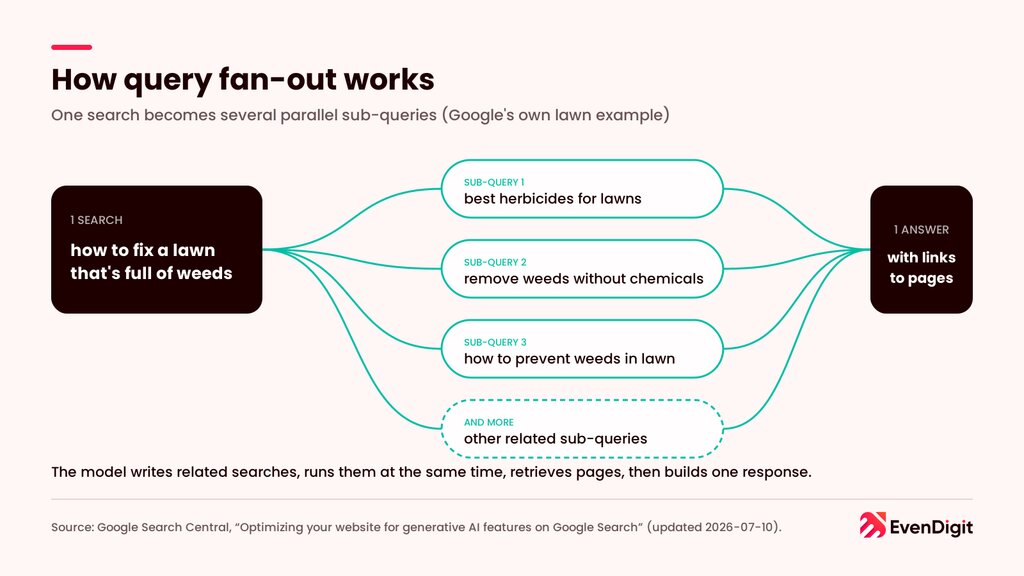
These searches run together, giving Google’s AI information from multiple sources to build one answer. It can then pull relevant information from pages that address any of these questions.
How Do AI Mode Sub-Queries Work?
Query fan-out follows five basic steps. The AI model first understands the user’s search, identifies related questions, and runs those searches simultaneously. Google then retrieves relevant pages for each query and uses the information to put together a single response.
- Someone enters a search in AI Mode or triggers an AI Overview.
- The model identifies the related information it needs to answer the question.
- It generates sub-queries across different topics and data sources.
- Google’s core ranking systems retrieve relevant pages from its index for each sub-query.
- The model reviews the retrieved information and builds a response with links to supporting pages.
Google refers to steps 4 and 5 as retrieval-augmented generation (RAG). In simple terms, the AI uses information from pages that Google has already retrieved and ranked to build its answer.
How Many Sub-Queries Does AI Create?
Google hasn’t published an official number. However, third-party studies offer some estimates. One set of findings puts the average at 10.7 fan-out queries per prompt for Gemini 3, 6.8 for Grok, 2.1 for ChatGPT, and 1.4 for Perplexity. Since these studies use different methods, treat the numbers as estimates rather than exact counts.
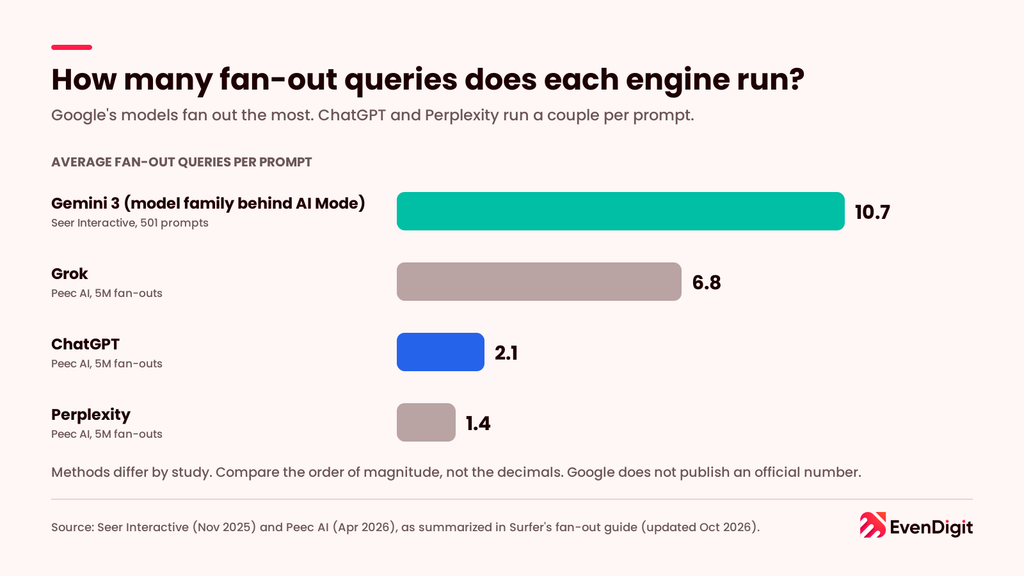
Two other findings are worth considering when optimizing content for fan-out queries:
- The number of sub-queries varies by AI engine. In AirOps’ study of 16,851 ChatGPT queries, 88.6% generated exactly two fan-out queries, 8.8% generated none, and 2.5% generated four or more.
- Individual sub-queries change from one run to another. In Surfer’s 1,600 test runs using Gemini grounding, only about 27% of fan-out queries appeared across multiple runs of the same prompt. Around 66% appeared just once.
- The broader topics are more consistent. About 90% of fan-outs fell into four or fewer topic clusters, and 84% shared at least one top-20 URL with the original query.
Key takeaway: Planning content around individual sub-queries isn’t practical. The topics and themes behind those queries, however, give you a more reliable starting point.
How Does Query Fan-Out Affect SEO and AI Visibility?
Query fan-out expands SEO and AI visibility opportunities beyond the primary keyword. Instead of competing only for one search query, your content can appear for multiple related questions that search engines and AI systems explore to build an answer.
It affects SEO and AI visibility in three ways:
- Expands keyword visibility: Your page can rank for related sub-queries, including specific questions that traditional keyword research tools may not capture because they have little or no measurable search volume.
- Creates more AI citation opportunities: AI systems can retrieve and cite your page when it answers a relevant sub-query, even if it doesn’t rank for the user’s original search query.
- Increases the importance of topic coverage: Content that addresses relevant supporting questions gives search engines and AI systems more information to draw from when answering different aspects of a topic.
Query fan-out makes content visibility less dependent on ranking for one primary keyword. Covering relevant sub-queries creates additional opportunities to rank in organic search and appear in AI-generated answers.
Does Covering Every Sub-Query on One Page Improve Citations?
No. Adding more sub-queries to a page doesn’t automatically improve its chances of getting cited. AirOps’ Fan-Out Effect study found that covering every sub-query increased citation rates by just 4.6 percentage points compared with covering none.
More interestingly, when query match was kept constant, pages covering 26-50% of sub-queries received citations 38.2% of the time. Pages covering all sub-queries had a lower citation rate of 34.0%.
Key takeaway: Ranking for related questions can improve visibility. Trying to squeeze every related question into one page doesn’t necessarily help.
How to Optimize for Query Fan-Out
To optimize content for query fan-out, identify the related questions behind your primary topic, group them by intent, and prioritize the ones your audience needs answered. Then structure your content so each question receives a clear answer, and create supporting pages for topics that deserve separate coverage.
Here are five steps to follow:
1. Identify related fan-out queries
Start with your primary topic and explore the related questions AI search platforms generate around it. Search the same topic across Google AI Mode, ChatGPT, Gemini, and Perplexity to find supporting questions, comparisons, and related subtopics.
Look for recurring questions across platforms and searches. These can reveal the information readers expect when exploring your topic.
2. Group queries by search intent
Once you have a list of related queries, group questions that serve the same purpose. For example, questions about a concept, its benefits, limitations, and practical applications may belong to the same topic cluster.
Also identify differences in intent. Someone asking what a concept means has a different need from someone comparing tools or looking for implementation advice. Grouping queries this way helps you decide what belongs together and prevents unrelated questions from making the article unfocused.
3. Prioritize the sub-queries worth answering
You don’t need to cover every fan-out query in your content. Prioritize questions that are closely related to your primary topic and help readers understand it or make a decision.
Consider:
- Relevance: Does the question directly support the article’s main topic?
- Audience value: Does answering it solve a real reader question or remove a point of confusion?
- Depth: Does it need a detailed explanation, or would a short answer be enough?
- Content overlap: Is the question already answered in another section or existing page?
This helps you stop adding questions just to increase keyword coverage.
4. Structure content for passage-level optimization
Organize your content into focused sections, with each section answering one main question or covering one subtopic. Use descriptive headings that reflect what readers are looking for, and provide a direct answer near the beginning of each section.
You can also use bullet points for key details, numbered steps for processes, and tables for comparisons. Keep explanations specific and include relevant examples, evidence, and sources where they help clarify the answer.
This makes individual sections easier for readers to navigate and gives AI search systems clearly organized information to retrieve.
5. Create supporting pages for distinct topics
Some fan-out queries may require more explanation than a section in your main article can provide. If a question has its own search intent and needs substantial coverage, consider creating a separate page for it.
For example, an article explaining AI agents may briefly cover AI agent security. But if readers also need detailed guidance on security risks, governance, and implementation, those topics may warrant a dedicated article.
Link supporting pages to the main article and to each other where relevant. This creates a connected topic cluster without forcing every related question into one page.
Final Thoughts
Understanding query fan-out is one part of improving your content’s visibility in AI search. The next step is identifying which related questions AI systems explore, whether your pages address them, and where better answers could improve your chances of being cited.
EvenDigit’s GEO and AEO team can help you assess this with our free AI visibility audit. We evaluate content against real buyer questions across ChatGPT, Google AI Overviews and AI Mode, Gemini, Perplexity, and Claude to identify coverage gaps and opportunities for improvement.
While no strategy can guarantee AI citations, this assessment gives you a practical starting point.
FAQs
Does Query Fan-Out Change Traditional SEO?
Query fan-out changes the range of searches a page needs to compete for, but it doesn’t replace the fundamentals of SEO. Google says its AI features still rely on core ranking and quality systems, so established SEO practices remain relevant. The available data also supports this: a page’s ranking position still plays a role in whether AI systems cite it.
Is Query Fan-Out the Same as Keyword Clustering?
No. Keyword clustering groups similar keywords before you create content. Query fan-out happens during a search, when an AI model generates several related sub-queries to answer one question. Topic clusters can help you plan your content, but they don’t tell you exactly which sub-queries Google will generate.
Do ChatGPT and Perplexity Use Query Fan-Out?
Yes, they use similar approaches. Google uses the term “query fan-out,” but ChatGPT, Perplexity, and Grok also run multiple searches for a single prompt. Peec AI measured an average of 2.1 queries per prompt for ChatGPT and 1.4 for Perplexity. However, most AI providers don’t share detailed information about how their search systems work.
Should I Create a Page for Every Fan-Out Query?
No. A separate page makes sense only when a sub-query has a distinct search intent and needs a more detailed answer. Only about 27% of fan-out queries repeat across multiple runs, and Google has warned that creating separate pages to manipulate AI responses can violate its scaled content abuse policy.
Does Covering Fan-Out Queries Guarantee My Page Will Be Cited?
No. Google clearly states that following its requirements and best practices doesn’t guarantee that a page will be crawled, indexed, or shown in search results. Surfer’s finding of 161% higher citation likelihood shows a correlation, not a guarantee. AirOps also found that ChatGPT didn’t cite 85% of the pages it retrieved.