Cookieless Marketing: How to Reach Customers Without Cookies
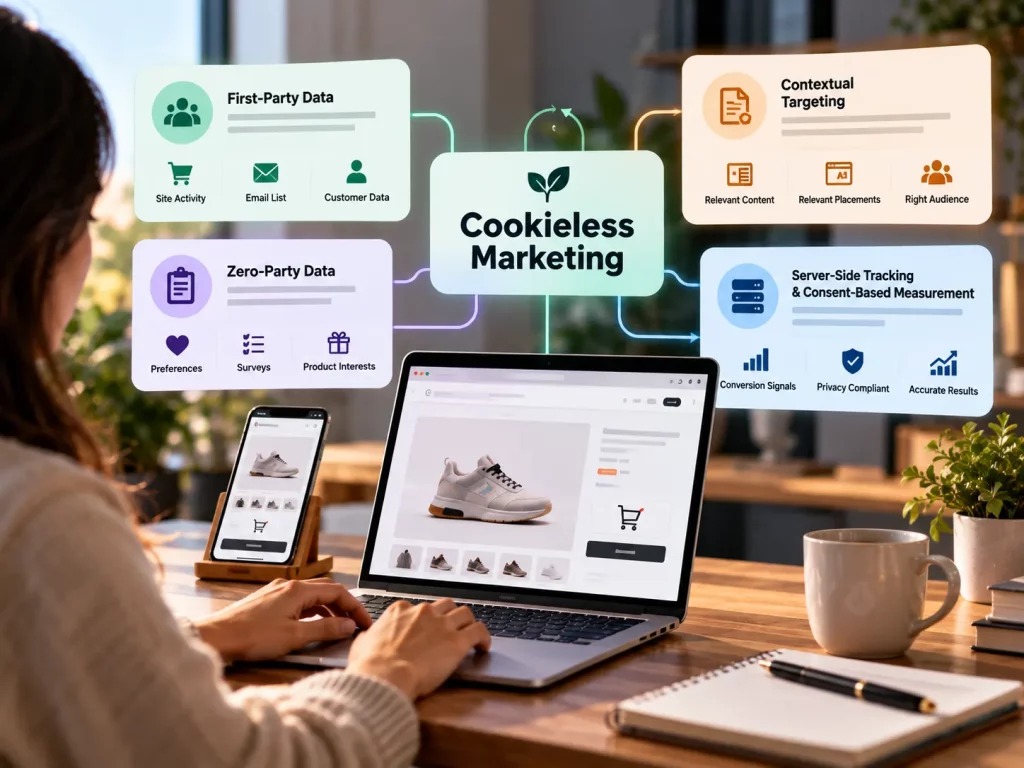
Cookieless marketing approaches such as first-party and zero-party data, server-side tracking, contextual advertising, and consent-based measurement help you reach customers easily. Instead of relying on third-party identifiers, your checkout, email list, customer data, and analytics setup become the base for your marketing.
Key Highlights
- Third-party cookie restrictions are already affecting tracking and audience targeting across browsers, making a cookieless approach relevant even without a Chrome phase-out deadline.
- Cookieless marketing combines first-party and zero-party data, contextual targeting, owned channels, and consent-based measurement rather than relying on a single replacement for cookies.
- Server-side tracking, Consent Mode, Meta Conversions API, and Google Enhanced Conversions can strengthen conversion signals when browser-based tracking is limited.
- Customer lists built from email, phone, and purchase data can support retargeting and retention without depending on third-party cookies.
- Cookieless measurement requires a shift toward modeled conversions, channel-level revenue, UTM tracking, and incrementality checks instead of relying on user-level attribution alone.
Why Are Third-Party Cookies Becoming Less Reliable?
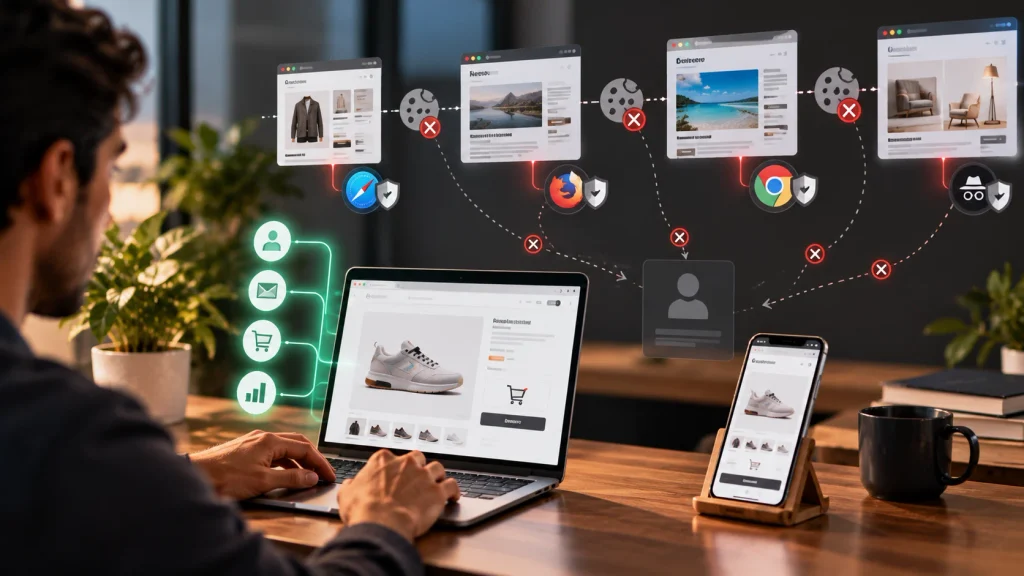
Safari, Firefox, and Brave have blocked third-party cookies by default for years. Chrome is different. In April 2025, Google confirmed that it would not force a full phase-out. Third-party cookies remain on by default in Chrome and are managed through existing browser settings.
That does not mean cookies are a safe long-term strategy. Google also retired most of its Privacy Sandbox APIs in October 2025, including Topics API, Protected Audience, and Attribution Reporting API. Google said low industry adoption was the reason.
So, in 2026:
- Chrome cookies are not disappearing on a fixed date.
- Most of Google’s planned cookie replacement tools are no longer available.
- Safari, Firefox, and Incognito users already limit third-party cookie tracking.
The practical takeaway is simple: do not wait for a cookie deprecation deadline. Start building a cookieless marketing strategy around data you own now.
How Can You Reach Customers Without Cookies?
You can use several cookieless marketing approaches to reach and retain customers without relying on third-party cookies:
- First-party data: What customers do on your site and at checkout.
- Zero-party data: What customers tell you directly and willingly.
- Contextual and owned channels: Reaching people through content and placements instead of tracking.
- Server-side tracking and consent-based measurement: Measuring results without relying on a browser cookie.
None of these fully replaces old-style cross-site retargeting on its own. Together, they cover most of what a typical ecommerce store needs.
Use First-Party Data to Reach and Retain Customers
First-party data is information you collect directly from your own store. This can include:
- Email address
- Phone number
- Purchase history
- Browsing behavior on your site
Practical steps for an ecommerce store
- Require email and phone at checkout. Phone numbers let you use SMS, which cookies never supported.
- Segment customers by purchase behavior. Someone who bought twice in 60 days is a different audience from someone who abandoned one cart.
- Upload your customer list to ad platforms. Use Google Customer Match or a Meta Custom Audience. This replaces cookie-based retargeting with list-based retargeting.
- Exclude existing customers from acquisition campaigns. Use the same customer list so you do not pay to acquire people who already bought.
For example, a mid-size apparel store can create a segment for customers who bought in the last 90 days but have not bought again. It can then target this group with a loyalty offer.
No pixel or cookie is needed. The store uses data it already owns.
Use Zero-Party Data to Understand Customer Preferences
Zero-party data is information customers choose to give you. It is not inferred or tracked. This can give you better insight into customer preferences than behavioral guesses.
Stores can collect zero-party data with simple methods:
- One-question post-purchase survey: Ask, “How did you hear about us?” or “What’s your main use case for this product?”
- Size or style quiz: Common in apparel and beauty. It can also work as a lead-capture form.
- Preference center: Let customers choose product categories they like or how often they want to hear from you.
Keep each touchpoint to one or two questions. Completion rates drop as forms get longer. A long form also makes this data source less useful.
Use Contextual Targeting and Owned Channels
Contextual advertising places ads based on page content, not a user’s history. For example, a kitchenware ad could appear on a recipe blog.
It does not require tracking, so cookie changes do not affect it. However, contextual targeting is less precise than behavioral targeting. It also cannot support retargeting on its own.
For most stores, owned channels are more important:
- Email and SMS use your own customer list and do not depend on cookies.
- Loyalty and rewards programs give customers a reason to stay connected to your store across visits.
- On-site content and SEO can attract customers without tracking them across the web.
- Retail media on Amazon, Walmart, and similar marketplaces uses the platform’s logged-in customer data. This makes it less affected by cookie restrictions. It can be useful as a supplement, but you are renting the audience and paying marketplace fees.
Retargeting without cookies still comes down to how well you use the data you already have.
How Does Cookieless Tracking Work?
Cookieless tracking captures events such as page views, purchases, and sign-ups on your own server.
Instead of using a third-party cookie set by the browser, the data is sent through your server. It can then reach your analytics and ad platforms.
This gives your tracking a path that cookie blocking cannot interrupt as easily.
If your store is still running on old Universal Analytics setups or a patchwork GA4 configuration, that’s worth fixing before layering on server-side tracking.
Where Do Server-Side Tracking and Consent Mode Fit?
Server-side tracking and Consent Mode solve different problems. Together, they help make cookieless measurement work.
Server-side tracking moves event processing from the customer’s browser to your own server. You can also use a server container in Google Tag Manager.
Shopify and most major platforms now support this natively. Because the event fires server-side, ad blockers, Safari’s Intelligent Tracking Prevention, and Chrome’s cookie settings do not affect it in the same way.
This helps make Meta and Google conversion data more reliable.
Consent Mode v2 controls how Google tags behave based on a visitor’s consent choice. It is effectively required if you run Google Ads and serve visitors in the EEA or UK.
Google has been restricting conversion tracking and remarketing for accounts without it since mid-2025. A further change in mid-2026 makes the ad_storage signal the sole gate for conversion tracking.
If a visitor declines consent, Consent Mode does not simply drop the data. It allows Google to statistically model missing conversions instead.
Pair server-side tracking with Consent Mode. Then add:
- Meta Conversions API
- Google Enhanced Conversions
Both send purchase events directly from your server to the ad platform. Most platforms now support one-click setup. This can be a 20–30 minute task rather than a development project.
How Do You Measure Marketing Performance Without Cookies?
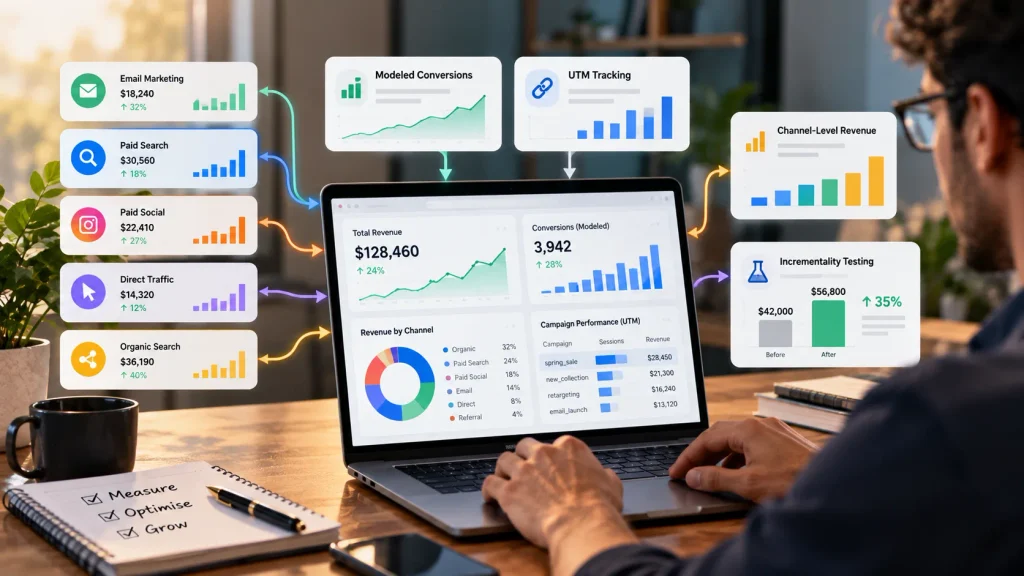
You should expect less precision than old-style last-click attribution provided. That precision is gone, and no tool fully restores it.
Instead, use cookieless measurement methods such as:
- Modeled conversions: Google and Meta estimate conversions that consent or tracking restrictions prevent them from observing directly.
- UTM and coupon-code tracking: These track the link or code used by the customer, not a browser identifier.
- Channel-level revenue tracking: Track revenue by channel instead of trying to map every step of one customer’s journey. For example, “email drove $12K this week” is more dependable than tracking every click from ad to email to purchase.
- Simple incrementality checks: Pause a channel for a week and see whether revenue changes. This can help you check whether modeled numbers match actual business results.
What Should Store Owners Do First?
Prioritize changes that deliver the greatest impact with the least effort when building a cookieless marketing strategy:
- Turn on server-side tracking. Shopify supports it natively; other platforms can use a GTM server container.
- Set up Consent Mode v2 if you serve EEA or UK traffic and run Google Ads.
- Install Meta Conversions API and Google Enhanced Conversions.
- Make phone number collection required at checkout.
- Upload your customer list to Customer Match or Custom Audiences for retargeting.
- Add one zero-party data question at a natural point, such as post-purchase or signup.
- Gradually move retargeting budget from cookie-based prospecting to list-based audiences and email/SMS.
Conclusion
Cookieless marketing changes how ecommerce teams think about customer journeys, but it does not require rebuilding every part of their marketing stack at once.
The practical path is to identify where visibility is weakest, close the most important data gaps, and then adapt targeting and measurement as needed. Teams that treat privacy changes as an ongoing measurement challenge can make better decisions without depending on a single tracking technology.
FAQs
Is cookieless tracking as accurate as cookie-based tracking?
No. Cookieless tracking can work well for aggregate and channel-level performance, but individual and cross-device tracking loses precision. Server-side tracking and Consent Mode can reduce that gap, but they do not remove it completely.
Do I still need Google Analytics if third-party cookies are blocked?
Yes. GA4 uses first-party cookies and consent-based modeling rather than third-party cookies. It still works for most visitors, but Consent Mode needs to be configured correctly to model missing data.
What’s the difference between first-party and zero-party data?
First-party data is what you observe from customer activity, such as purchases and site behavior. Zero-party data is what customers tell you directly and voluntarily, such as preferences and survey answers. Both come from your own relationship with the customer rather than a third party.
Do small ecommerce stores need a customer data platform (CDP)?
Not usually. A CDP becomes more useful when you combine data from many systems at scale. Most single-storefront businesses can get more value faster from clean checkout data capture and a well-configured email and SMS platform.
Does contextual advertising work without any first-party data?
Yes. Contextual advertising can work without first-party data, but it cannot retarget or personalize on its own. It works best when paired with first-party audiences for retention. Contextual placements can then focus on reaching new customers.