
What Is Agentic Commerce? What Merchants Need to Know

TL;DR
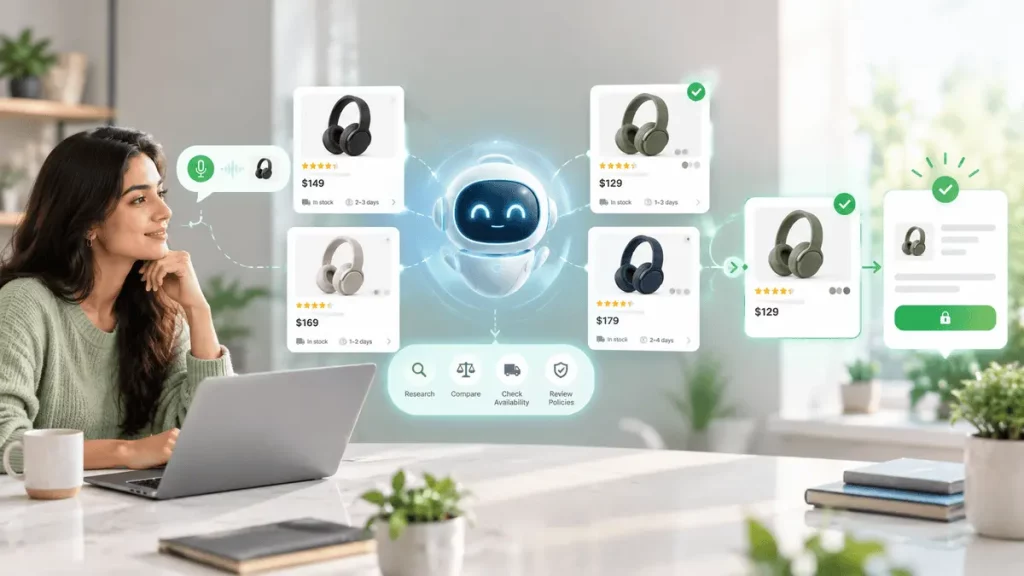
Agentic commerce is shopping carried out by AI agents instead of people. An agent takes a shopper’s goal, researches products across merchants, compares options, and can complete the purchase with the shopper’s approval.
Key Takeaways
- Clean up your product data so AI shopping agents can accurately understand your products, pricing, availability, and policies.
- Keep inventory and feeds in sync across your website, marketplaces, and commerce platforms to avoid outdated product information.
- Strengthen your AI visibility by making your products easier for AI systems to discover, understand, and evaluate.
- Prepare your checkout and policies for AI-assisted purchases and emerging agentic commerce standards.
- Build stronger trust signals through reviews, independent mentions, and consistent product information across the web.
What Is Agentic Commerce?
Agentic commerce is online shopping where an AI agent researches, compares, and completes a purchase for a shopper, often with almost no manual input from the person. Instead of browsing a site, filtering results, and clicking “buy,” the shopper just tells an AI agent what they want. The agent does the rest.
It checks product data across merchants. It weighs the options against what the shopper asked for. Then it either recommends a choice or completes the purchase outright.
This is a real step up from a chatbot or a recommendation engine. A chatbot answers questions. A recommendation engine suggests things based on shopper’s browsing history. An agent actually shops. It figures out what they want, checks real product data against that, and can pull the trigger on the purchase.
Here’s why this matters to merchants:
Agents don’t scroll your homepage or browse your category pages the way a person does. They read data such as price, availability, specs, shipping time, return policy. If that data is missing or inconsistent, your product is invisible to an agent. It doesn’t matter how good the product actually is.
Shopify’s own Q1 2026 platform data shows AI-referred traffic to its merchants growing more than 8x year-over-year, with AI-referred orders up nearly 13x and those orders carrying a 14% higher average order value than orders from organic search.
Adobe found an even sharper shift: AI-referred traffic converted 38% worse than other traffic in March 2025, but by March 2026, it was converting 42% better, as compiled from Adobe Digital Insights data.
For ecommerce brands, that’s the real headline. Agentic commerce traffic doesn’t just exist, it can also bring stronger purchase intent as AI-driven shopping develops.
Agentic Commerce vs. Traditional Commerce vs. Conversational Commerce
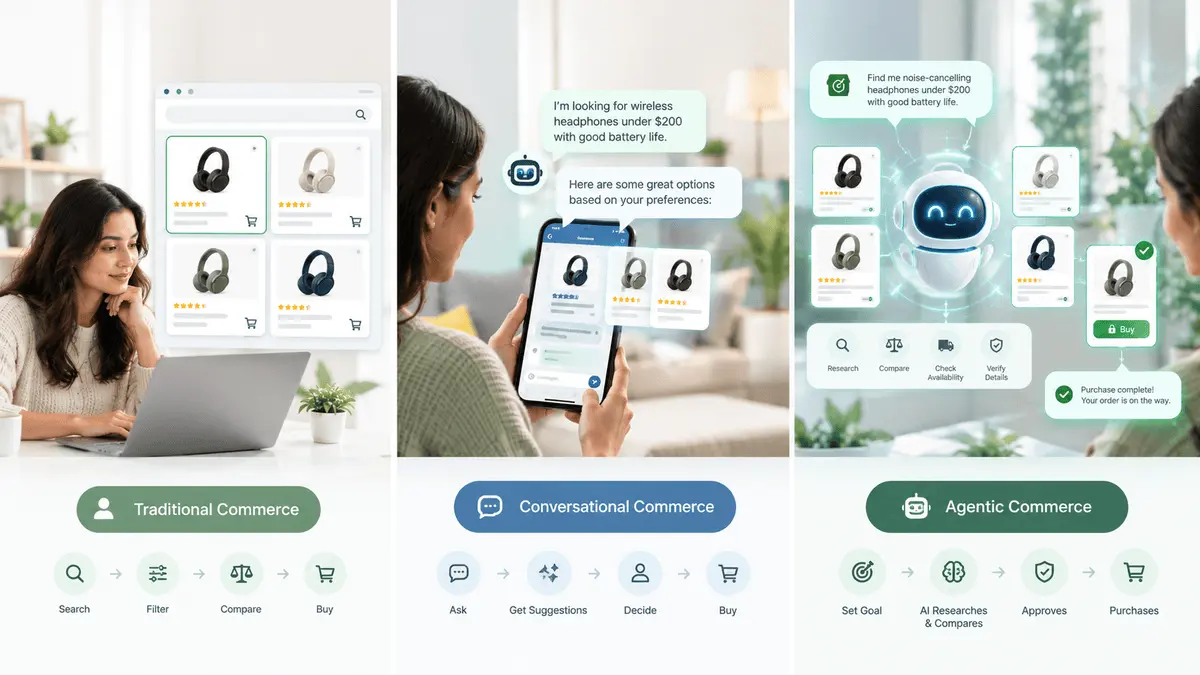
Agentic commerce differs from traditional ecommerce in who does the work. It differs from conversational commerce in who makes the final call.
- Traditional commerce: a person browses and decides, start to finish.
- Conversational commerce: an AI layer helps that person along, but the person still has to act.
- Agentic commerce: the AI both decides and acts. The person approves, but doesn’t perform each step themselves.
How Is Agentic Commerce Different From Traditional Ecommerce?
In traditional ecommerce, a person searches, filters, compares, and checks out themselves, guided by what they see on your website. In agentic commerce, an AI agent does those same steps on the shopper’s behalf, working from your structured product data, not from what your site looks like.
You’re no longer just designing for humans. You’re also feeding data to a system that shops without ever “seeing” your page.
What’s the Difference Between Agentic and Conversational Commerce?
Conversational commerce helps shoppers decide. Agentic commerce can decide and act for them.
Conversational commerce happens through a chat interface. A customer asks a chatbot for help, gets recommendations, but still has to look them over and click to buy. The human is still the one deciding.
Agentic commerce goes further. The agent can evaluate the options and complete the purchase itself, once the shopper sets the goal and approves the final step.
| Traditional Commerce | Conversational Commerce | Agentic Commerce | |
| Who decides | The shopper | The shopper, with AI suggestions | The AI agent, within shopper-set limits |
| Who executes the purchase | The shopper | The shopper | The AI agent (with shopper approval) |
| Example | Browsing a category page and checking out | Asking a chatbot for product recommendations | An AI agent finding, comparing, and buying a product autonomously |
Getting your product data ready for this kind of evaluation is largely the same work as structuring your Shopify catalog for AI answer engines. Schema, feed accuracy, and clear specs do double duty for both AI answers and agent-driven shopping.
How Does Agentic Commerce Work?
Agentic commerce connects a shopper’s intent with product and commerce systems that an AI agent can interpret and act on. The agent takes the shopper’s requirements, evaluates available options, and uses commerce infrastructure to move toward a purchase.
Imagine a shopper saying:
“Find me a waterproof women’s hiking jacket under $200 that can arrive before Friday.”
An agent could interpret:
- product category
- gender
- use case
- waterproof requirement
- price limit
- delivery deadline
It can then evaluate products against those constraints instead of simply matching the words in the query.
For merchants, this makes accurate commerce data increasingly important. Google’s agentic commerce infrastructure includes merchant data attributes and the Universal Commerce Protocol designed to help AI systems interact with commerce services.
Types of Agentic Commerce Protocols:
- MCP (Model Context Protocol): connects agents to product and catalog data.
- ACP (Agentic Commerce Protocol): standardizes checkout and payment, co-developed by OpenAI and Stripe.
- UCP (Universal Commerce Protocol): covers the full shopping lifecycle, from discovery to checkout.
What Are the Different Types of Agentic Commerce?
Agentic commerce today splits into three main types: AI shopping agents, on-site merchant agents, and checkout agents. Most merchants will end up dealing with all three at once, and each one asks something slightly different of your product data.
1.AI shopping agents
AI shopping agents help buyers find the products they want. A shopper describes what they want, and the agent searches across brands and merchants, compares options on price, availability, and reviews, then either recommends a match or completes the purchase outright if it’s been given permission.
Examples: ChatGPT’s shopping features, Perplexity’s “Buy with Pro,” Google Gemini, and Amazon’s Alexa+.
2.On-site merchant agents
Merchant agents live inside your own website or app rather than out in the open web. Unlike a consumer shopping agent, this type doesn’t compare you against competitors. It works entirely within your own store to help a visitor, human or automated, find the right product faster. This is the type most merchants already have some exposure to, even if they haven’t thought of it as “agentic” before.
Examples: AI-powered site search tools, guided-selling chat widgets, and personalization engines that adjust what a shopper sees based on what they’ve said they want.
3.Checkout and payment agents
Checkout and payment agents complete the purchase itself, without the shopper ever leaving the chat interface they’re already in. The clearest example today is ChatGPT’s “Buy it in ChatGPT” checkout, built on the Agentic Commerce Protocol with Stripe, which lets a shopper complete a purchase from a participating merchant without opening a browser tab.
This is the newest and least common type of agentic commerce right now. It is also closely tied to emerging autonomous checkout and commerce protocol standards, so it’s worth watching even if it isn’t urgent for your store yet.
What Does Agentic Ecommerce Mean for Shopify and Other Merchants?
Agentic commerce shifts part of the competition from winning a shopper’s attention to winning an algorithm’s evaluation. That’s real upside if your data and operations are clean and real exposure if they’re not.
Benefits
- A new discovery channel. Agents surface products outside your existing search, social, and paid channels, reaching shoppers who’d never have found you through a browser search.
- More purchase-ready traffic. Shoppers who arrive through an agent usually come in with a clear goal already narrowed down. Less browsing, shorter path to conversion.
- Easier repeat purchases. Agents are a natural fit for replenishment categories such as skincare, pet food, household goods, where an agent can reorder without the shopper starting from scratch each time.
- Operational strength finally gets rewarded. Accurate inventory, honest availability, and clear policies matter more than brand recognition when an agent is comparing options on data alone.
Challenges
- You lose visibility into the buying journey. When an agent handles research and comparison, you lose the on-site behavioral data that currently drives your marketing decisions.
- Less control over how your product is presented. The agent decides what to surface and how to describe it. Your merchandising, photography, and on-site storytelling don’t carry the same weight they do for a human visitor.
- Attribution gets murkier. Knowing which sale came from which channel is harder when an agent completes the purchase instead of a tracked click path.
- Your data needs constant upkeep. Feeds, specs, and pricing have to stay accurate in real time. An agent checking stale data won’t come back later, it’ll just skip the product.
Risks
- Margin pressure. If agents optimize purely on price and spec match, you can get pulled into a race to the bottom in categories where you used to compete on more than price.
- New fraud exposure. Automated purchasing at scale opens the door to account takeover and impersonation risks that your current fraud rules weren’t built to catch.
- Spending too early. Most product categories are still in the early stages of agent adoption. Building deep protocol integrations before shopper demand justifies it is a real risk.
How Should Merchants Prepare for Agentic Commerce?
Start with your product data, your inventory accuracy, and your checkout in that order. Those three things determine whether an AI agent can even evaluate your products, before anything else matters.
Here’s exactly what to do.
1. Fix your product descriptions first.
Go through your top-selling products and make sure every one has a complete, accurate description: price, size, materials, what’s included, and shipping time.
Keep that information exactly the same across your website, your Shopify feed, and any marketplace listings you use. If your website says one thing and your feed says another, an AI agent has no way to know which one to trust, so it’ll often skip you.
How to do it: Pick your top 50–100 products by sales volume and audit them first. Don’t try to fix your entire catalog at once, start where the revenue is.
2. Make sure your inventory numbers are always right.
If your site shows something in stock and it isn’t, an AI agent won’t wait around or follow up later. It’ll just move on to a competitor’s product instead.
How to do it: Turn on real-time inventory sync between your store and any apps, marketplaces, or sales channels you use, so stock counts update the moment something sells. Most ecommerce platforms have a setting for this. It’s usually a configuration fix, not a rebuild.
3. Make your products understandable to a computer, not just a person.
This sounds technical, but the idea is simple: fill out a detailed, structured “spec sheet” behind the scenes for every product, so a machine reading your site knows exactly what it is without guessing.
Think of it as labeling, not redesigning.
How to do it: Most Shopify apps can add this for you once your product data is clean, or a developer can set it up in a day or two.
4. Strip unnecessary steps out of checkout.
A complicated checkout hurts you with human shoppers and agent-led purchases alike.
How to do it: Walk through your own checkout flow and count the steps. Cut anything that isn’t essential: extra form fields, forced account creation, hidden shipping costs that surprise people at the last step. For more specific fixes, implement Shopify CRO best practices.
5. Put your policies where they’re easy to find and easy to read.
Returns, shipping timelines, warranty terms, state them plainly on your site, not buried in a PDF or locked behind a support ticket.
How to do it: Add a short, plain-language policy summary directly on product pages, not just in a separate footer link.
6. Get more reviews and outside mentions.
AI models weigh what other people say about your brand more heavily than what you say about yourself.
How to do it: Ask recent customers for reviews after delivery, and keep an eye on where your brand gets mentioned outside your own site: forums, comparison articles, Reddit threads. Those show up in how AI models judge your trustworthiness.
How EvenDigit Can Help Merchants Prepare for Agentic Commerce
EvenDigit helps ecommerce brands prepare for AI-driven product discovery and agentic commerce by making their stores easier for both people and AI systems to understand, evaluate, and act on.
- AI Engine Optimization (AIEO): We make your product and website information easier for AI systems to understand, connect, and surface when shoppers are looking for what you sell.
- Feed & API Management: We help keep product data such as pricing, availability, specifications, and inventory accurate and consistent across the channels AI shopping agents rely on.
- Reputation Management: We strengthen the independent signals that can shape how AI systems understand your brand, including reviews, industry mentions, and relevant third-party content.
- Agentic Commerce Readiness: We assess your ecommerce setup against emerging AI commerce standards and protocols, helping identify where your store may need better data, feeds, checkout, or infrastructure.
- AI Visibility & Analytics: We track how your brand and products appear across AI search and answer experiences, giving you a clearer view of where you are being discovered, where competitors are appearing instead, and where there are gaps to address.
Not sure where your store stands? We can assess your product data, website, AI visibility, and commerce setup to identify what needs attention first. Get in touch with us.
FAQs
Is agentic commerce the same as an AI shopping agent?
No. An AI shopping agent can do the research and purchase. Agentic commerce is the broader shopping model that tool enables, covering the shift from human-led browsing to agent-led discovery and purchase.
How do AI agents decide which products to recommend?
Agents weigh structured data against the shopper’s stated goal: price, availability, specs, and trust signals like reviews. Brand recognition and ad spend carry far less weight than they do with human shoppers, since the agent is evaluating data, not impressions.
How do ecommerce conversion rates change when AI agents shop for customers?
There is no single conversion-rate outcome for agentic commerce yet because adoption and implementation vary, but early AI-referred traffic data suggests that shoppers arriving through AI can show stronger purchase intent than some traditional traffic sources.
For example, Shopify reported that AI-referred sessions converted at nearly 50% higher rates than organic search sessions in its Q1 2026 commerce data. Shopify also reported that AI-referred orders grew nearly 13 times year over year during that period.
Will customers still visit ecommerce websites?
Not necessarily. Some purchases may happen with less direct website interaction, but shoppers will continue to use merchant websites for product information, trust signals, customer service and transactions depending on the shopping journey.