
Predictive Analytics for eCommerce: How Storeowners Can Forecast Sales & Churn
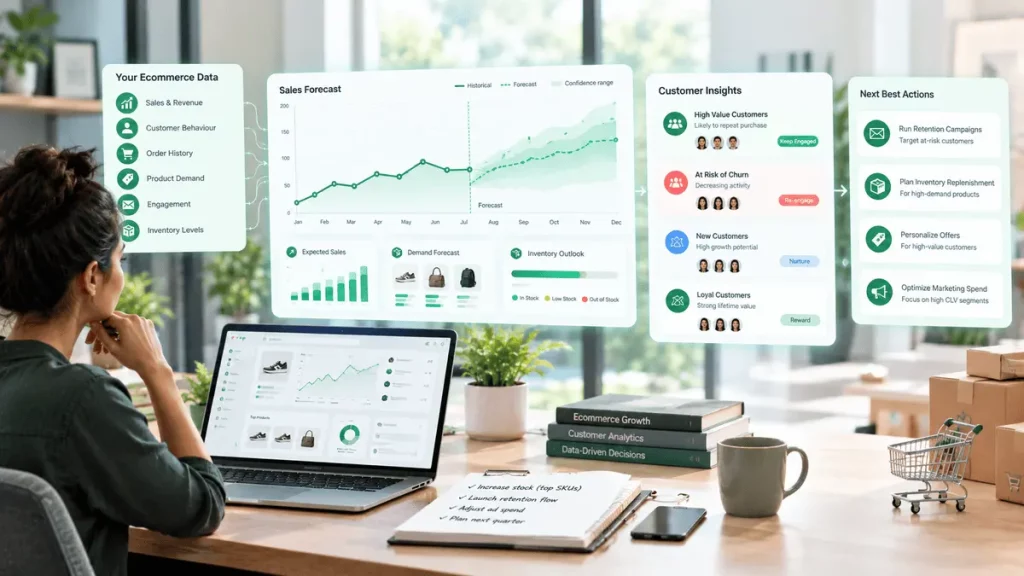
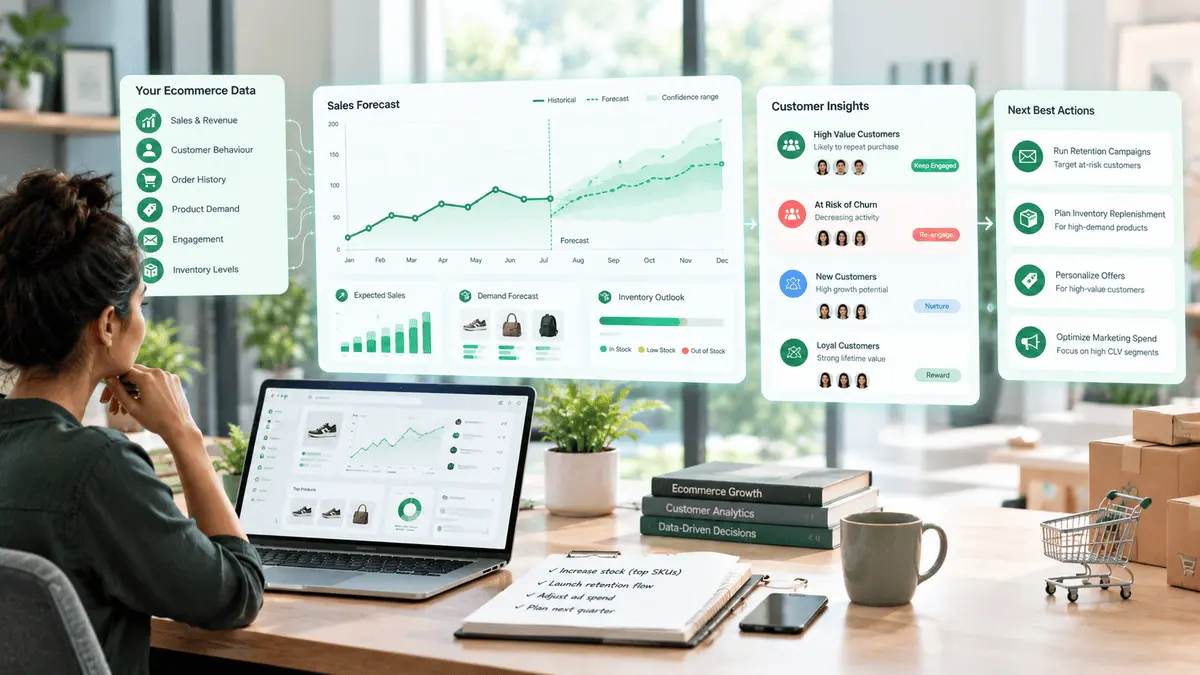
Predictive analytics helps ecommerce store owners use past sales and customer behaviour to estimate what is likely to happen next, from future demand and repeat purchases to customer churn. The goal isn’t to predict every sale or customer perfectly, but to spot patterns early enough to make better inventory, marketing, and retention decisions.
Key Takeaways
- Predictive analytics uses historical sales, customer, and behavioural data to estimate what is likely to happen next.
- Ecommerce stores can use predictive models for demand forecasting, churn risk, CLV, next-purchase timing, and product affinity.
- Prediction quality depends on factors such as data volume, purchase frequency, seasonality, product lifecycle, and data quality.
- The business value comes from connecting predictions to actions, such as replenishment campaigns, retention flows, inventory planning, and customer acquisition.
- Shopify provides reporting, insights, and some predictive inventory capabilities, while platforms such as Klaviyo and dedicated inventory tools offer more specialized predictive features.
What Does Predictive Analytics Mean for Ecommerce Stores?
Predictive analytics turns historical customer, sales, and behavioural data into estimates of what is likely to happen next, helping ecommerce stores make decisions before a problem or opportunity becomes obvious.
In ecommerce, predictive analytics uses statistical models, machine learning, and historical customer behaviour to estimate future outcomes. Instead of focusing only on descriptive questions such as “What was our revenue last month?”, predictive analytics helps answer questions such as:
- Which customers are likely to buy again or become inactive?
- How much demand can we expect for a product or category?
- Which customers are likely to generate higher long-term value?
- When might an existing customer make their next purchase?
These predictions are probabilities, not guarantees. Their usefulness depends on the quality and amount of data available, how predictable the underlying buying behaviour is, and how quickly the business changes.
What Can Predictive Analytics Help an Ecommerce Store Predict?
Predictive analytics helps ecommerce stores estimate future customer behaviour, product demand, and marketing outcomes so teams can act before the underlying trend becomes obvious.
Modern ecommerce customer data analytics can support several types of predictions:
Customer Predictions
- Customer Churn: Identifies customers whose recent behaviour suggests they may be less likely to purchase again.
- Customer Lifetime Value (CLV): Estimates the future revenue or value a customer or customer cohort may generate over a defined period.
- Next Purchase: Estimates when a customer is likely to place their next order based on their previous purchasing behaviour.
- Product Affinity: Estimates which products or categories a customer may be more likely to purchase based on previous interactions and transactions.
Demand Predictions
- Demand Forecasting: Estimates future product or SKU demand using historical sales, seasonality, trends, and other relevant variables.
- Stockout Risk: Helps identify products that may run out of inventory based on expected demand and current stock levels.
Marketing Predictions
- Discount Sensitivity: Helps identify customers who may need an incentive to convert versus those who are likely to purchase without one.
- Acquisition Value: Helps estimate which customer segments may generate greater long-term value, rather than evaluating acquisition only on the first order.
What Are the Benefits of Predictive Analytics for Ecommerce Stores?
Predictive analytics can help ecommerce teams move from reacting to past performance to making decisions based on expected demand, customer behaviour, and future value.
| Business Pillar | Traditional Reactive Strategy | Predictive Proactive Strategy |
| Inventory Management | Ordering based mainly on historical sales. | Adjusting inventory plans using expected demand, sales velocity, seasonality, and supplier lead times. |
| Customer Retention | Sending win-back campaigns after a fixed period of inactivity. | Identifying customers whose behaviour is moving outside their normal purchase pattern and testing earlier interventions. |
| Marketing Spend | Evaluating customers primarily on first-order revenue or short-term ROAS. | Using predicted customer value to inform audience segmentation and acquisition decisions. |
| Cash Flow & Planning | Setting revenue targets using historical growth rates. | Building forecasts using expected sales, repeat purchases, seasonality, and promotional activity. |
The benefit isn’t the prediction itself. It comes from using the prediction to make a better-timed business decision.
Where to Use Predictive Analytics in Ecommerce?
Predictive analytics can support ecommerce marketing, customer retention, inventory planning, and on-site personalization when predictions are connected to clear business actions.
- Retention & Email/SMS Marketing: Use predicted next-purchase timing or churn risk to determine when a customer may need a replenishment reminder or re-engagement message.
- Paid Customer Acquisition: Use predicted customer value to identify high-value customer segments and inform acquisition targeting, bidding, and audience development.
- Supply Chain & Operations: Combine expected demand with current inventory and supplier lead times to identify potential stock shortages and improve replenishment planning.
- On-Site Personalization: Use predicted product affinity to tailor recommendations, cross-sells, upsells, or product collections to individual shoppers.
How Can Predictive Analytics Help Forecast Ecommerce Sales?
Predictive sales models combine historical sales, customer purchasing patterns, seasonality, promotions, and other relevant variables to estimate future revenue and product demand.
Standard spreadsheets often rely on fixed growth assumptions, such as applying last year’s growth rate to this year’s sales. Predictive forecasting can incorporate changing purchase behaviour and multiple variables instead.
Common inputs include:
- Baseline Purchase Velocity: Recent sales velocity by product, category, or SKU.
- Cohort Repurchase Rates: How frequently existing customer groups return and purchase again.
- Seasonality & Trends: Recurring demand patterns, holidays, seasonal shifts, and relevant market trends.
- Promotional Impact: Expected changes in demand associated with planned discounts, launches, campaigns, or other promotions.
The resulting forecast is an estimate, not a guaranteed sales figure. Its usefulness depends on how closely future conditions resemble the patterns represented in the underlying data.
How Accurate Are Ecommerce Sales Forecasts?
There is no universal accuracy rate for ecommerce sales forecasts. Forecast quality varies by product, sales volume, forecast horizon, data quality, and how much future conditions differ from historical patterns.
Several factors influence forecast accuracy:
- Data Volume: More historical transactions generally provide more behavioural patterns for a model to learn from, although volume alone does not guarantee an accurate forecast.
- Purchase Frequency: Products with frequent, relatively consistent purchases are generally easier to forecast than products with irregular demand.
- Seasonality: Longer historical datasets can help models identify recurring seasonal patterns, particularly when a business has several years of comparable data.
- External Disruptions: Supply chain delays, unexpected demand spikes, major pricing changes, viral trends, or advertising changes can cause actual results to differ substantially from forecasts.
- Catalog Stability: Established products with relatively consistent sales histories can be easier to forecast than new products, limited-edition launches, or rapidly changing catalogs.
For this reason, ecommerce teams should evaluate forecasts against actual results over time rather than treating a single accuracy percentage as a guarantee.
How Can Predictive Analytics Help Predict Customer Churn?
Predictive churn models identify customers whose purchasing behaviour is changing in ways that may indicate a higher risk of becoming inactive.
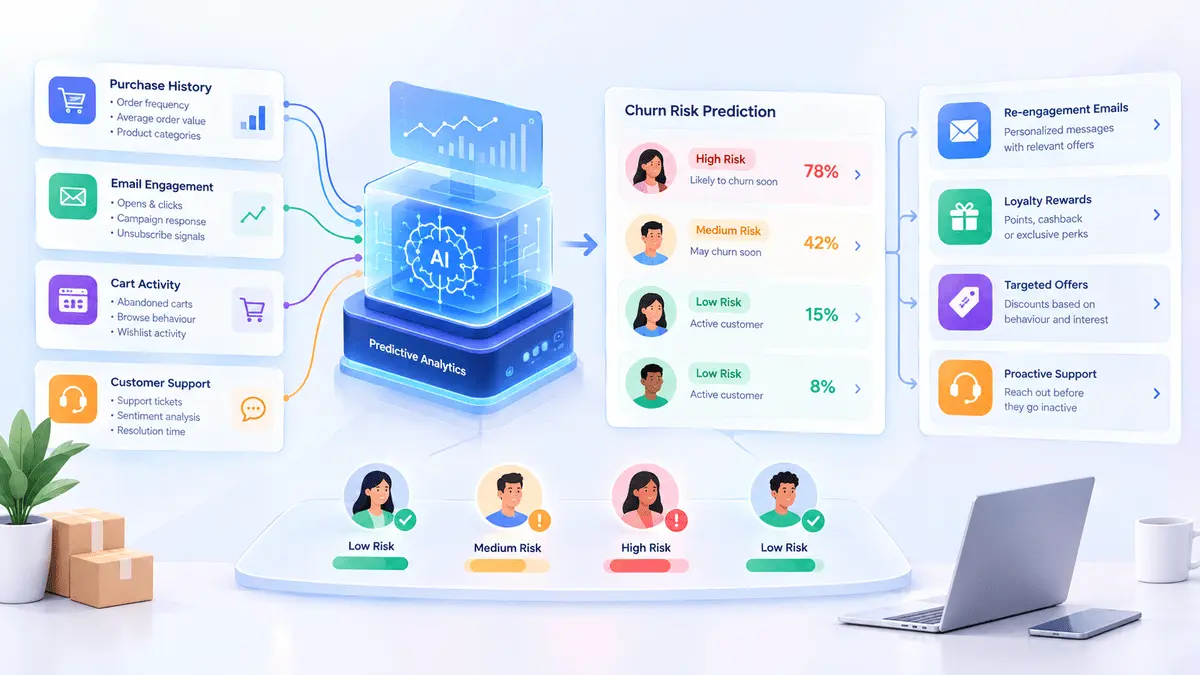
Traditional retention often relies on fixed rules, such as “mark a customer inactive after 90 days without an order.” Predictive churn analysis instead considers each customer’s historical behaviour and purchase frequency.
For example:
- Frequent Buyer: A customer who normally orders every 15 days may warrant attention if 25 days pass without a purchase.
- Seasonal Buyer: A customer who typically purchases once a year should not automatically be treated as inactive after 90 days.
This approach helps stores distinguish between customers who are naturally between purchases and those whose behaviour has meaningfully changed.
The prediction should be treated as a risk signal rather than proof that a customer will churn. Stores can then test whether earlier, more relevant interventions improve retention without unnecessarily discounting customers who would have purchased anyway.
What Customer Signals Can Indicate Churn Risk?
Changes in purchase behaviour, engagement, and customer interactions can provide signals that a customer may be becoming less likely to purchase again.
Common signals include:
- Declining Email/SMS Engagement: Fewer clicks, ignored messages, or reduced interaction with relevant campaigns.
- Stretching Purchase Cycles: The time between purchases becomes longer than the customer’s normal buying pattern.
- Decreasing Order Value: Orders become smaller or customers stop purchasing products they previously bought regularly.
- Support Friction: Repeated returns, unresolved service issues, or negative feedback may affect future purchasing behaviour.
- Reduced Site Engagement: Fewer product views, sessions, or cart interactions can provide additional context when combined with other signals.
No single signal proves that a customer will churn. Predictive models are more useful when they evaluate multiple signals together and compare them with the customer’s historical behaviour.
What Data Does Ecommerce Predictive Analytics Require?
Predictive analytics works best when models have enough clean historical data to identify meaningful patterns in customer behaviour, sales, and product demand.
Sales and Customer Data Requirements
- Complete transaction records, including order dates, SKUs, quantities, discounts, and order values.
- Customer purchase frequency and historical order patterns.
- Customer attributes such as geographic region and acquisition source, where relevant to the prediction.
- Product and category information that allows demand to be analysed at the appropriate level.
Behavioral Data Requirements
- On-site activity such as product and collection views.
- Shopping cart actions, including adds, removals, and checkout activity.
- Email, SMS, and other marketing interactions.
- Relevant customer service, return, and subscription data where available.
The exact data requirements depend on the prediction being made. A demand forecast may rely heavily on SKU-level sales and inventory data, while a churn model may need customer purchase history and engagement signals.
How Much Historical Data Does an Ecommerce Store Need?
There is no universal minimum number of orders or months of data required for every ecommerce predictive model. The amount needed depends on the prediction, purchase frequency, data quality, and complexity of the store’s sales patterns.
As a general principle:
- New or low-volume stores: Focus first on collecting consistent, clean transaction and behavioural data. Basic trends and segmentation may be more useful than complex predictions.
- Growing stores: Increasing order volume and customer history can provide stronger behavioural patterns for CLV, churn, and demand models.
- Established stores: Longer historical datasets can help models account for seasonality, repeat-purchase patterns, and changes across customer cohorts.
Some predictive platforms have their own eligibility requirements. For example, Klaviyo’s predictive analytics features require specific amounts of customer and order history, including at least 500 customers who have placed an order and 180 days of order history, along with additional criteria. This is a platform-specific requirement, not a universal ecommerce threshold.
For businesses with seasonal demand, 12 or more months of comparable data can also provide useful context because it allows the model to identify recurring annual patterns. More history isn’t automatically better, however, if the business, product mix, pricing, or customer base has changed significantly.
Does Shopify Have Predictive Analytics?
Shopify provides historical reporting, analytics insights, and some predictive inventory-related capabilities, but merchants may need specialized tools for deeper customer-level predictions such as predicted CLV or churn risk.
Native Shopify Analytics can help merchants understand metrics such as:
- Sales and revenue
- Average order value
- Conversion rates
- Product performance
- Customer behaviour
- Inventory performance
Shopify also provides inventory insights that can use recent sales rates to estimate metrics such as days of inventory remaining.
For more specialized predictions, Shopify merchants can connect tools that model customer lifetime value, churn risk, next-purchase behaviour, or detailed demand forecasts.
What Other Tools Can Shopify Stores Use for Predictive Analytics?
Shopify brands can combine their ecommerce platform with specialized customer analytics, marketing, and inventory forecasting tools depending on the type of prediction they need.
- Klaviyo: Provides predictive analytics such as predicted CLV, churn risk, and expected next-purchase timing for eligible customer profiles.
- Triple Whale: Provides ecommerce analytics and customer value insights that can help merchants evaluate acquisition and retention performance.
- Lifetimely: Focuses on customer lifetime value, cohort analysis, and retention insights.
- Inventory Planner: Uses sales history, inventory levels, and supply information to support demand forecasting and replenishment planning.
These tools serve different purposes, so merchants should choose based on the business decision they need to improve rather than simply adding more analytics platforms to their stack.
How Can Ecommerce Stores Read and Act on Predictive Data?
Store owners should focus on predictive metrics that connect directly to a business decision, rather than tracking predictions simply because a platform makes them available.
Essential Metrics to Monitor
- Predicted Customer Lifetime Value: Estimates the future value of customers or customer cohorts over a defined period.
- Churn Risk: Identifies customers whose behaviour indicates a higher likelihood of becoming inactive.
- Expected Next Purchase: Estimates when customers may be ready to purchase again.
- Forecasted vs. Actual Demand: Compares predicted product demand with actual sales to evaluate and refine the forecasting process.
The key is to evaluate predictions against outcomes. A churn score is useful only if the resulting retention action changes customer behaviour, and a demand forecast is useful only if it helps improve inventory decisions.
How Can Stores Turn Predictions Into Sales and Retention Actions?
Predictive data becomes commercially useful when stores connect it to specific actions, measure the results, and refine those actions based on what actually happens.
- Automate Replenishment Flows: Use predicted purchase windows to time email or SMS reminders around when customers are likely to need a product again. Test the timing rather than assuming one fixed interval works for everyone.
- Launch Proactive Retention Campaigns: Create customer segments based on elevated churn risk and test relevant interventions before customers become fully inactive.
- Build High-Value Acquisition Audiences: Use customers with higher predicted long-term value to inform audience development and acquisition campaigns, while measuring whether the resulting customers actually deliver higher value.
- Prevent Potential Stockouts: Combine predicted demand with current inventory and supplier lead times to identify products that may need replenishment sooner.
This prevents predictive analytics from becoming another dashboard that generates insights without changing what the business does.
What Can Make Ecommerce Predictions Wrong?
Predictive models learn from patterns in historical data, so forecasts can become less reliable when future conditions differ significantly from the past.
Common causes include:
- New Products: Products without meaningful sales history have limited data for demand forecasting.
- Sudden Demand Spikes: Viral content, unexpected trends, or major media exposure can create demand that historical patterns cannot anticipate.
- Promotional Changes: A major discount or campaign can change purchasing behaviour compared with normal sales periods.
- Stockouts: Historical sales may underestimate true demand if products were unavailable for part of the period being analysed.
- Pricing Changes: Significant price increases or reductions can alter conversion and purchase frequency.
- Customer Mix Changes: Rapid changes in acquisition channels, geography, or target audiences can make older customer behaviour less representative.
- Supply Disruptions: Supplier delays or availability issues can cause actual sales to diverge from demand forecasts.
For this reason, predictive analytics should support merchant decision-making rather than replace it. Forecasts work best as an input into planning, with actual performance used to continuously test and refine the model.
How Can EvenDigit Help?
EvenDigit helps Shopify brands connect ecommerce data, predictive tools, and marketing workflows so they can turn customer and sales signals into measurable actions.
Implementing predictive analytics isn’t simply about adding another analytics platform. Stores need accurate tracking, the right integrations, useful customer segments, and workflows that act on the resulting insights.
EvenDigit can help with:
- Predictive Stack Integration: Connect tools such as Klaviyo, analytics platforms, and demand-planning software with the Shopify store and existing marketing stack.
- Automated Retention Marketing: Build email and SMS workflows around purchase behaviour, replenishment windows, and customer segments.
- Data-Driven Customer Acquisition: Use customer value insights to inform paid acquisition audiences and evaluate customers beyond first-order revenue.
- Analytics Audits: Identify tracking gaps, improve data quality, and establish reporting that connects marketing activity with customer and revenue outcomes.
Want to explore where predictive analytics could fit into your Shopify store? Talk to EvenDigit.
FAQs
Can Small Shopify Stores Use Predictive Analytics?
Yes, small stores can use predictive tools like Klaviyo once they reach approximately 500 completed orders.
Small Shopify stores can access built-in predictive analytics features as soon as they hit baseline data thresholds (typically 500+ lifetime orders and 180 days of history). Setting up clean data collection early ensures your algorithms have accurate data to process as your store scales.
Is Shopify Analytics the Same as Predictive Analytics?
No, native Shopify Analytics offers descriptive historical reports, whereas predictive analytics uses machine learning to forecast future customer behavior.
Shopify Analytics shows past performance metrics, such as historical sales, conversion rates, and channel revenue. Predictive analytics uses statistical models to project future outcomes, such as individual customer churn risks, upcoming SKU stock demand, and long-term customer lifetime value.