
Shopify AEO Best Practices: How to Get Your Products Recommended in AI Answers

Quick answer: Shopify AEO (Answer Engine Optimization) means structuring your product data, including schema, feeds, specs, and reviews, so tools like ChatGPT, Perplexity, and Google AI Overviews can actually read your catalog and recommend what’s in it. It’s a different job than ranking a page on Google. Here the goal is to get cited or surfaced inside an AI answer, whether or not that turns into a click.
AI shopping tools are moving fast, and exactly how checkout happens inside them keeps shifting. What hasn’t changed is the layer underneath. If your product data isn’t structured for machines to read, none of that matters. You’re invisible to the systems now standing between a shopper and a purchase decision. Here’s what actually needs fixing on a Shopify store.
How Do AI Recommendation Engines and Agentic Commerce Evaluate Products?
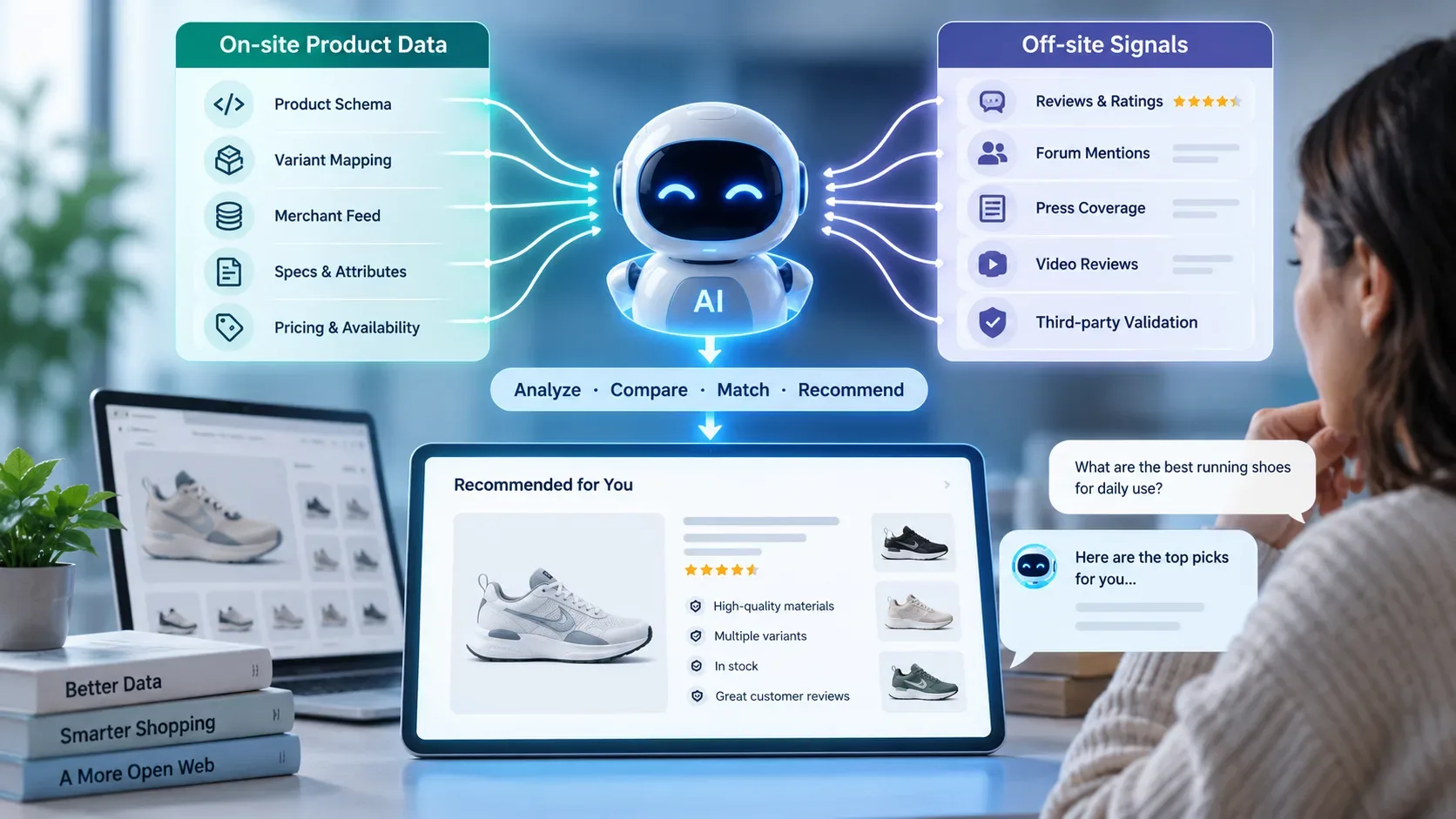
AI shopping tools lean on the same kinds of signals, pulled from two different places.
- On-site: your product schema, variant mapping, merchant feed, pricing, availability, specs.
- Off-site: reviews, forum mentions, press coverage, third-party validation.
Here’s the part that trips people up. Most AI answers are pulled from content that’s already been indexed, not from a live crawl of your site the moment someone asks a question. So if a product page hasn’t been crawled and indexed yet, flawless schema on it doesn’t help. Nobody’s reading it. Crawler access isn’t one item on a checklist. It’s the gate everything else has to get through first.
The off-site half works a bit like a background check. An AI system will cross-reference your brand name and product claims against G2, Trustpilot, Reddit threads, YouTube reviews, or anywhere else independent, to decide how much weight to give what your own site says about itself. Schema with nothing backing it up externally reads very differently than schema plus a trail of outside sources saying the same thing.
Your customers are already asking ChatGPT, Gemini, and Google AI for recommendations. Is your business in those answers?
Run the Free AI Search Readiness Assessment →1. Optimize Product Schema for Shopify AEO
Most default Shopify themes ship with bare-bones schema: title, price, in-stock status, and not much else. That’s not enough for an AI system trying to work out whether your product matches what someone asked for. Add rich JSON-LD through an app like JSON-LD for SEO, or a custom Liquid snippet, covering:
- Product schema (ProductGroup & variant offers): map every size, color, and material variant explicitly, so systems can tell your variants apart.
- GTIN / MPN: the identifiers that let a product be recognized consistently across commerce and search.
- Review markup & AggregateRating: machine-readable star ratings and review counts.
- FAQ schema (FAQPage): structured Q&A on product pages so systems can lift direct answers.
Google’s structured data documentation is worth bookmarking here. It’s the clearest reference for what each property needs and how Google evaluates it.
2. Sync a Clean Merchant Feed for ChatGPT Shopping and Google AI Overviews
Schema handles what’s on the page. It doesn’t handle what’s true right now. Platforms drawing on live inventory, pricing, and availability depend on a merchant feed that’s actually kept in sync. That includes the protocol layers behind them, like OpenAI and Stripe’s Agentic Commerce Protocol and Google and Shopify’s Universal Commerce Protocol.
- Sync with Google Merchant Center & Shopping APIs daily, or via webhook, so pricing and stock never drift between your site and what AI systems show.
- Standardize titles and attributes: “Brand + Product Type + Key Feature + Size/Color” beats a clever internal name every time.
- Use high-resolution, clean image URLs with a transparent or solid background, since these are what render inside shoppable cards.
Google’s product data specification lays out exactly which attributes matter and how they should be formatted, if you want the source rather than a summary of it.
3. Replace Brand Prose with Machine-Parsable Specs
An AI system needs facts to match against a request, not atmosphere. “Step into a cloud of pure bliss with our heavenly handmade boots” tells a language model nothing useful. “Waterproof, insulated to -20°F” tells it everything it needs.
- Use plain HTML spec tables in product descriptions instead of paragraphs.
- Don’t hide specs behind JS tabs. Keep them in the page’s actual content, since a crawler that can’t render the tab can’t see what’s inside it.
4. Make Your Shopify Store Accessible to AI Crawlers
Plenty of stores block the exact crawlers they’re trying to attract, usually by accident. Two places to check:
- robots.txt.liquid: in Shopify Admin, go to Online Store > Themes > Edit Code, find or create robots.txt.liquid, and confirm GPTBot, PerplexityBot, and ClaudeBot aren’t disallowed.
- Your CDN: if you’re running Cloudflare or similar, check its bot-management rules separately. A clean robots.txt doesn’t help if the CDN is rejecting the request before it gets there.
Treat crawler access as part of your broader security and privacy setup, not something to flip on for every bot without thinking about it.
5. Use Review Markup and Natural-Language FAQs
Reviews and FAQs hand an AI system real-world context it can’t get from your own copy.
- Use a review app built for this, like Judge.me, Okendo, or Yotpo, that actually exports AggregateRating and Review schema.
- Ask sharper post-purchase questions. “How did this jacket hold up in cold, windy weather?” gets you something usable. “Did you like it?” doesn’t.
- Add conversational FAQ blocks near the bottom of your best-selling pages: “Will this fit under a 16-inch cabinet?” “Is this warm enough below freezing?”
Common AEO Mistakes That Undo All of This
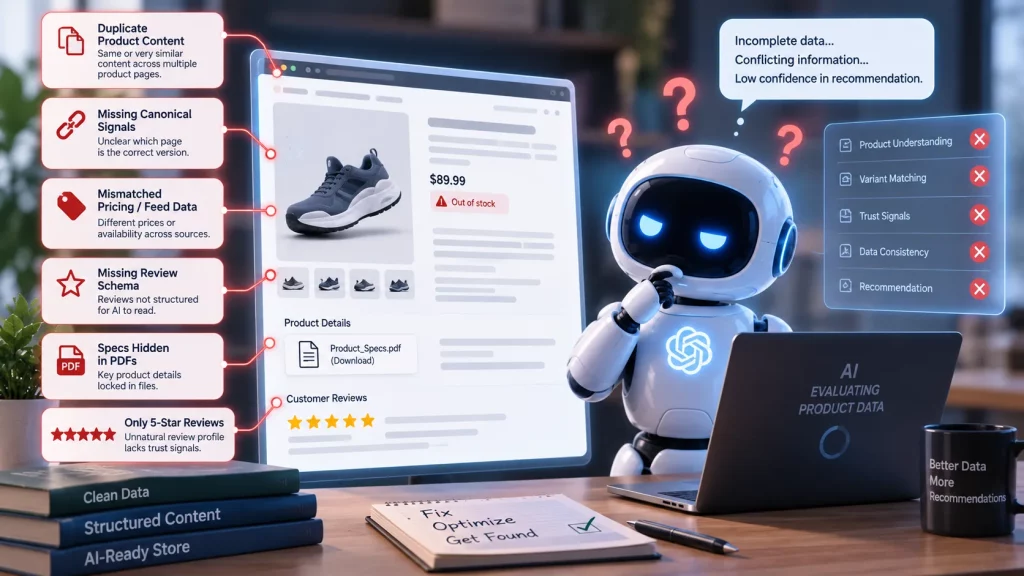
Most of the damage isn’t from skipping AEO. It’s from doing half of it and assuming the rest sorts itself out.
- Duplicate manufacturer descriptions: if the same paragraph every other reseller is running sits untouched on your PDP, an AI system has no reason to treat your page as a distinct source.
- No canonical tags on filtered or paginated URLs: five faceted-nav paths to one product can mean five slightly different schema signals for the same item, instead of one clean one.
- Feed and site drifting apart: a price change that updates on-site but takes a day to hit the feed is exactly the kind of mismatch that erodes trust over time, even when every individual update is correct.
- Review app installed but not actually rendering schema: some only output AggregateRating and Review markup on certain plans, or with a setting switched on. Check the page source. Don’t assume.
- Specs locked in a PDF: if the information a crawler needs is sitting inside a downloadable spec sheet instead of the page’s HTML, it’s invisible to exactly the systems this is all for.
- Nothing but five-star reviews: a page with perfect ratings and zero owner responses to a critical one can look staged rather than real, both to review-literate crawlers and to actual buyers.
Shopify AEO & Agentic Commerce Action Checklist
| Optimization Focus | Technical Requirement |
|---|---|
| Crawlability | GPTBot, PerplexityBot, ClaudeBot allowed in robots.txt.liquid; CDN bot rules checked separately |
| Product Schema | ProductGroup, Offer, identifiers, and variant attributes populated |
| Review Markup | AggregateRating and reviewCount schema where applicable |
| FAQ Schema | Structured Q&A implemented, answering genuine customer questions |
| Merchant Feed Sync | Automated, accurate feed connected to Google Merchant Center and relevant APIs |
| Specification Tables | HTML table elements replacing vague prose on key product pages |
How to Tell If Any of This Is Actually Working
This is the part most guides skip, and it’s the part that tells you whether the rest was worth doing.
- Search Console’s Generative AI performance report: Google added a dedicated report inside the Performance tab in June 2026, showing how often your pages turn up in AI Overviews and AI Mode. Right now it only shows impressions, with no clicks, CTR, or query data yet, and it’s still rolling out beyond an initial group of properties. Don’t assume it’s live on your account yet.
- GA4 referral traffic: watch for visits sourced from chatgpt.com, perplexity.ai, and similar. Treat this as a floor, not a ceiling. A lot of AI-driven research never results in a click at all, so the real number is higher than what you’ll see here.
- Ask the AI yourself: the simplest, most reliable check available right now. Put your buyer’s actual questions into ChatGPT, Perplexity, and Claude, and see what comes back.
- Branded search volume: a steady rise in people searching your brand name directly is often a downstream sign of AI-driven discovery, even when the discovery itself can’t be traced.
How Can Shopify Merchants Get Started With AEO?
Pick your top three revenue-generating products and audit each one the way an AI system would. Can it find the crawler access, the schema, the specs, the feed, and the FAQ it needs to recommend this confidently?
Then sequence the fix instead of tackling everything at once. Crawler access comes first, since nothing downstream matters if AI systems can’t reach the page at all. Schema and feed sync come next, since both are largely one-time technical work rather than ongoing content. Reviews and FAQs are the layer worth revisiting every quarter, as real customer questions pile up.
If you’d rather have someone else run that audit, that’s exactly what EvenDigit’s Shopify SEO services are built for.
FAQs
What is Shopify AEO?
Structuring a store’s product information and supporting signals so AI search and answer engines can understand, evaluate, and potentially recommend its products in response to conversational questions.
How is AEO different from regular Shopify SEO?
SEO ranks pages in search results for keywords. AEO makes your product information, schema, feeds, and content easy for an AI system to interpret and use when it’s generating an answer. The target is a citation, not a click.
How do I optimize a Shopify store for ChatGPT and other AI search tools?
Make your product information accurate and machine-readable: complete schema, documented variants and specs, accurate feeds, open crawler access, and reviews or FAQs built around real customer questions.
Does Product Schema actually help with AI search?
It gives systems structured information, like name, offers, availability, identifiers, and ratings, that’s easier to interpret than prose. It doesn’t guarantee an AI recommendation on its own.
Why do I need a Merchant Feed if I already have Product Schema?
Schema describes one page. A feed provides structured catalog data to commerce and shopping platforms. You need both to keep pricing, availability, and attributes consistent everywhere your products show up.
Will allowing AI bots in robots.txt slow down my site?
No. It permits access to public content, but it doesn’t touch page-load speed for human visitors. Still worth reviewing as part of your broader security setup, and check your CDN separately.
How do reviews help my products show up in AI recommendations?
Detailed reviews describing fit, performance, durability, or a specific use case give an AI system natural-language evidence to match against a shopper’s question.
Can I actually see whether my store is being cited in AI Overviews?
Partially. Search Console’s Generative AI performance report shows impressions for pages appearing in AI Overviews and AI Mode. Click and query-level detail aren’t available yet, and access is still rolling out.
How long does Shopify AEO take to show results?
There’s no established benchmark yet. The underlying AI shopping features are too new, and change too often, for a reliable timeline. Treat it as an ongoing habit, not a campaign with an end date.
Does this replace my existing SEO work?
No. Think of it as a layer added to your existing SEO work, not a substitute for it. Standard SEO still decides whether your pages get crawled and indexed in the first place. AEO decides whether what does get crawled is actually usable once an AI system gets there.