
Social Commerce Strategy: Turn Scrolls Into Sales in 2026

A social commerce strategy turns social media discovery into purchases by connecting content, product discovery, social proof, creators, and checkout. In 2026, that means more than adding product tags to your posts. You need to decide where your customers are most likely to discover your products, how they prefer to evaluate them, where they should complete the purchase, and how you will measure the revenue that social actually generates.
This guide breaks social commerce down into the strategies you can choose from, the platforms that support them, the elements you need to make them work, and the metrics that show whether social is actually driving revenue.
Key takeaways
- Five approaches cover most D2C social commerce strategies: native social commerce, creator-led commerce, shoppable posts that drive website sales, discovery-led commerce, and full-funnel social commerce.
- TikTok Shop is particularly suited to products that demonstrate well and can convert through short-form content, creators, and LIVE shopping.
- Instagram and Facebook remain important for product discovery, creator content, paid social, retargeting, and driving shoppers to ecommerce sites.
- Pinterest and YouTube are especially useful when shoppers need inspiration, education, or comparison before buying.
- A strong social commerce strategy does not stop at the social post. The product page, checkout, tracking, attribution, customer support, and fulfillment experience all affect whether social traffic becomes revenue.
Why does social commerce matter in 2026?
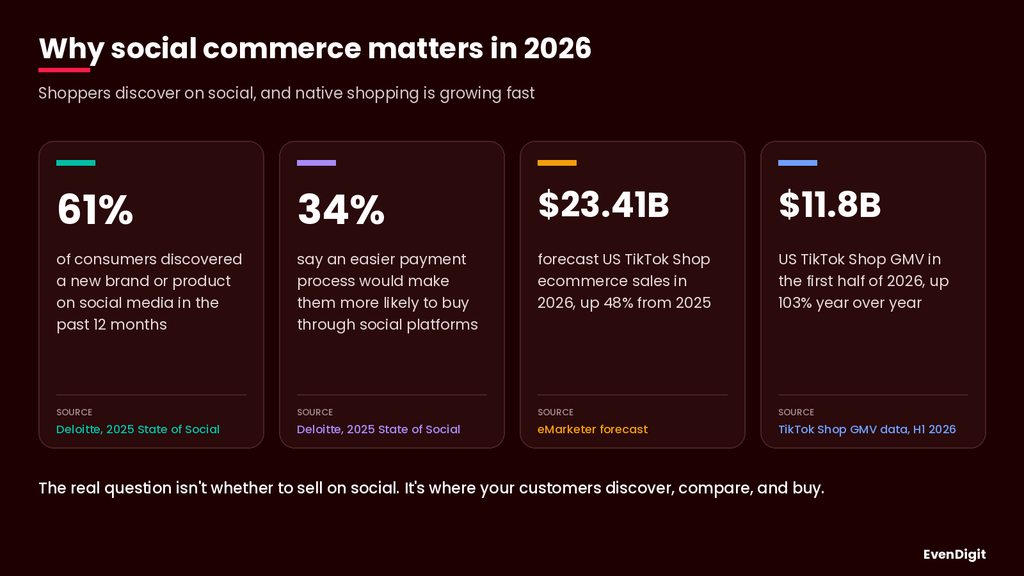
Social commerce matters because social platforms are no longer just places where shoppers discover products. They increasingly influence the entire path from product discovery to evaluation and purchase.
Deloitte’s 2025 State of Social research found that 61% of consumers had discovered a new brand or product on social media in the previous 12 months, while 34% said an easier payment process would make them more likely to purchase through social platforms.
The opportunity is also growing. eMarketer forecasts that TikTok Shop’s US ecommerce sales will reach $23.41 billion in 2026, a 48% increase from 2025. TikTok Shop also generated $11.8 billion in US GMV during the first half of 2026, up 103% year over year, showing how quickly native social commerce is expanding.
But growth alone is not a reason to put your budget on every social platform. The important question is whether a platform matches the way your customers discover, evaluate, and buy your product.
What are the most effective social commerce strategies in 2026?
The most effective social commerce strategy depends on how your product is discovered and how much consideration it needs before purchase. For most D2C brands, five approaches cover the main ways social can turn attention into sales:
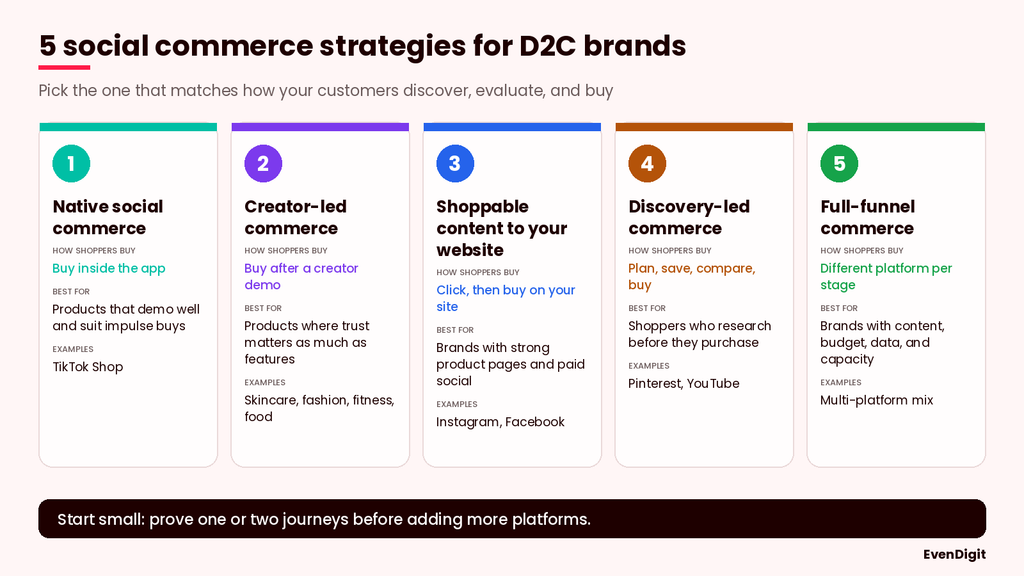
1. Native social commerce
Native social commerce works best when shoppers can understand the product quickly and move from discovery to purchase with little friction. TikTok Shop is the clearest example because shoppers can discover products through videos and LIVE content and purchase through the platform’s shopping experience.
This approach suits products that demonstrate well, have relatively simple purchase decisions, or benefit from impulse buying. Beauty, personal care, fashion accessories, household products, and other visually demonstrable products can fit this model particularly well.
The strategy is to build content around the product, make that content shoppable, use creators or affiliates to expand reach, and then optimize campaigns for purchases rather than engagement.
2. Creator-led commerce
Creator-led commerce works when shoppers need to see a product in a real context or want another person’s experience before deciding to buy. Instead of treating creators only as an awareness channel, the strategy connects their content directly to a measurable purchase journey using reviews and UGC.
A creator can demonstrate the product, answer common objections, show how it fits into everyday use, and direct viewers to a product page or social storefront. Affiliate commissions, trackable links, creator codes, and paid amplification can then connect that content to revenue.
This approach is particularly useful for products where trust matters as much as product features. Skincare, beauty, fashion, fitness, food, lifestyle, and consumer products can all benefit when the creator’s audience closely matches the brand’s buyer.
3. Shoppable content that drives website sales
This social commerce strategy works when social is your strongest discovery channel, but your ecommerce website remains the place where you want shoppers to complete the transaction.
The journey is straightforward: a customer discovers the product through a post, Reel, creator collaboration, or ad, clicks through to the product page, evaluates the offer, and completes checkout on the brand’s site.
This model is particularly relevant for Instagram and Facebook. The key is to treat the social post and product page as one conversion journey rather than two separate marketing activities.
The social content has to create enough interest to earn the click. The product page then has to answer the questions that stop the shopper from buying: price, product benefits, reviews, sizing or specifications, delivery, returns, and payment options.
Because Meta’s commerce model has changed, brands should not build their 2026 strategy around assumptions that Instagram or Facebook will function exactly like TikTok Shop. Website conversion, product feeds, creator content, paid social, retargeting, and reliable measurement are now important parts of the journey.
4. Discovery-led social commerce
Discovery-led social commerce works when shoppers need time to plan, compare, save, or research before purchasing. Instead of trying to force an immediate transaction, the strategy uses social content to enter the customer’s consideration process early and remain useful until they are ready to buy.
Pinterest is particularly suited to this model. Pinterest says it has 640 million monthly active users and that 96% of its top searches are unbranded, which means users are often open to discovering products and brands they did not specifically search for.
YouTube can work in a similar way for products that need explanation, demonstration, comparison, or reviews. Long-form videos, Shorts, creator recommendations, and product tagging can help move shoppers from research toward purchase.
This approach is useful for categories such as home, fashion, beauty, travel-related products, electronics, and other purchases where inspiration or information plays a significant role.
5. Full-funnel social commerce
Full-funnel social commerce works when a brand has enough content, budget, data, and operational capacity to use different platforms for different parts of the buying journey.
For example, a brand might use TikTok for product discovery and creator content, Instagram for creator partnerships and retargeting, YouTube for product education, and its website for checkout. The exact combination should follow customer behavior rather than a fixed platform formula.
This is the most scalable approach, but it is not automatically the best starting point. A smaller brand is usually better off proving one or two strong social commerce journeys before adding more platforms.
Which social commerce platforms should you prioritize first?
You do not need to sell on every social platform to build a successful social commerce strategy. Start with the two platforms where your customers already discover products, your product format works naturally, and you can support the required content and customer interactions consistently.
The right choice between Instagram, YouTube, or TikTok depends on how people buy your product, not simply on where you have the most followers.
Start with these three questions
- Where does your audience already discover products?
- How does your product need to be demonstrated?
- Can you consistently support the platform?
A practical starting point is to choose one primary platform and one supporting platform, rather than spreading your effort across five channels.
| If your priority is… | Consider prioritizing… |
| Fast product discovery and impulse-led purchases | TikTok |
| Visual discovery and brand-led shopping | |
| Retargeting and reaching established audiences | |
| Product research and planned purchases | |
| Education, demonstrations and creator-led recommendations | YouTube |
These are starting points, not fixed rules. Your product category, audience, market, and checkout model should determine the final mix.
Once you choose your platforms, adapt the commerce journey to each one rather than simply cross-posting the same content everywhere.
Social Commerce Strategies for TikTok Shop
TikTok Shop suits impulse buys and products that demo well, because it’s the one major platform here with native in-app checkout. Sellers get four native selling methods: live shopping, shoppable posts and videos, product showcase, and the Shop tab.
Strategy 1: Go live on a regular schedule. LIVE lets you demo a product and answer questions while viewers buy without leaving the app. It brings in shoppers who would otherwise hesitate, because their questions get answered on the spot.
Strategy 2: Plan around platform sales events. Platform-run sales days put your products in front of shoppers who are already in buying mode. The platform often promotes the event as well, which widens your reach.
Strategy 3: Put ad budget behind shoppable video. This is one of the TikTok marketing tactics every e-commerce brand should use. Video shopping ads turn product videos into ads that let people buy straight from TikTok Shop. You pay to reach new shoppers with content that already shows the product working.
Example: Maybelline New York ran Video Shopping Ads for three weeks in Indonesia in April 2022. The campaign reached 2.6 million people, with 3,900+ purchases and 3.8X ROAS, according to TikTok’s case study.
Social Commerce Strategies for Instagram
Instagram now works as a discovery channel that sends shoppers to your website, so build around product tags, a clean catalog, and shopping ads. Meta discontinued Checkout on Facebook and Instagram on September 4, 2025.
Product tags still work in feed posts, Stories, and Reels, and the catalog behind them also powers your ads.
Show Image
Strategy 1: Pair creator content with catalog ads. Creator partnership ads show a creator’s post next to products from your catalog. The creator brings trust, and the catalog brings relevance, so the ad speaks to what each shopper actually wants.
Strategy 2: Let Advantage+ Shopping automation run catalog campaigns. Automated campaigns choose audiences, placements, and products for you. That cuts manual setup and lets spend flow toward what’s converting.
Social Commerce Strategies for Facebook
Facebook works best for broad reach and retargeting, with the sale completing on your website. The same Meta catalog powers your Facebook Shop, Instagram Shopping, and Advantage+ catalog ads, so one clean feed serves both platforms.
Strategy 1: Enrich your catalog ads. Fuller product information makes dynamic Facebook ads more relevant to people who viewed a product but didn’t buy. It brings back warm shoppers with a better reason to return.
Strategy 2: Sell through retail partners with collaborative ads. If retailers stock your products, collaborative ads let you advertise those products using the retailer’s catalog and data. It extends your social reach to sales that close on a partner’s site.
Social Commerce Strategies for Pinterest
Pinterest works best for planning-led categories like home, fashion, and gifts, where shoppers save ideas for weeks before buying. In most cases, Product Pins and shopping ads link to the merchant’s website to complete checkout, and the older Buyable Pins program is no longer supported.
Show Image
Strategy 1: Sync your catalog and run shopping ads. A synced catalog turns products into Product Pins with live price and availability. Shopping ads then promote them to people searching your category, which brings in new buyers at the moment they’re planning.
Example: Etsy ran a six-week Pinterest test with shopping and collection ads and saw a 12x increase in incremental ROAS, or $12.47 in incremental sales for every dollar spent (a 2021 test).
Strategy 2: Test automated campaigns against your current setup. Running Pinterest’s automated campaigns head-to-head with your usual approach shows whether automation pays off before you shift budget.
Strategy 3: Launch new products with automated creative. New products need fast reach. Automated campaigns and creative can scale a launch across markets without rebuilding ads by hand.
What are the most common social commerce mistakes?
A social commerce strategy can lose sales even when the content gets strong reach. Most problems come from choosing the wrong commerce path, making the buying journey harder than it needs to be, or measuring activity instead of revenue.
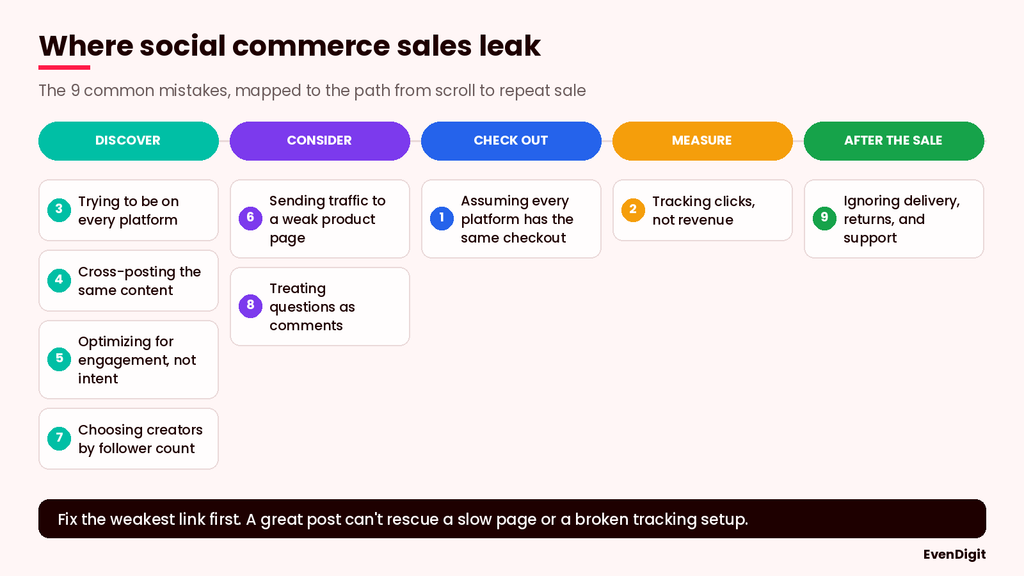
1. Assuming every platform uses the same checkout model
Do not assume that a customer can complete a purchase natively on every social platform. Commerce features, checkout options, and shopping formats differ by platform and market, and they change over time.
Before building a campaign, confirm where the customer will complete the purchase and make that path clear in your content and product experience.
2. Tracking clicks without tracking revenue
Clicks, views, and engagement can show that people are interested, but they do not tell you whether social commerce is generating profitable sales.
Track the complete journey from social discovery to product view, add to cart, and purchase. Where possible, separate direct social sales from website sales influenced by social activity so you can understand the actual contribution of each platform.
3. Trying to be active on every platform
Being present everywhere does not automatically create more sales. Spreading your content and budget across too many platforms can leave you with inconsistent publishing, weak creative, and insufficient data on what actually works.
Start with the platforms that match your audience, product, and buying behavior. Expand only when you have a repeatable process on your primary channels.
4. Cross-posting the same content everywhere
A product video that works on TikTok may not work as an Instagram post, Pinterest asset, or YouTube video.
The product can remain the same, but the content should reflect how people use each platform. Adapt the hook, format, product demonstration, caption, and call to action to the way customers discover and evaluate products there.
5. Optimizing for engagement instead of buying intent
A post can generate thousands of likes and still produce very few sales.
Look beyond engagement and identify which content generates product views, qualified traffic, add-to-carts, purchases, and repeat customers. Engagement is useful when it contributes to the buying journey, but it should not become the final measure of social commerce success.
6. Sending social traffic to a poor product page
Getting a customer from social media to your website is only half the job. If the product page is slow, difficult to navigate, or missing information the customer needs, the sale can still be lost.
Make sure the product page answers the questions raised by your social content. Product images, demonstrations, pricing, reviews, delivery information, returns, and clear purchase options should be easy to find.
7. Choosing creators based only on follower count
A large audience does not guarantee that a creator will generate sales.
Look at audience relevance, engagement quality, content fit, previous brand collaborations, and the creator’s ability to explain or demonstrate your product. A smaller creator with a highly relevant audience can sometimes be more useful for conversion than a much larger account with weak product relevance.
8. Treating customer questions as comments instead of buying signals
Questions about price, sizing, availability, ingredients, delivery, or product differences often indicate purchase intent.
Use comments, direct messages, and social conversations to identify recurring objections. Answer them publicly where appropriate and turn frequently asked questions into future content, product information, or buying guides.
9. Ignoring what happens after the purchase
Social commerce does not end when someone clicks Buy.
Delivery problems, poor product information, or a difficult returns process can affect reviews, repeat purchases, and future social proof. Connect the social commerce experience with fulfillment, customer service, and retention so that the customer journey remains consistent after the sale.
The strongest social commerce strategies treat social platforms as part of the entire buying journey, not simply as another source of traffic.
How can EvenDigit help with social commerce?
We help ecommerce brands build social commerce strategies around the full path to purchase, from audience and platform selection to paid social, creative testing, conversion optimization, and performance tracking.
Through our social media marketing services, we have helped ecommerce brands achieve 4 x ROAS in 6 months, scale to 6.1x ROAS with $11,246 in revenue, and generate 94 purchases at 3.05x ROAS.
So whether you’re getting traffic but not enough purchases, struggling to scale campaigns profitably, or unsure which social channels deserve your budget, we can help you identify what is holding your social commerce funnel back and turn it into a clearer path to revenue. Get in touch with us.
FAQs
Is Instagram Shopping still worth using without in-app checkout?
Yes. Instagram can still drive product discovery and website traffic through product tags, shopping content, and ads. Measure the sales and revenue generated after shoppers reach your website.
Can small brands use social commerce effectively?
Yes. You do not need a large following to get started. Focus on one or two platforms where your audience is active, use relevant creators or product-led content, and measure sales before expanding.
Which social commerce strategy is best for ecommerce?
It depends on how your customers buy. Native commerce works well for products suited to quick purchases, creator-led commerce helps when demonstrations and trust matter, while shoppable posts and discovery-led strategies can work better when customers research before buying