
SEO Framework: The 5 Layers Every Business Owner Should Understand

Short Summary
SEO covers several different activities, and each one addresses a different part of organic search performance. A website can have strong content but poor technical accessibility, or strong rankings but weak conversion performance. A five-layer SEO framework helps business owners understand these differences, identify what is limiting growth, and prioritize SEO work based on business impact.
Key Takeaways
- SEO has five pillars with multiple components, not one, which is the main reason most businesses are confused about SEO.
- Each layer addresses a different SEO problem, which makes a framework necessary to identify and prioritize it.
- An SEO framework is different from a checklist.
- The most important SEO layer for businesses is the Technical layer. If anything is broken here, none of the layers above it will perform well.
A business we worked with once got outranked by a competitor with a fraction of their backlink count, a thinner content library, and a smaller team. The business owner assumed the competitor had “better SEO” in some vague, unspecified way. The real answer was narrower: their own site had pages excluded from Google’s index because of a crawl setting nobody had checked in over a year. No amount of content or link building could have fixed that, because the pages doing the work were never visible to Google in the first place.
That’s the actual problem most business owners run into: not a lack of information about SEO, but a lack of structure for organizing it. You can find a thousand SEO checklists online, and completing every item on one still won’t tell you which task matters this month, or why a competitor with fewer backlinks outranks you anyway.
An SEO framework solves that by grouping SEO work into a few layers, ordered by how they depend on each other. This article walks through the 5 layers of SEO that make up this framework, what each includes, how they connect, and where a business with limited time and budget should actually start.
Why SEO Confusion Happens

SEO isn’t one discipline pretending to be complicated. It’s several distinct disciplines (web development, copywriting, digital PR, data analysis) that all feed into a single outcome, and most explanations of SEO don’t say that out loud.
SEO components overlap. Internal linking can be considered an on-page activity, but it also helps search engines discover pages and understand relationships between topics. Content can target keywords, answer search intent, demonstrate expertise, and create opportunities for internal links. Backlinks can contribute to authority while also bringing referral traffic and brand exposure. Each element fixes different issues and influences different parts of organic search performance.
Not every SEO task carries equal priority. A checklist may include many valid recommendations without saying which issue deserves immediate attention. Without clear priorities, effort spreads thin and the actual problem remains unsolved. A sound SEO strategy should focus on what’s blocking visibility, value, and business impact right now. That’s exactly what an SEO framework defines.
What an SEO Framework Actually Is
An SEO framework is a structured way of organizing SEO activities into a small number of connected categories, ordered by how much one depends on the others, so a business can prioritize decisions instead of working through an undifferentiated list of tasks.
At EvenDigit, the framework covers five pillars:
- A technical foundation to make your business visible to search engines
- On-page relevance to satisfy your audience’s intent
- Content to build topical authority on the subjects that matter to your business
- External trust signals to make you sound trustworthy
- Ongoing measurement to guide your next step
Each layer builds on the one before it, which is why the order matters.
Framework vs. checklist: A framework explains which areas need attention and why; a checklist tracks the individual tasks required to address them. A checklist may include “fix broken sitemap,” “add internal links,” and “improve image alt text.” A framework helps determine which of those issues belong to the more important problem.
| SEO Framework | SEO Checklist |
|---|---|
| Organizes SEO into major layers | Lists individual tasks |
| Explains how activities relate | Tracks task completion |
| Helps identify the underlying problem | Identifies specific actions |
| Supports strategy and decision-making | Supports implementation and maintenance |
The 5 Layers of SEO

Technical SEO, search relevance, content and topical authority, trust, and measurement are the five pillars. They aren’t a linear hierarchy so much as a sequential bottom-up model: each layer depends on the stability of the one below it. If your foundation is broken, layers above it will not perform well.
| Layer | What It Solves |
|---|---|
| 1. Technical SEO Foundation | Makes important pages accessible and indexable |
| 2. Search Relevance & On-Page SEO | Aligns pages with relevant searches |
| 3. Content & Topical Authority | Provides useful and comprehensive information |
| 4. Authority & Trust | Builds external credibility and reputation |
| 5. Measurement & Continuous Improvement | Shows what is working and what needs to change |
Layer 1: Technical SEO Foundation
Technical SEO ensures search engines can discover, crawl, render, index, and understand the pages that matter to your business. This supports visibility in Google Search and AI-powered search experiences.
Key components:
- Crawlability and indexing — if a page can’t be crawled or indexed, it will barely appear in search results
- Site architecture — organizes pages and internal links so search engines can discover content and understand relationships between products, services, categories, and supporting pages
- Rendering and JavaScript — keeps content, links, navigation, and metadata accessible when search engines process pages
- Mobile and performance — Core Web Vitals, loading speed, HTTPS, layout stability
- Structured data — helps search engines interpret products, articles, organizations, local businesses
- AI search accessibility — keeps information crawlable and clearly presented for AI-powered systems
Fix these four blockers first: pages excluded from Google’s index, a broken or missing sitemap, Core Web Vitals failures, a non-mobile-friendly site. If any one check flags a problem, fix it before investing further in content or advertising.
For a deeper walkthrough of what to check and in what order, see Top 10 SEO Audit Elements to Review First.
Not sure where your own site stands on this layer? EvenDigit’s SEO services start with exactly this kind of technical review.
Layer 2: Search Relevance and On-Page SEO
A technically sound site still has to satisfy search intent. This layer establishes relevance between what someone types into a search box and what a given page delivers.
On-page SEO includes keyword targeting, matching search intent, title tags, heading structure, URL formatting, internal links, metadata, and general page structure. All of it answers one question: what is this page about, and who is it for?
Search intent comes first, keywords second. Someone searching “best SEO agencies in India” wants to compare options; someone searching “SEO agency near me” wants a service provider. Before optimizing a page, identify whether the searcher wants to learn something, compare options, find a specific business or product, or take an action.
Prioritize pages close to converting (service pages, high-intent product pages) and pages already getting some visibility but underperforming. Optimize each to target a clear topic, match dominant search intent, use relevant keywords naturally, have a clear title and heading structure, and link to relevant pages across the site.
For a step-by-step on this layer, see How to Master Keyword Research for Effective SEO.
Layer 3: Content and Topical Authority
Content SEO turns search relevance into useful information. Topical authority builds depth around subjects a business wants to be recognized for.
Valuable content matches search intent, is specific enough to solve a problem or support a decision, shows expertise through evidence and experience, and provides the right depth without unnecessary padding. These qualities align with Google’s E-E-A-T framework: experience, expertise, authoritativeness, and trustworthiness.
The same fundamentals matter in AI search. Clear, well-supported content gives AI systems stronger information to reference when answering queries.
Topical authority comes from coverage, not keyword repetition. A practical structure: core topic → supporting topics → relevant internal linking → comprehensive coverage. A business selling accounting software could cover the core subject through content on features, implementation, integrations, comparisons, use cases, and common customer questions.
Quality beats quantity here. A site publishing four posts a month that each fill a specific gap in coverage typically outperforms a site publishing twenty thin posts without a topical plan. More pages means more surface area for search engines to judge, not automatically more relevance.
Content doesn’t fundamentally change for AI search visibility. It has another place to compete. Content needs to make expertise and answers clear enough to be understood and referenced, across both traditional and AI search.
E-E-A-T shows up again and again in how Google evaluates content quality — worth understanding on its own.
Layer 4: Authority and Trust
Even a technically sound, well-written site benefits from external validation: signals from outside your own website showing that credible sources vouch for you.
Off-page components include backlinks, digital PR, mentions and citations, and reviews and reputation. These are strongest when they reflect real expertise or recognition rather than manufactured signals.
Not all backlinks carry equal value. A useful backlink comes from a relevant, credible source and appears naturally in context where it adds value to that source’s audience. Evaluate backlinks on relevance, authority, context, and whether the link was earned naturally.
Authority-building cannot compensate for a broken technical foundation or a page that misses search intent. Earning a great backlink to a page that isn’t indexed wastes that link’s value. Fix the foundation and relevance first.
For a fuller picture of what makes a backlink valuable, see Everything You Should Know About Backlinks.
Layer 5: Measurement and Continuous Improvement
SEO performance should be measured by what organic search contributes to the business, not rankings alone.
| Metric | What It Tells You | What It Doesn’t Tell You |
|---|---|---|
| Impressions | How often pages appeared in search results | Whether anyone found the result relevant |
| Clicks | How many people chose your result | Whether that visit led to any business value |
| CTR | How compelling your title and description are | Whether the page itself is doing its job |
| Rankings | Roughly where a page sits for a given term | Whether ranking well is producing revenue |
| Conversions | Whether a visit resulted in a lead, sale, or action | Which upstream layer deserves the credit |
| Revenue / ROI | Whether SEO is contributing to the bottom line | Short-term fluctuations unrelated to SEO quality |
Tracking AI visibility works best as a complementary layer, not a replacement for traditional rankings and traffic. Google’s Search Console now includes a Generative AI performance report showing impressions from AI Overviews and AI Mode. For visibility across ChatGPT and Perplexity, track brand mentions, citations, and competitor presence over time. These platforms generate different responses and expose different data, so treat these numbers as directional rather than equivalent to keyword rankings.
The cycle: measure, identify, optimize, test, repeat. This keeps SEO responsive to actual performance rather than assumptions.
How the Layers Work Together
Treating these five layers as separate services (someone for technical, someone else for content, a third for links) misses the point. They function as one connected system: Foundation → Relevance → Value → Authority → Measurement.
If search engines can’t crawl or index your pages, nothing else gets a chance to matter. An indexed page still needs to match what people are searching for, or it won’t earn the click. Once a page matches intent, content is what turns it from technically correct into worth reading. Outside sources vouching for content that’s already earned attention reinforce it, they don’t substitute for content that hasn’t. Measurement shows whether the first four layers are working together, or exactly where the chain breaks.
Skip a step, and everything built on top of it works twice as hard for half the result.
What Happens When One Layer Is Weak

A weak layer caps what the others can achieve, even when everything else looks like it’s working:
- Strong content, poor indexing: Genuinely useful pages sit outside Google’s index because of a technical oversight, and none of that content quality ever gets evaluated.
- Good rankings, poor conversion path: A page ranks well and drives traffic, but a confusing layout, missing pricing, or a broken contact form means almost none of that traffic converts.
- Many backlinks, weak relevance: A site accumulates links from unrelated industries or low-quality directories, doing little to build the kind of topical trust that actually influences rankings for core terms.
- Large content library, no strategic focus: A site publishes consistently but without a topical plan, ending up with pages that compete with each other or fail to build coherent authority on any single subject.
Each pattern looks like “we’re doing SEO” from the outside. None of them produce results, because one weak layer is quietly capping what the others can achieve.
Diagnosing which layer needs attention:
| What You’re Seeing | Layer to Check |
|---|---|
| Important pages aren’t appearing in search | Technical SEO |
| Pages appear but attract little relevant traffic | Search Relevance & On-Page SEO |
| Core pages perform, but coverage around key topics is thin | Content & Topical Authority |
| Content is useful, but external recognition is limited | Authority & Trust |
| Rankings or traffic change, but business impact is unclear | Measurement & Improvement |
Use this as a starting point, not a diagnosis. An SEO audit can confirm the underlying issue and show which problems deserve attention first.
Where to Start: A Practical Sequence
- Audit your technical foundation. Make sure search engines can reliably access, crawl, render, and index your important pages before putting effort into new content or link building.
- Identify your highest-value search opportunities. Find searches with a clear connection to your products, services, and business goals — weigh relevance and commercial value alongside volume and competition.
- Optimize existing pages before creating new ones. Improve pages that already have search visibility, authority, or business value. Check intent match, keyword targeting, structure, and internal links.
- Build content around genuine information gaps. Cover the questions, problems, and comparisons your audience cares about, connected through relevant internal links.
- Strengthen authority and trust. Build recognition through relevant industry references, digital PR, reviews, and naturally earned backlinks. Prioritize relevance over volume.
- Measure and find the next opportunity. Track qualified traffic, conversions, leads, and revenue alongside search visibility, and use results to guide the next investment.
Common Misconceptions That Waste Budget
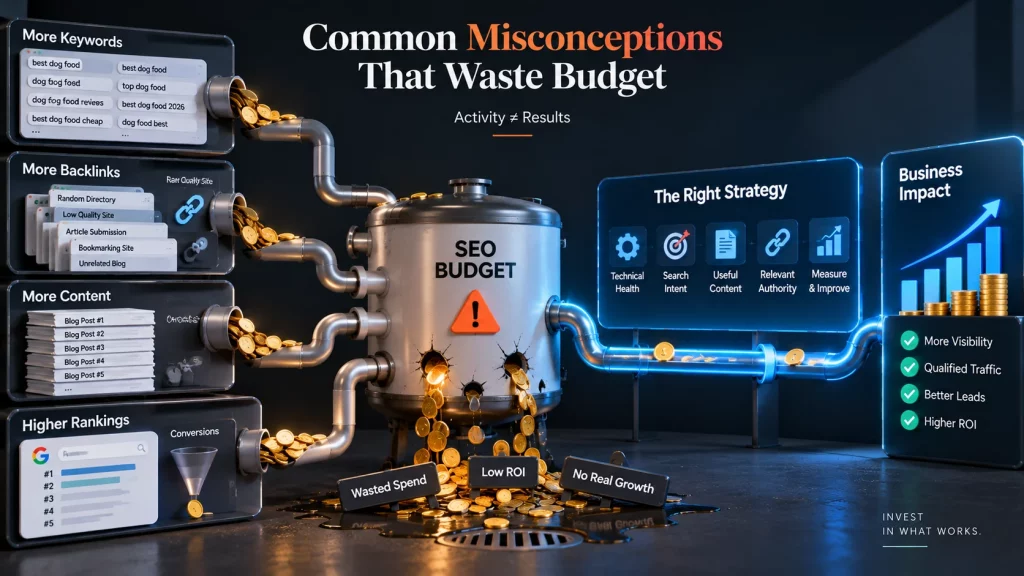
- More tasks doesn’t mean better SEO. Fixing a major indexing problem on an important page is more useful than completing several minor tasks just to check them off a list.
- More keywords doesn’t guarantee visibility. A focused page that clearly answers what people are looking for outperforms a page packed with keyword variations.
- A backlink’s value depends on relevance, credibility, and context — not on volume. Many unrelated or low-quality links do less than one relevant mention on a trusted industry platform.
- Posting more often isn’t the same as more traffic. Content quality, usefulness, and search intent should guide what you publish, not a fixed monthly quota.
- Ranking well isn’t the same as earning revenue. A page can rank for a search that brings visitors unlikely to convert. Track qualified traffic, leads, conversions, and revenue, not position alone.
For businesses with limited time and budget, the same five layers apply, only the order of urgency shifts: fix critical technical issues before expanding, put time into pages closest to revenue before new content, only publish content that answers a real question a real customer is asking, and measure by leads and revenue rather than rankings alone.
Final Takeaway
The five layers only work as a system: Foundation → Relevance → Value → Authority → Measurement. Skipping any layer wastes the effort put into everything that follows.
Guide your next SEO decision with three questions: Where are we (which layer is weakest)? What needs attention (what’s actually blocking that layer)? What should happen next (the smallest action that moves it forward)?
A practical next step for most businesses is a short, honest look at Layer 1 and Layer 2 — technical accessibility and on-page relevance for the handful of pages that matter most to revenue. That single check usually reveals more than another list of generic SEO tasks ever will.
Want a first look at where your own site stands on AI search visibility specifically?
FAQs
What is an SEO framework?
A structured way of organizing SEO work into connected layers, ordered by dependency, so a business can prioritize decisions instead of working through an unranked list of tasks.
How is an SEO framework different from a checklist?
A framework explains which areas need attention and why. A checklist tracks the individual tasks required to address them. A framework helps you find the underlying problem; a checklist helps you execute once you know what it is.
What are the 5 layers of SEO?
Technical SEO Foundation, Search Relevance and On-Page SEO, Content and Topical Authority, Authority and Trust, and Measurement and Continuous Improvement. They function as a connected system, not five separate services.
Should you build backlinks before fixing technical issues?
No. Authority-building can’t compensate for a broken technical foundation or a page that misses search intent. Fix indexing and relevance first, then invest in earning backlinks.
How do you know if your technical SEO foundation is healthy?
Check that your important pages are indexed, Core Web Vitals aren’t flagged as “Poor,” and your sitemap is submitted and error-free. If any one check flags a problem, fix it before investing further.
How is AI search visibility tracked differently from traditional rankings?
Google’s Search Console includes a Generative AI performance report for AI Overviews and AI Mode impressions. For ChatGPT and Perplexity, track brand mentions, citations, and competitor presence. Treat these as a complementary layer, not a replacement for traditional traffic and conversion metrics.