B2B Conversion Rate Optimization: How to Fix Funnel Leaks
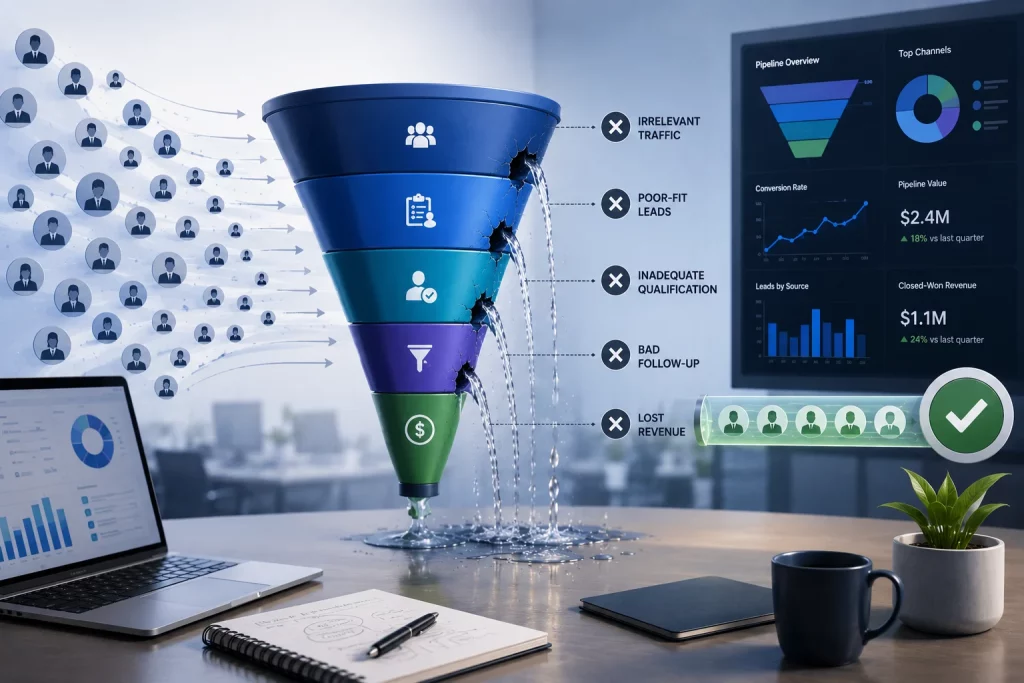
B2B conversion rate optimization means improving not only how many visitors convert, but how many of those conversions turn into revenue. Unlike eCommerce CRO, where a conversion is a sale, B2B CRO has to account for a multi-stage funnel: form fill, MQL, SQL, closed-won.
For a B2B business, a conversion is only the start. A visitor becomes a lead. The lead has to be qualified. Only then does it stand a chance of becoming a real sales opportunity.
Optimize for the first step alone and you can grow lead volume while the pipeline underneath it gets weaker.
Take a hypothetical SaaS company we’ll call Acme. Acme runs 1,000 monthly visitors to a demo-request page, converts 45 into form fills, and Sales works those down to 8 SQLs and 1 closed deal.
Marketing shortens the form and broadens the headline to lift conversions. Form fills jump to 90. But the new fills skew toward smaller companies and non-decision-makers, so SQLs stay flat at 8, or drop. The conversion rate doubled. The pipeline didn’t move.
We’ll return to Acme through this piece to keep each fix concrete. Worth noting upfront: several of these fixes only hold if the team sticks with them under pressure, which is where most B2B CRO efforts actually break down. More on that later.
Key Highlights
- A rising conversion rate can still mean a weakening pipeline if the new leads aren’t qualified.
- Most B2B funnel leaks happen at four points: landing pages, forms, the demo-booking flow, and lead scoring.
- Explicit ICP messaging and intentional form friction filter out poor-fit leads before they reach Sales.
- Lead scoring should weight buying intent (pricing visits, competitor comparisons) over engagement volume (downloads, clicks).
- Track MQL-to-SQL rate, SQL-to-closed-won rate, pipeline value per 100 leads, and cost per SQL, not conversion rate alone.
Why a High B2B Conversion Rate Doesn’t Always Mean a Healthy Sales Funnel
In eCommerce, a conversion is a transaction. A hundred visitors, three purchases, a 3% conversion rate. Push that to five and revenue moves with it.
B2B works differently. A conversion is usually an interaction, a whitepaper download, a webinar signup, a form fill, not a completed sale. The funnel looks like this:
All Site Traffic → Form Submissions (MQLs) → Sales Qualified Leads (SQLs) → Closed-Won Revenue
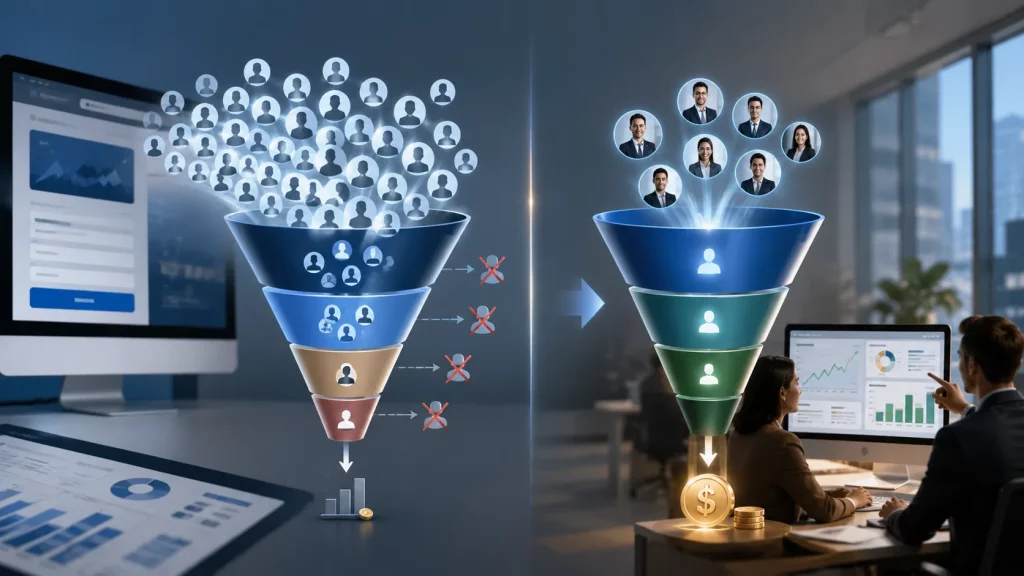
Optimize purely for form-submission rate and unqualified prospects tend to come along for the ride. Broad targeting lets students, job seekers, and people with no purchasing authority convert alongside genuine decision-makers.
Minimal qualification, forms cut down to name and email, strips out the context needed to judge fit. The result is misleading growth: a conversion rate climbing from 2% to 4.5% while most of the new leads lack the budget, authority, or need to ever become customers. Acme’s doubled form-fill rate follows this exact pattern.
The stakes are higher than they were a few years ago. Gartner’s most recent buyer survey found 67% of B2B buyers now prefer a rep-free purchasing experience, up from 61% the year before. Separate Gartner research puts the share of the purchase journey buyers spend meeting with suppliers at around 17%.
Most of the qualification work a sales rep used to do on a call now happens silently on your website, before a buyer ever touches a form. By the time Acme’s rep gets on a call, the buyer has usually already decided whether Acme is a fit, based entirely on what the site showed them. Getting the form wrong costs more than it used to.
Where B2B Sales Funnels Leak Qualified Leads
Landing pages built for everyone qualify no one. If a five-person startup and a 5,000-person enterprise both read Acme’s headline and think it was written for them, Sales inherits the filtering job the page skipped.
In practice, this looks like generic value props, “save time, save money, scale faster,” that could belong to any SaaS category page, paired with a single catch-all CTA regardless of company size or use case.
Shorter forms trade friction for blind spots. Every field cut improves completion rate but removes information. Acme’s jump from 45 to 90 form fills came partly from cutting the “company size” and “current tools” fields, the two data points Sales used to triage quickly. Without them, every lead looks the same until someone manually researches it.
A calendar link is not a qualification step. Sending every visitor straight to a rep’s calendar turns early discovery calls into a screening function Sales shouldn’t have to perform.
Roughly a third of Acme’s demo slots were going to calls that ended in “not a fit, no budget, wrong timing,” time that should never have reached a rep’s calendar.
Most lead-scoring models reward the wrong signal. A prospect who downloads five ebooks can out-score an executive who quietly checks pricing and integrations pages.
Engagement volume isn’t buying intent. Outreach built on volume-based scoring tends to backfire: Gartner found that 73% of B2B buyers avoid suppliers who send them irrelevant outreach.
How to Fix B2B Landing Pages for Better Lead Quality
Segment Landing Pages by Buyer Persona
Instead of one page trying to speak to everyone, Acme runs “Operations Software Built for Mid-Market Logistics Fleets with 200+ Drivers” for its logistics segment, with a separate variant and its own proof points for healthcare.
Use Disqualifying Copy to Filter Out Poor-Fit Leads
Naming who the product is for also names who it isn’t for. “Built for teams managing 200+ drivers” tells a 10-person operation, before they fill out a form, that this isn’t their tool, sparing Sales the rejection later.
A/B Test by SQL Rate, Not Just Conversion Rate
Run the segmented page against the generic one and track SQL rate, not just form-fill rate, as the success metric. A page that converts fewer visitors but produces more SQLs is the win, even when the headline number looks worse.
How to Optimize B2B Lead Forms Without Losing Lead Quality
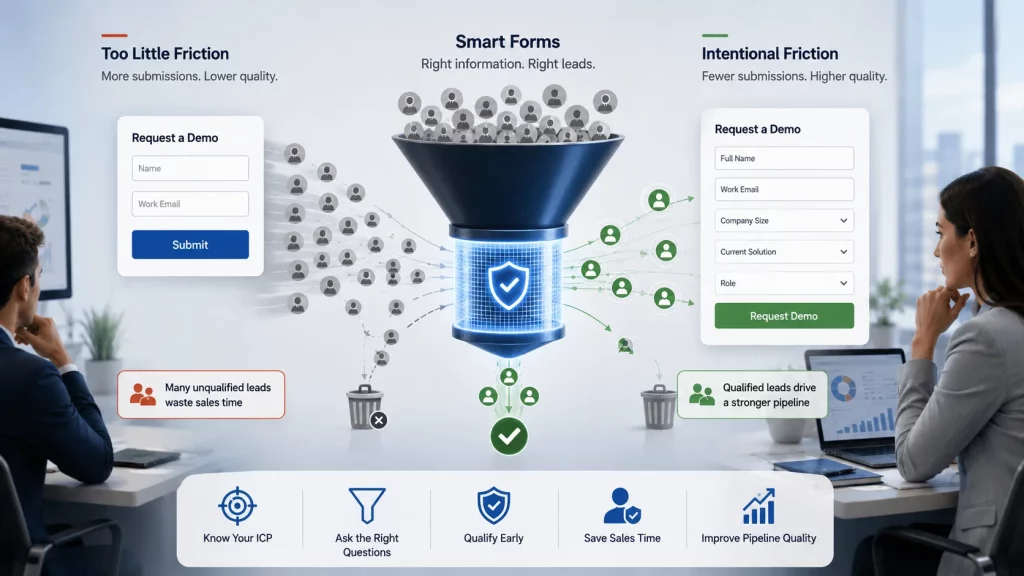
There’s no fixed rule for how many fields is too many, it depends on offer intent. A low-commitment content download can stay short.
A demo request, which signals real buying interest, can support more friction without losing quality volume, because the visitors willing to fill it out are already more qualified.
Progressive profiling helps here. Rather than asking every field on the first form, ask the minimum needed to route the lead, then collect more on the next touch.
When Acme’s prospect downloads a whitepaper, the form stays short. When that same prospect comes back and requests a demo, the form asks for company size and current stack, information Acme didn’t need before but does now.
Enrichment tools each solve a different piece of this:
- HubSpot pulls basic firmographic data automatically once you have an email domain.
- Clearbit goes deeper on company and technographic data for accounts you want to score more precisely.
- ZoomInfo adds contact-level intent signals, useful for catching in-market accounts before they ever fill out a form.
Which one makes sense depends on how much of this data your CRM already gives you versus how much you’re paying to backfill.
How to Qualify Leads Before They Reach Your Sales Calendar
Instead of sending every visitor straight to a sales calendar, insert a short qualification step:
Book Demo → Business Email → Firmographic Enrichment → Screening Question → Qualification → Sales Calendar
One well-placed question, target deployment timeline, for instance, routes qualified prospects straight to Sales. Everyone else doesn’t disappear from the funnel.
They go to a recorded product tour or a lighter nurture track instead. For Acme, the third of demo requests that weren’t sales-ready got redirected to an on-demand walkthrough, keeping them warm instead of burning a rep’s calendar slot and going cold.
How to Build a B2B Lead Scoring Model That Reflects Buying Intent
Score behavior by intent, not volume:
- Low intent (1–5 points): blog reads, social clicks, top-funnel downloads
- Medium intent (10–25 points): webinar attendance, case-study downloads, feature-page visits
- High intent (50+ points): pricing-page visits, competitor comparisons, ROI calculator submissions
Run Acme’s numbers through this model and the picture flips. A prospect who downloaded five ebooks scores 25 points under the old volume-based model but only 5–10 under an intent-weighted one.
An executive who visited pricing once and compared Acme against a competitor scores 50+ under the new model, versus maybe 10 under the old. The model didn’t just change scores. It changed who Sales calls first.
The common failure isn’t building the model. It’s building it once and never touching it again. Buying behavior shifts as your product, market, and competitors change, and a scoring model calibrated a year ago quietly drifts out of alignment with what actually predicts a close.
A scoring model is only as useful as the handoff it feeds into, which is where most of these efforts start to break down.
Why You Need a Marketing–Sales SLA for Lead Handoff
Define what actually counts as an MQL: matches your ICP and shows real intent, not “downloaded a PDF once.” Give Sales full context on how the lead got there, keywords, pages viewed, content consumed.
Close the loop with a rejection taxonomy Sales can select from in seconds, not free text: No Budget, Too Small, Wrong Timing, Not a Decision-Maker, Poor Fit.
Feed those reasons back into targeting, scoring, and landing-page messaging on a set cycle. The data only helps if someone reviews it monthly instead of letting it pile up unread in a CRM field.
Common B2B CRO Mistakes to Avoid
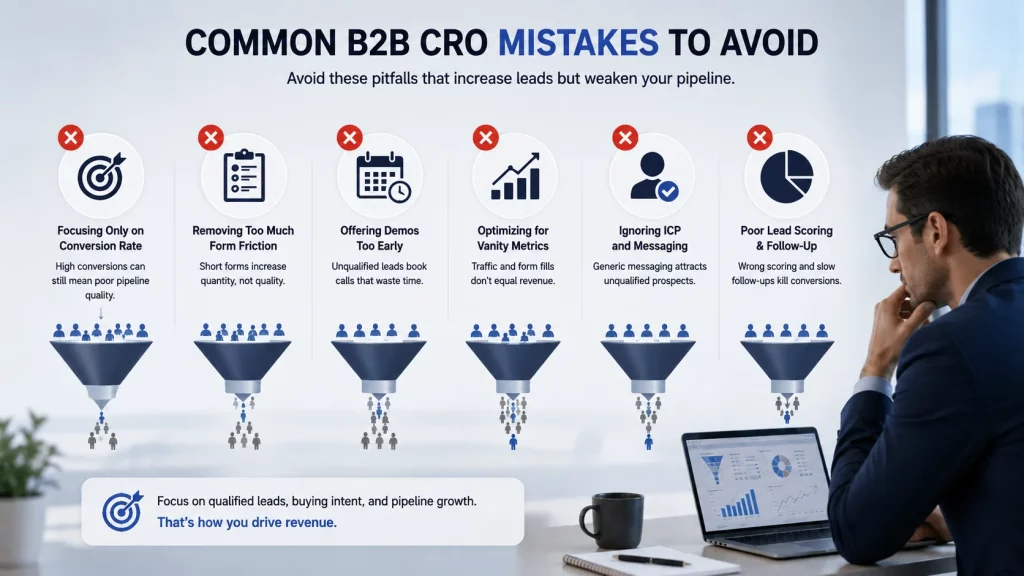
Most of these fixes fail in execution, not in concept.
- Sales bypasses the checkpoint under quota pressure. A qualification step only works if reps and leadership hold the line when pipeline looks thin. The first bad quarter is usually when the checkpoint gets skipped “just this once,” and once is enough to undo the discipline.
- Scoring models get built and abandoned. A model set up during a CRO project and never revisited within six months is already stale. Someone needs explicit ownership of recalibrating it.
- Qualification theater replaces real qualification. A screening question that doesn’t predict anything, asking for job title when job title doesn’t correlate with close rate, for example, adds friction without adding signal.
- Marketing and Sales define “qualified” differently and never reconcile it. Without a shared, written definition, both teams keep scoring their own way, and the handoff stays broken no matter how good the landing page or the form gets.
Key B2B CRO Metrics to Track (Beyond Conversion Rate)
A lower top-of-funnel number is a good outcome if these move up:
| Metric | What It Tells You |
| MQL → SQL rate | Whether the leads you’re generating actually qualify |
| SQL → Closed-Won rate | Whether qualified leads are converting to revenue |
| Pipeline value per 100 leads | Real revenue potential per unit of lead volume |
| Cost per SQL | True acquisition cost, not just cost per lead |
Review these monthly, alongside the rejection-reason breakdown from Sales. A quarterly cadence is usually too slow to catch a scoring model or landing page that’s already drifted off target.
Final Thoughts on B2B Conversion Rate Optimization
If your conversion rate looks healthy but your pipeline doesn’t, the problem usually isn’t how many people are converting. It’s who’s converting, and what happens to them after.
Fix the landing page, the form, the booking flow, and the scoring model together, and the top-line number will stop being the thing you optimize for its own sake.
Frequently Asked Questions
Is a higher conversion rate always better in B2B?
No. A higher rate driven by removing qualifying friction, a shorter form, a broader CTA, usually brings in more unqualified leads along with it. What matters is what happens at the next funnel stage, not the conversion rate on its own.
What is a good B2B conversion rate?
There’s no universal number. It depends on industry, deal size, traffic source, and how tightly your offer matches buyer intent. Your own funnel’s historical performance and qualification rate is the benchmark worth tracking, not an industry average.
What’s the difference between an MQL and an SQL?
An MQL has shown enough fit or engagement to justify continued marketing attention. An SQL has been checked against budget, authority, need, and timeline, and is ready for a sales conversation. Mixing the two up is the most common source of friction between Marketing and Sales teams.
How do you measure B2B CRO success?
Track MQL-to-SQL rate, SQL-to-closed-won rate, pipeline value per 100 leads, and cost per SQL. A CRO effort that improves these while lowering raw conversion volume is working, even if the headline number looks worse.
How long does it take to see results from B2B CRO?
It depends on your sales cycle length, but the order of results is predictable. Form-fill quality shifts first, often within a few weeks of a landing page or form change. MQL-to-SQL rate follows once enough new leads have moved through qualification. Pipeline value and closed-won impact show up last, on the timeline of your existing sales cycle.