How to Choose an AI Visibility Tracking Tool: Key Features and Top Tools Compared
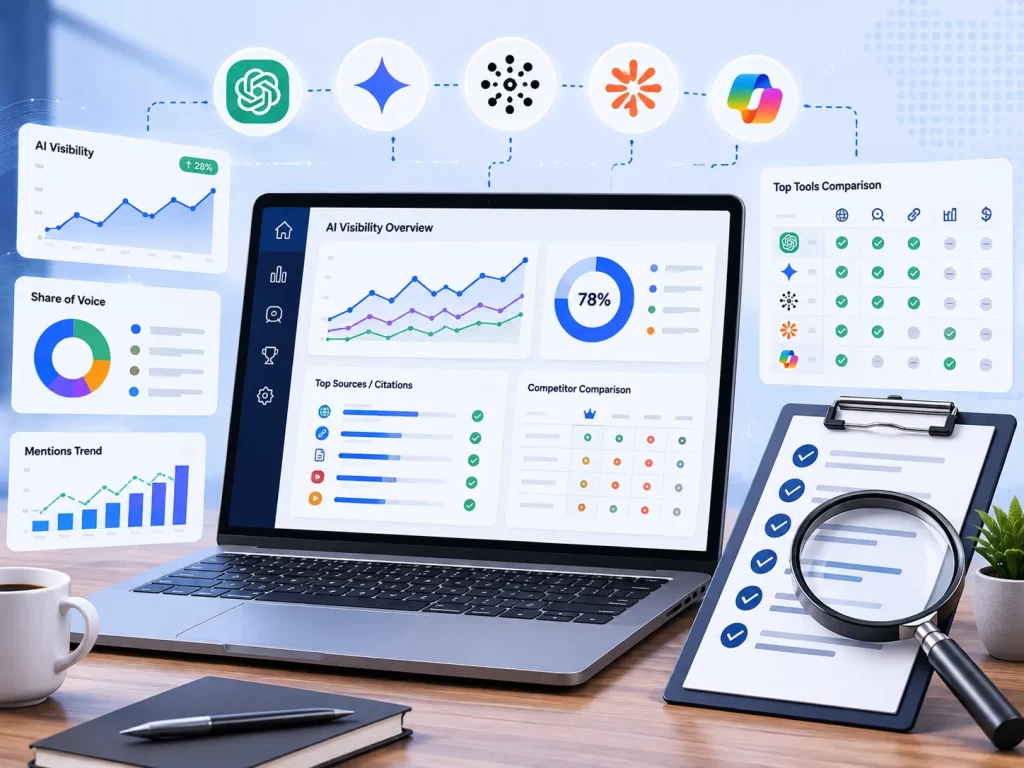
Many established SEO platforms like Semrush now offer AI visibility features as an add-on to their existing SEO capabilities. These can be useful if you want a basic view of how your brand appears in AI-generated results without adding another platform to your stack.
However, AI visibility is not simply another version of traditional search rankings. Tracking AI visibility requires monitoring prompts, generated responses, tracking brand mentions, citations, competitors, and changes across multiple AI engines.
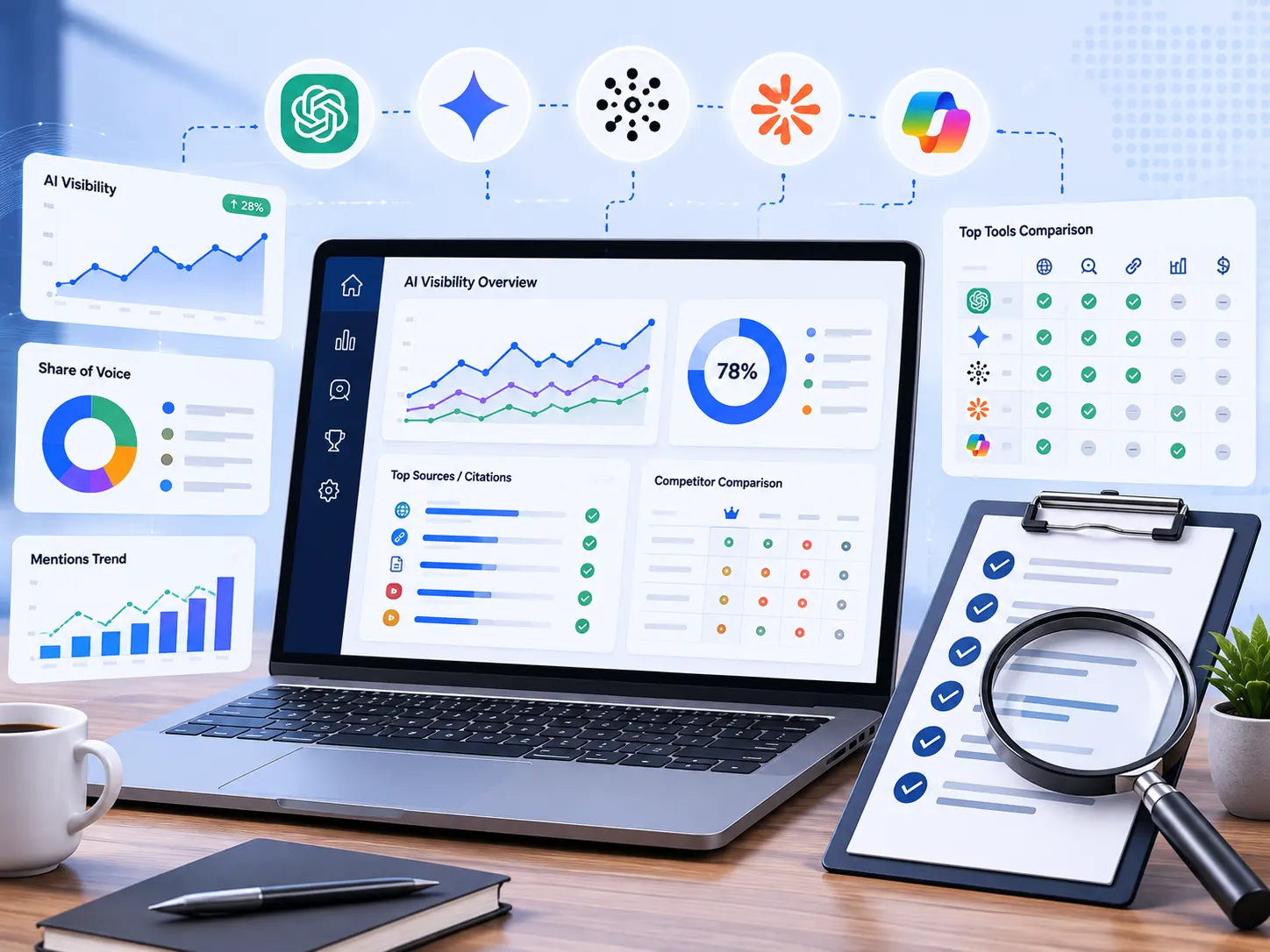
The top answer engine optimization software are built around these, making them worth considering when AI search is becoming a significant part of your acquisition strategy, and you need deeper, ongoing visibility into how AI systems represent your brand.
Key Highlights
- Choose based on your needs. Compare AI visibility tools by LLM coverage, prompt tracking, competitor monitoring, citation tracking, reporting, and pricing.
- Look beyond brand mentions. The most useful tools show where your brand appears, which sources AI cites, and where competitors outperform you.
- Match the tool to your use case. Budget monitoring, detailed citation analysis, enterprise-level coverage, and integrated SEO tracking require different capabilities.
- Validate before committing. Run your own customer-relevant prompts across major AI engines and compare the results with the tool’s reporting before signing up.
- Treat AI visibility as ongoing. AI responses and citation patterns change over time, so choose a tool that supports regular monitoring rather than one-time checks.
How to Choose an AI Visibility Tracking Tool
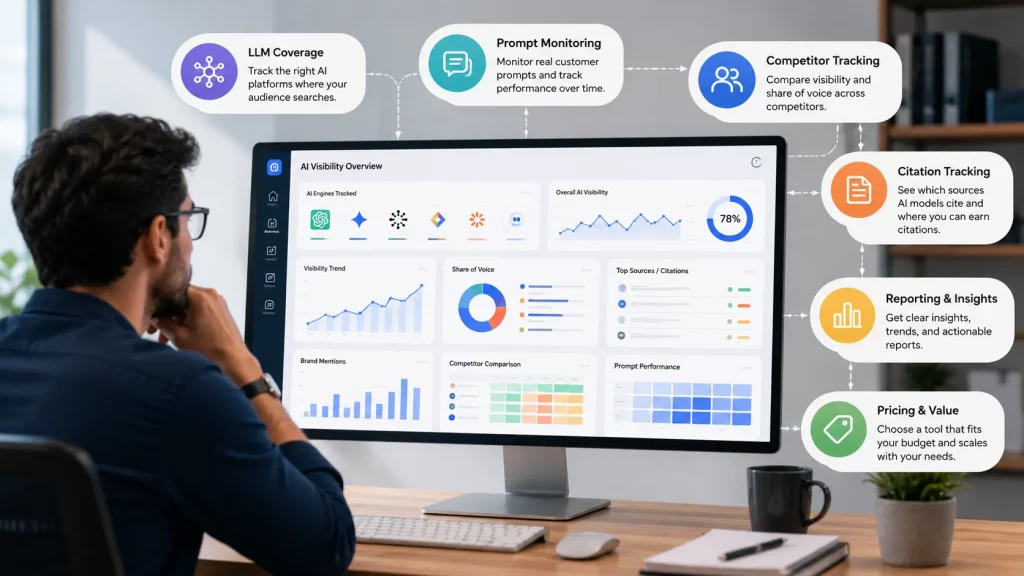
A great starting point for choosing an AEO or AI visibility checker is to evaluate whether it covers these features.
1. LLM Coverage: Check Which Models Are Actually Tracked
Not every tool tracks the same AI platforms, so this is the first thing to check.
Some tools only track ChatGPT. Others cover ChatGPT, Perplexity, Google AI Overviews, Gemini, Claude, and Copilot. A brand can perform well on one AI engine and be almost invisible on another, so narrow coverage gives you a partial and sometimes misleading picture.
Before signing up, ask:
- Which specific AI platforms are included, and does that match where your customers actually search?
- Is coverage the same across all pricing tiers, or does the cheapest plan only include one or two engines?
- Does the tool separate results by platform, or does it blend everything into one average score that hides weak spots?
If your customers are mostly asking ChatGPT, a tool with deep ChatGPT tracking might be enough. If your category spans multiple AI tools, single-engine tracking will leave you guessing about the rest.
2. Prompt Monitoring and Prompt Tracking
The prompts you track decide the quality of everything else in the AI visibility report. Prompt monitoring is the process of running a defined set of real, buyer-relevant questions against AI models on a regular schedule, then recording how your brand shows up each time.
Look for the top answer engine optimization software that lets you:
- Build your own custom prompt list based on how your customers actually phrase questions, not just generic industry terms
- Track prompt performance over time, not just as a one-time snapshot
- Run a large enough set of prompts to get a reliable read, since AI answers can vary from one run to the next even for the same question
A tool that only runs a handful of prompts a month, or reuses generic templates that don’t match your buyers’ language, won’t give you much to act on.
3. Competitor Monitoring and Share of Voice
Knowing your brand’s AI visibility only tells half the story. You also need to see who shows up alongside you, or instead of you, when the same prompts run.
This is where share of voice becomes useful. It measures how often your brand appears compared to named competitors across the same set of prompts, and whether that gap is closing or widening.
When comparing AEO/GEO tools on this feature, check:
- How many competitors you can track at once, and whether that number is capped on lower plans
- Whether the tool shows changes in competitor visibility over time, not just a single comparison
- Whether you can see the exact prompts where a competitor is mentioned and you are not, since that tells you where to focus content efforts
Competitor monitoring without this kind of prompt-level detail tends to raise questions without giving you a way to act on them.
4. LLM Citation Tracking: Where the AI Is Getting Its Information
This is arguably the most useful feature of any AI visibility tool, and the one that separates basic mention trackers from more capable platforms.
LLM citation tracking shows you exactly which web pages, articles, reviews, or third-party sites an AI model pulled from when it built its answer. If a competitor’s blog post or a review site is being cited repeatedly instead of your own page, that’s a specific, fixable gap.
Things to check here:
- Does the tool distinguish between a citation (a linked source) and a mention (your brand name referenced without a link)? These matter differently.
- Can you see citation data at the page level, not just the domain level?
- Does it flag when an outdated or inaccurate page about your brand is being cited, so you can address it?
AEO tool that only tells you “you were mentioned 40 times this month” isn’t nearly as useful as one that tells you which pages are earning those mentions and which pages competitors are winning with.
5. Reporting: Can You Actually Use the Data?
A dashboard full of numbers is only helpful if someone on your team can turn it into a decision. When evaluating reporting features, look past the visuals and ask what the tool actually helps you do next.
Useful reporting typically includes:
- Trend views over weeks and months, not just a single point-in-time score
- Report sharing with stakeholders who don’t log into the platform
- Segmentation by prompt, platform, region, or topic, so you can spot patterns instead of just an overall number
- Some level of recommended next steps, even if basic, rather than raw data with no interpretation
If a tool stops at “here’s your visibility score” without helping you understand why it moved, you’ll end up doing that analysis manually anyway.
What Are The Best Tools For Tracking AI Visibility
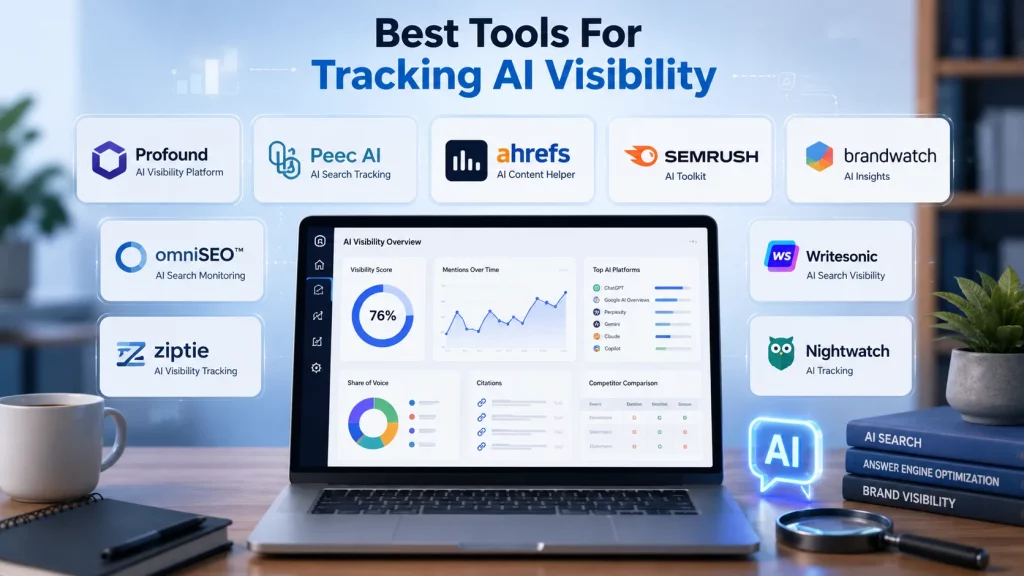
Here are the top five answer engine optimization software options that come with LLM coverage, prompt monitoring, competitor monitoring, and citation tracking.
1. Profound
Profound is an enterprise-focused AI visibility tracker built to monitor brand presence across the widest range of AI engines in the category, from ChatGPT up to nine platforms, including Claude, Gemini, and Grok on its top tier.
Key features:
- Daily prompt tracking across up to 9 AI engines on Enterprise
- Citation and sentiment analysis alongside competitive presence data
- Content generation and optimization agents built into the platform
- SSO and SOC 2 compliance on Enterprise plans
Price: $99/mo (Starter, ChatGPT only), $399/mo (Growth, 3 engines), custom (Enterprise, up to 9 engines)
Best for: Enterprise brands that need the broadest engine coverage and have a content team ready to act on the data.
2. Otterly.AI

Otterly.AI is a budget-friendly AI visibility checker that tracks brand mentions and citations across four core AI engines, with unlimited team seats included even on its cheapest plan.
Key features:
- Daily tracking across ChatGPT, Google AI Overviews, Perplexity, and Microsoft Copilot
- Link citation analysis on every tier
- Unlimited team members on all plans, including the entry tier
- AI keyword research tool included
Price: $29/mo (Lite, 15 prompts), $189/mo (Standard, 100 prompts), $489/mo (Premium, 400 prompts). Gemini and Google AI Mode are paid add-ons.
Best for: Budget-conscious teams and small agencies that want a real tracking tool without a big spend.
If you want quick diagnostics for free, try HubSpot’s AEO Grader. It is a free AI visibility checker that gives you a decent one-time report on brand presence, AI presence quality, share of voice, and market competition.
3. Peec AI
Peec AI is an analytics-first AI visibility tool built around clean prompt-level tracking and detailed citation source data, with reporting designed to plug directly into existing dashboards.
Key features:
- Source-level citation analysis showing exactly which pages and domains get cited
- Looker Studio integration for custom reporting
- Unlimited user seats on every plan
- Competitor benchmarking across selected AI models
Price: $95/mo (Starter, 50 prompts, 3 models), $245/mo (Pro, 150 prompts), $495/mo (Advanced, 350 prompts). Extra AI models cost 35–165/mo each; full coverage including Claude requires Enterprise.
Best for: Teams that want clean analytics and reporting over having every AI engine included by default.
4. Scrunch AI
Scrunch AI positions itself as more than just a brand-mention tracking tool. It pairs AI visibility data with site audits and AI crawler traffic analysis to explain why AI systems cite or skip a brand’s content.
Key features:
- AI crawler and agent traffic analytics tied to Google Analytics
- Site audits that flag content access and quality issues blocking AI citations
- Citation source breakdown by brand, third-party, and competitor domains
- Sentiment analysis and competitor benchmarking
Price: $250/mo (Core, 4 AI models, 125 prompts), $500/mo (Agency Core), custom (Enterprise, up to 9 models including Claude)
Best for: Teams that want to understand why AI skips their content, not just that it does.
5. SE Visible (by SE Ranking)

SE Visible is SE Ranking’s AI visibility layer, built for teams that already run their SEO through SE Ranking and want AI search tracking in the same dashboard rather than a separate AEO tool.
Key features:
- AI visibility tracking bundled with an existing SEO toolkit
- Brand mention tracking and LLM citation tracking across Google AI Overviews, Google AI Mode, ChatGPT, and Perplexity
- Competitor benchmarking and sentiment tracking
- GA4 integration for combined traffic context
Price: ~$89/mo as an add-on to an existing SE Ranking plan, or bundled into SE Ranking’s Agency Pack
Best for: Teams already using SE Ranking for SEO that want AI visibility without adopting a new platform
Comparing Top 5 Answer Optimization Software
| Tool | Starting Price | LLM Coverage | Prompt Tracking | LLM Citation Tracking | Best For |
| Profound | $99/mo → custom | Up to 9 engines (Enterprise) | 50 → custom | Yes, with sentiment | Broadest engine coverage |
| Otterly.AI | $29/mo | 4 engines, add-ons for more | 15–400 | Yes, on every tier | Budget teams, small agencies |
| Peec AI | $95/mo | 3 engines, add-ons for more | 50–350 | Yes, source-level | Clean analytics and reporting |
| Scrunch AI | $250/mo | 4 engines, up to 9 (Enterprise) | 125 (Core) | Yes, plus crawler traffic | Understanding why AI skips you |
| SE Visible | ~$89/mo add-on | 4 engines | Bundled with SE Ranking | Basic | Teams already on SE Ranking |
Which AEO Tool is Best for Your Business
There’s none if you don’t know what exactly you want the tool for. So, decide your goal first.
- You just want to track brand mentions in AI search engines, on a tight budget. Start with Otterly.AI. The $29/mo Lite plan covers four core engines and unlimited seats, which is enough to establish a baseline before spending more.
- You need to defend or grow a Google-first content strategy and don’t want a second dashboard. SE Visible is the lowest-friction option if you already run SE Ranking, since AI visibility sits next to your existing SEO data.
- Citation-level detail and clean reporting matter more than covering every AI engine. Peec AI is built for this. Its source-level citation breakdown and Looker Studio export are stronger than its competitors at a similar price.
- You want to understand why AI skips your content, not just that it does. Scrunch AI’s site audits and AI crawler traffic data go a step further than pure mention tracking, useful if your team can act on technical fixes.
- You’re an enterprise brand with buyers spread across many AI platforms, and budget isn’t the constraint. Profound’s Enterprise tier is the only option here covering up to nine engines, including Claude and Gemini, in one dashboard.
If you’re still between two options after this, the deciding factor is usually your team’s capacity: an AI visibility tool with deep data is only useful if someone can turn it into content or technical changes.
Run a short trial with your own prompts before signing an annual contract, since real output on your own brand tells you more than any comparison table.
Conclusion
AI visibility isn’t a one-time check. Citation patterns shift as AI models update and as more content gets published in your category. Whichever tool you choose from our list of top answer engine optimization software, treat this as an ongoing part of your marketing measurement, not a single audit you run once and forget.
Frequently Asked Questions
Is Google Search Console enough to track AI visibility?
No. GSC’s GenAI performance reports give you brand visibility only on Google’s AI mode, overview, and discover. It doesn’t show what ChatGPT, Perplexity, or other AI search engines say about your brand. Also, mode results are mostly invisible or lumped into generic organic numbers inside GSC. Dedicated answer engine optimization software is the only way to view this data directly.
How many AI engines do I actually need to track?
It depends on where your customers already search. If most of your buyers use ChatGPT, a tool with strong ChatGPT coverage may be enough to start. If your category is more evenly spread across ChatGPT, Perplexity, Gemini, and Google AI Overviews, narrow coverage will give you an incomplete picture. Check your website analytics for AI referral traffic first; that’s usually the fastest way to see which engines matter most for your business.
Can I track AI visibility manually instead of paying for a tool?
Yes, in fact, tracking AI visibility before buying a tool is the best way to know where you stand. And if you already have an SEO tool with a built-in AI visibility checker, manual checks will help you validate the results. Run your 15 to 20 most important prompts manually across ChatGPT, Perplexity, and Google AI Overviews and note what comes up.
How often does AI visibility data actually change?
Citation patterns can shift meaningfully from one month to the next as AI models update and as competitors publish new content. This is why most answer engine optimization software tracks daily or weekly rather than running a one-time scan, and why AI visibility should be treated as ongoing monitoring rather than a single audit.
Should I choose a standalone AI visibility tool or one bundled with my existing SEO software?
If your team already relies on a platform like SE Ranking or Semrush for SEO, a bundled option is cost-effective. A standalone AEO/GEO tool tends to go deeper on LLM citation tracking, prompt-level detail, and competitor benchmarking, which matters more if AI visibility is becoming a primary channel rather than a secondary metric you check occasionally.