How Local Businesses Can Show Up in AI Search With GEO

When someone asks ChatGPT “best dentist near me” or types “affordable plumber in Austin” into Perplexity, they get a direct answer, not ten blue links. If your business isn’t part of that answer, you don’t exist to that customer. This is why Generative Engine Optimization, or GEO, has become just as important as traditional local SEO.

GEO is the practice of structuring your business information and content so AI tools like ChatGPT, Perplexity, Google AI Overviews, and Gemini can find you, understand you, and recommend you. For local businesses, this means showing up when someone asks an AI assistant for a recommendation instead of scrolling through a search results page.
This guide breaks down exactly what businesses need to do to show up in local AI search and the GEO strategies for local businesses.
What Makes AI Search Different From Traditional Local SEO
Traditional local SEO is about helping your business rank in search results. AI search goes a step further. It tries to answer the user’s question directly by recommending businesses it trusts.
In traditional search, someone searching for “best coffee shop near me” sees a list of websites, Google Business Profiles, and map results. The user compares ratings, clicks through websites, and decides where to go.
With local AI search, the experience is different. Someone might ask, “Which coffee shop nearby has good Wi-Fi and is quiet enough to work from?” Instead of showing blue links, the AI provides a short recommendation based on information it has gathered from multiple trusted sources.
Here’s how the two approaches differ:
| Traditional Local SEO | AI Search (GEO) |
| Focuses on ranking web pages and Google Business Profiles | Focuses on being recommended in AI-generated answers |
| Relies heavily on keywords and backlinks | Relies on trust, context, and consistent business information |
| Users compare multiple search results | AI summarizes the best options for users |
| Success depends on ranking position | Success depends on whether AI considers your business a reliable recommendation |
| Optimizes primarily for search engines | Optimizes for both search engines and AI assistants |
Traditional local SEO mainly focuses on ranking in Google’s local pack and Maps results. GEO expands that goal by helping your business appear in AI-generated recommendations, including AI Overview local responses and conversational answers from ChatGPT, Gemini, and Perplexity. Today, businesses need to optimize for both search engines and AI assistants because customers use both to find nearby services.
Why Local Businesses Can’t Ignore GEO Anymore
More people are starting their “near me” searches inside AI tools instead of Google. Someone planning a trip asks ChatGPT for restaurant recommendations. Someone moving to a new city asks Perplexity for a reliable moving company. Someone dealing with a plumbing emergency asks an AI assistant which local plumber has same-day availability.
If your business only exists on your website and a Google Business Profile that hasn’t been touched in two years, AI tools have very little to work with. They will pull recommendations from businesses that gave them more to work with, even if those competitors are smaller or newer.
GEO is not a replacement for local SEO. It works alongside it. But it requires a different kind of attention, one focused on clarity, structure, and verifiable information rather than just keywords and backlinks.
Your customers are already asking ChatGPT, Gemini, and Google AI for recommendations. Is your business in those answers?
Run the Free AI Search Readiness Assessment →How AI Search Finds and Recommends Local Businesses
AI systems don’t crawl the web the way Google’s search engine does. They pull from a mix of sources: your Google Business Profile, reviews on Google and Yelp, your website content, business directories, local news mentions, and structured data embedded in your site.

What matters most is consistency across these sources. If your business name, address, and services are described the same way everywhere, AI systems can confirm you’re a real, established business. If the information is scattered or contradictory, they’re less likely to recommend you, even if you’re a strong local business on the ground.
Core GEO Strategies for Local Businesses
1. Get Your Basic Information Airtight
AI models pull local business details from multiple sources: your website, Google Business Profile, Yelp, industry directories, and news mentions. If your business name, address, phone number, or hours are inconsistent across these platforms, AI tools either skip you or give out wrong information, which is worse than not being mentioned at all.
Here’s what to do:
- Start with an audit.
- Check that NAP consistency (name, address, phone number) is identical everywhere it appears.
- Update your hours, especially seasonal or holiday hours.
- Make sure your website footer and contact page match your Google Business Profile exactly.
This sounds basic, but it is the single most common reason local businesses get left out of AI-generated answers.
2. Write Content That Answers Real Questions
AI search tools are built to answer user queries, not to rank keyword-stuffed pages. Your website content needs to directly answer the questions your customers are actually asking.
Instead of a generic “About Us” page, write content around real, specific questions: “Do you offer same-day appointments?” “What’s included in a standard AC tune-up?” “Do you serve pets in apartment buildings, or only houses?”
Structure each answer so it leads with the direct response, then follows with supporting detail. AI models extract the first sentence or two of a section far more often than they extract a full paragraph buried in fluff. If a customer asks, “Does this business deliver on Sundays?” your content should have a clear yes or no answer within the first line, not three sentences in.
3. Use Schema Markup So AI Tools Can Read Your Site Correctly
Schema markup is code embedded into your website. It helps search engines and AI crawlers understand exactly what your content means.
For local businesses, the LocalBusiness schema, Review schema, and FAQ schema matter the most.
The LocalBusiness schema tells AI tools your business type, location, hours, and contact details in a structured format that they can parse instantly. Review schema highlights your ratings so they can be pulled into AI summaries. FAQ schema turns your question-and-answer content into something AI tools can lift directly into their responses.
You don’t need to write this code from scratch. Most website platforms have plugins or built-in tools for adding schema, and a developer can implement it in an afternoon if you’re on a custom site.
4. Build a Strong, Genuine Review Profile
AI search tools do not want to recommend a bad business; it makes their platform look unreliable. When a user asks an AI engine for a recommendation, the algorithm sifts through your customer reviews to gauge your trustworthiness.
However, AI does not just look at your average star rating anymore. It scans the linguistic context within your reviews
For example:
Old Algorithm: “This business has 4.8 stars and 100 reviews. Rank them.”
AI Search Engine: “Do the text reviews explicitly mention ‘painless root canal’ or ‘fair pricing’? How recently did a customer verify this claim?”
How to get reviews that AI trusts
To build the deep topical authority AI engines crave, you need reviews that contain descriptive, contextual language. When asking your clients for feedback, don’t just say, “Please leave us a review.” Give them specific prompts:
- “Could you mention the specific service we provided for you today?”
- “Let us know which neighborhood technician helped you out!”
Proof of how good reviews can boost AI visibility: Our digital marketing experts helped an Austin-based cleaning company generate over 80 new verified reviews in just 2 months by implementing smart reputation management. This influx of fresh, genuine customer sentiment provided a substantial credibility signal that AI discovery models look for.
5. Get Mentioned on Other Trusted Sites
AI models track multiple sources before recommending a business. If your business is only mentioned on your own website, that’s a weak signal. If you’re mentioned in local news articles, industry directories, community blogs, or “best of” roundup posts, that’s a much stronger one.
Here’s how local businesses can get mentions from trusted sites:
- Reach out to local publications for coverage.
- Get listed in industry-specific directories relevant to your business type.
- Sponsor local events or community initiatives that naturally lead to media mentions.
Every credible third-party mention adds another data point AI tools can use to confirm you’re a real, trustworthy business.
Also Read: How to Track Brand Mentions in AI Search Engines
6. Build Topical Authority With Deeper Content
A single homepage cannot compete with a business that has published dozens of specific, useful pages around its services. If you’re an HVAC company, publish separate pages or posts on furnace maintenance, AC repair signs, and thermostat troubleshooting, not just one page listing all your services.
This depth helps in two ways. It gives AI tools multiple entry points to find and recommend you for very specific questions, and it signals topical authority, meaning you’re seen as a genuine expert in your field rather than a business with a bare-bones website.
7. Optimize Your Google Business Profile Like It’s a Content Asset
Your Google Business Profile is one of the most important data sources for local AI search. AI assistants frequently rely on it to understand your services, business category, operating hours, reviews, photos, and customer questions. A complete and regularly updated profile improves your chances of appearing in Google’s local pack, Maps results, and AI Overview local responses.
How to optimize the Google Business Profile:
- Fill in every field: categories, service areas, hours, attributes, business description.
- Post updates regularly, not just when you have an offer.
- Add photos consistently.
- Answer every question in the Q&A section yourself before a random user answers incorrectly.
This structural optimization yields massive real-world rewards. By executing precision local targeting and profile optimization, we helped our client, a Houston-based plumbing company, achieve a 40% increase in booked jobs within 90 days, illustrating how a highly visible local profile directly moves the revenue needle.
8. Keep Everything Updated
AI models favor recent, current information. A business with content from 2021 that hasn’t been touched since looks stagnant compared to one updating its site, profile, and listings regularly.
Set a quarterly schedule to review your website content, business listings, and FAQ sections. Update pricing if it’s changed, refresh service descriptions, and add new customer questions as they come up in real conversations with your team.
How to Measure If GEO Is Working for Your Local Business
Unlike traditional SEO, GEO doesn’t have a single dashboard showing your ranking. But there are ways to track AI visibility.
Search your business name and services directly in ChatGPT, Perplexity, and Google AI Overviews to see if you appear in the answers. Ask the AI tools questions your customers would realistically ask, like “best [your service] in [your city],” and note whether you show up.
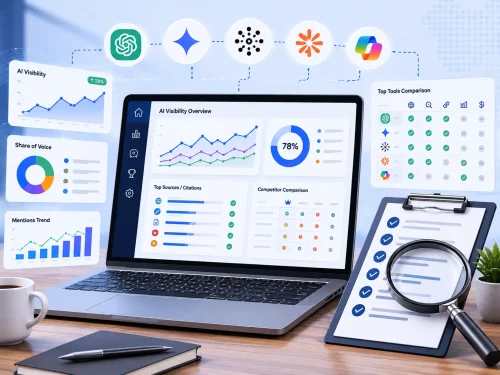
To scale this effectively, professional local campaigns combine human expertise with a dedicated tech stack. Utilizing advanced tools with interactive reporting dashboards allows you to accurately watch for an uptick in customers who found you through modern, automated search pathways.
Common Mistakes Local Businesses Make With GEO
- Many local businesses assume GEO means adding more keywords to their homepage. It doesn’t. AI tools are looking for clarity and verified facts, not keyword density.
- Others focus entirely on their own website and ignore third-party mentions, reviews, and directory listings, which are just as important, if not more so, since AI tools value cross-referenced information.
- A common mistake is inconsistent business information across platforms. If your phone number on your website doesn’t match what’s on your Google Business Profile, that inconsistency can cause AI tools to either drop your listing or provide the wrong information to a potential customer.
How Can EvenDigit Help Your Business Dominate Local AI Search?
We specialize in helping local home service businesses increase their visibility where customers search today. By combining proven local SEO strategies with automation, AI-powered optimization tools, and data-driven insights, we strengthen your online presence across both traditional search engines and emerging AI search platforms.
Here is how we do it:
- Airtight Local Syndication: We handle comprehensive digital audits and listing management to guarantee absolute NAP consistency across Google Maps, Yelp, and industry-specific directories so AI engines trust your data.
- AI-Optimized Content & Schema: EvenDigit’s content teams structure your website copy into conversational Q&A formats that directly answer real-world user questions, pairing it with technical schema markup so AI crawlers can effortlessly parse your site.
- Smart Reputation Management: Our experts deploy automated review generation strategies to rapidly scale your text-rich customer testimonials, providing the exact social proof and semantic validation AI models look for when recommending a service provider.
- Advanced Growth Tech Stack: By combining human expertise with cutting-edge tools for machine-learning-driven campaign optimization, deep call tracking, and live ROI reporting, we give you complete control and visibility over your leads.
Whether you are a plumber looking to rule your ZIP code or a local medical practice wanting to capture high-intent “near me” searches, EvenDigit acts as an extension of your team to ensure your business doesn’t just adapt to the AI era; it leads it.
Final Thoughts
GEO for local business is not a trend to watch from a distance. It’s already shaping which local businesses get discovered by the next wave of customers using AI tools instead of traditional search. The businesses that treat their online information as a clear, consistent, and well-documented asset will be the ones that show up in these AI-generated answers, while those that don’t will quietly become invisible to an entire segment of potential customers.
Start with the basics: clean up your information, answer real customer questions directly, and build a genuine, well-reviewed presence across multiple platforms. GEO rewards businesses that are easy to trust and easy to understand, which, at its core, is just good business practice translated for a new kind of search.
Frequently Asked Questions
Why is NAP consistency important for GEO?
NAP consistency ensures your business name, address, and phone number are identical across every platform. This helps AI verify your business information and improves trust, increasing the likelihood of being recommended.
Do reviews really affect whether AI tools recommend a business?
Yes. AI models treat detailed, recent reviews as a strong trust signal and often reference them directly when generating recommendations.
How do local businesses get cited in ChatGPT and Google AI Overviews?
By having accurate, consistent information across the sources these tools trust: Google Business Profile, reviews, structured data, and content that directly answers common customer questions. There’s no submission form. Citation happens naturally when your information is clear and credible enough for the AI to reference with confidence.
Should local business owners hire GEO experts?
It depends on your time, not just your budget. GEO takes ongoing work across reviews, listings, content, and citations. It’s not a one-time fix. If you have the bandwidth to manage this consistently, you can do it yourself. If not, bringing in help to manage all the moving pieces at once usually moves faster.